CWX2 Shipping Service by TS Lines Boosts Trade Between China and West India

Intra-Asia container carrier TS Lines has expanded its Indian Subcontinent network with the launch of the China-West India Express 2 (CWX2) service. The new weekly shipping route is designed to strengthen trade between China and West India by providing faster, more reliable, and efficient container transportation.
The CWX2 service directly connects major manufacturing hubs in Shanghai, Ningbo, and Shekou with key commercial ports on India’s west coast, helping businesses improve supply chain efficiency while reducing transit time and cargo handling.

Weekly Service Enhances Supply Chain Efficiency

The CWX2 service operates on a 42-day round-trip rotation, covering the following ports:
Shanghai → Ningbo → Shekou → Port Klang (West) → Nhava Sheva → Hazira → Mundra → Port Klang (West) → Shanghai
The direct shipping route is expected to facilitate the movement of:
By reducing transshipment requirements, the service offers greater schedule reliability and lower logistics costs for exporters and importers

Hazira Added to TS Lines' India Network

A major highlight of the CWX2 launch is TS Lines’ first scheduled call at Hazira Port.
With the addition of Hazira, the company now connects India’s three major western container gateways under a single service:
The expanded network improves access to key industrial and manufacturing hubs across Gujarat, Maharashtra, and northern India, enabling smoother cargo movement and stronger regional connectivity.

Supporting China–India Trade Growth

According to TS Lines, the new CWX2 service complements its existing Indian Subcontinent operations by increasing service frequency, improving routing flexibility, and strengthening network resilience.
The enhanced shipping connectivity is expected to support the growing logistics requirements of the China–India trade corridor, while promoting faster bilateral trade and more efficient supply chains.

Indian Electric Vehicle Exports Set to Rise After India-UK Trade Pact

The India-UK Comprehensive Economic and Trade Agreement (CETA) is set to create significant export opportunities for Indian passenger vehicle manufacturers, including Maruti Suzuki, Mahindra & Mahindra, and Tata Motors Passenger Vehicles. Scheduled to come into effect on July 15, the agreement provides a phased roadmap for duty-free exports of electric, hybrid, and hydrogen-powered passenger vehicles to the United Kingdom.
The trade pact is expected to strengthen India’s position as a global manufacturing hub for clean mobility while improving the international competitiveness of Indian-made electric vehicles.

Duty-Free EV Exports to Expand Through Quota System

Under the agreement, tariff concessions for eligible clean mobility vehicles will begin from the sixth year through a quota-based mechanism. The benefits apply to vehicles priced below GBP 80,000 across three price categories.
The annual export quota will start at 17,600 vehicles in the sixth year and gradually increase to 88,000 vehicles by the fifteenth year, providing Indian automakers with greater market access and long-term export growth.

Indian Automakers Eye UK EV Market

Indian manufacturers are expected to leverage the agreement to expand their presence in the UK’s rapidly growing electric vehicle market.
Maruti Suzuki is well positioned after successfully exporting its eVITARA to Europe, including the UK. Meanwhile, Mahindra & Mahindra and Tata Motors Passenger Vehicles are also evaluating opportunities to increase exports of affordable right-hand-drive electric vehicles.
The phased implementation gives manufacturers sufficient time to scale production, strengthen supply chains, and expand dealership and distribution networks in the UK.

Trade Pact Supports India's EV Manufacturing Ambitions

The United Kingdom remains one of Europe’s largest right-hand-drive automobile markets, making it an ideal export destination for Indian-made vehicles. The agreement is expected to boost India’s ambitions of becoming a global hub for electric vehicle manufacturing and exports.
In addition to the automotive sector, the India-UK trade pact aims to deepen bilateral economic cooperation, with both countries targeting US$100 billion in bilateral trade by 2030. Clean mobility, advanced manufacturing, and technology are expected to be major drivers of this growth.

Key Highlights:

Renault India Commences Duster Exports from Chennai, Targets Global Markets

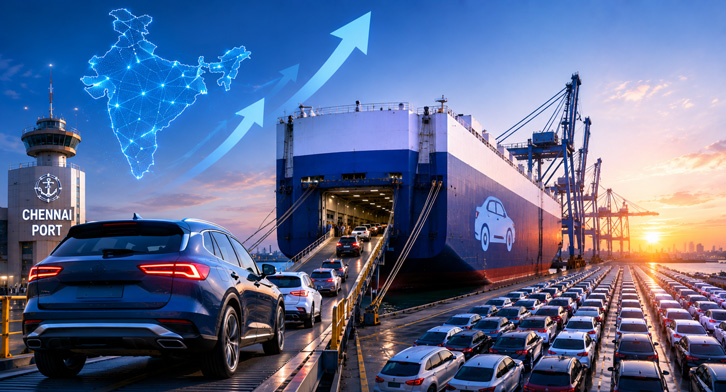
Renault India has commenced exports of the all-new Duster, marking a major milestone in its global manufacturing and export strategy. The first shipment of 750 vehicles departed from Kamarajar Port in Chennai for South Africa, with additional international markets expected to be added in the coming months.
The export programme reinforces India’s growing importance within Renault’s global production network. According to Renault, the Chennai manufacturing facility has demonstrated world-class quality, competitiveness, and production capabilities, making India a strategic base for the company’s international operations.
Renault aims to achieve €2 billion in annual exports from India by 2030, reflecting the country’s expanding role in the automaker’s long-term global growth plans. India continues to offer a strong manufacturing ecosystem supported by skilled engineering talent, modern infrastructure, large-scale production capacity, and an efficient logistics network.
The all-new Duster is the first Renault model in India to be built on the Renault Group Modular Platform, which supports multiple powertrain technologies. The SUV has also received a 5-star Bharat NCAP safety rating across all variants, enhancing its competitiveness in both domestic and international markets.
The latest export initiative further strengthens Chennai’s position as one of India’s leading automotive export hubs while highlighting the country’s emergence as a preferred global manufacturing destination for automobile companies.

Key Highlights:

India Advances Emerging Technologies with AI, 5G, Semiconductors and Digital Infrastructure

India Strengthens Its Position as a Global Technology Leader

India is rapidly emerging as a global technology powerhouse through sustained investments in digital infrastructure, artificial intelligence (AI), semiconductors, quantum computing, cloud computing, blockchain, cybersecurity, and supercomputing. These strategic initiatives are strengthening the country’s innovation ecosystem and supporting the Government’s long-term vision of Viksit Bharat 2047.
With mission-driven technology programmes and robust policy support, India is transforming from a technology consumer into a technology creator while enhancing its global competitiveness.

Digital India Programme Accelerates Digital Transformation

The Digital India Programme has become the foundation of India’s digital transformation by significantly expanding connectivity across the country.
Optical fibre coverage increased from 19.35 lakh route kilometres in 2019 to 42.36 lakh route kilometres in 2025, while internet connections surged from 25.15 crore in 2014 to 102.86 crore in 2026. These developments have improved digital access for businesses, government services, education, healthcare, and financial inclusion.

India Achieves One of the World's Fastest 5G Rollouts

India has successfully completed one of the fastest 5G deployments globally, with services now reaching 99.9% of districts.
The nationwide rollout is enabling faster digital connectivity, supporting Industry 4.0, smart cities, digital businesses, IoT applications, and advanced communication technologies.

India Climbs the Global Innovation Rankings

India’s sustained investment in technology, research, digital governance, and innovation has significantly enhanced its international standing.
The country improved from 81st place in 2015 to 38th in the Global Innovation Index 2025, reflecting stronger research capabilities, digital public infrastructure, startup growth, and technology-driven economic development.

Viksit Bharat 2047: Building a Technology-Driven Future

According to the Government, India’s trusted digital governance systems, expanding research ecosystem, international technology partnerships, and investments in skill development are helping the nation transition into a global technology creator.
Continued investments in AI, semiconductors, quantum technologies, cybersecurity, cloud computing, and digital infrastructure are expected to accelerate innovation-led economic growth, strengthen self-reliance in critical technologies, and position India as a key player in shaping the future global technology landscape.

Key Highlights:

Double-Stack Container Trains Commence at JNPA, Strengthening India’s Freight Network

In a major boost to India’s rail-based logistics network, the Container Corporation of India (CONCOR) has successfully commenced double-stack container train operations on the Western Dedicated Freight Corridor (DFC) from Jawaharlal Nehru Port Authority (JNPA).
The new service connects JNPA with CONCOR Multi-Modal Logistics Parks (MMLPs) at Dadri (Delhi-NCR), Khatuwas (Rajasthan), and Varnama (Gujarat), enabling faster, more efficient, and cost-effective movement of import and export containers across key industrial and consumption centres.

Enhanced Rail Connectivity Across Major Logistics Hubs

The double-stack container train service is now operational in both directions between JNPA and the three MMLPs. It also provides extended connectivity to important inland cargo destinations, including:
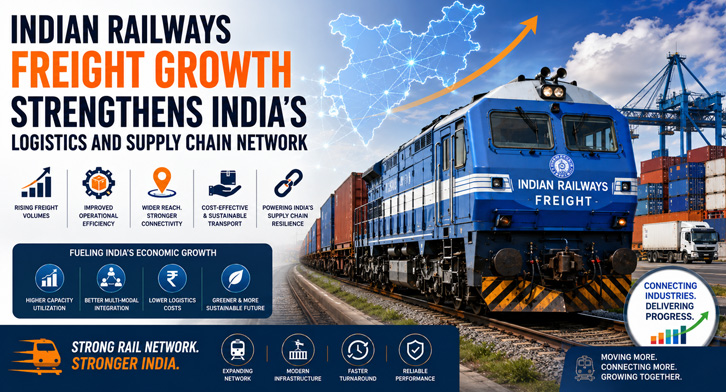
The expanded network improves multimodal logistics by offering seamless rail connectivity between ports and inland freight hubs.

Faster Cargo Movement and Lower Logistics Costs

The introduction of double-stack container trains is expected to significantly improve supply chain efficiency by:
The initiative strengthens India’s freight infrastructure while supporting faster evacuation of import and export cargo through the Western DFC.

Strengthening India's Freight and Logistics Ecosystem

The launch of double-stack operations marks another milestone in India’s efforts to modernize its logistics sector through dedicated freight corridors and multimodal transport solutions.
By improving operational efficiency and reducing logistics costs, the service supports India’s ambition to build a faster, more sustainable, and globally competitive freight transportation network.

Key Highlights:

Emirates Shipping Lines Launches ECSX Service at Deendayal Port’s Kandla Container Terminal

Deendayal Port Authority (DPA) has welcomed the maiden call of MV ESL Shekou under Emirates Shipping Lines’ ECSX Service at the Kandla International Container Terminal (KICT) on June 18, 2026.
The inaugural vessel call marks an important milestone in enhancing container shipping connectivity and strengthening trade links between India and global markets. It also reflects the growing confidence of international shipping lines in Kandla Port as a key maritime gateway.

Strengthening Global Maritime Connectivity

The MV ESL Shekou, with a Gross Registered Tonnage (GRT) of 66,280 MT and a Length Overall (LOA) of 276 metres, is among the larger container vessels calling at Kandla.

Supporting India's Maritime Growth

The maiden ECSX service aligns with Deendayal Port Authority’s vision of “Connecting Global Trade and Driving Maritime Growth.” The new shipping service is expected to improve port competitiveness, attract additional international shipping services, and support India’s expanding maritime and logistics ecosystem.

Key Highlights:

Great Nicobar Island Deep Water Transshipment Port to Revamp Indo-Pacific Freight Logistics

The ambitious Great Nicobar Island development project is poised to become a transformative force in India’s maritime sector, positioning the Andaman and Nicobar Islands as a major logistics and transshipment hub in the Indo-Pacific region. The project is entering its implementation phase, with the International Container Transshipment Terminal (ICTT) emerging as its flagship component. The first phase of the terminal is targeted for completion within three years and is expected to handle around 6 million TEUs at an estimated investment of Rs. 20,000 crore. Located strategically near the Malacca Strait, one of the world’s busiest shipping corridors, Great Nicobar will reduce dependence on foreign ports for container transshipment.
Building the ICTT to an ultimate capacity of 21 million TEUs will fundamentally reshape trade patterns in the Indo-Pacific. Currently, a large share of India’s transshipment cargo is routed through international hubs like Colombo, Singapore, or Port Klang, adding extra time and costs for local exporters. By offering a world-class deep-water alternative right on the edge of the Malacca Strait, Great Nicobar allows mainline mega-vessels to drop cargo directly within Indian territory, speeding up transit times and significantly strengthening the country’s maritime security.
To support this massive container hub, the project includes a comprehensive multi-modal infrastructure grid. Plans feature a modern greenfield international airport alongside an extended runway at INS Baaz, allowing the island to handle large cargo aircraft and support integrated sea-air logistics. Additionally, partnering with Cochin Shipyard Ltd. to build advanced ship repair facilities ensures that international vessels can undergo full maintenance and refueling right at the terminal, creating a complete, self-sustaining maritime services ecosystem in the middle of major global trade lanes.

Key Highlights:

India’s Steel Capacity Utilization Reaches 90% Milestone on Heavy Infrastructure Demand

India’s steel sector continues to demonstrate powerful momentum, with domestic steel demand rising 9% year-on-year in May 2026 and 8.7% in FY26-to-date. According to a report by Kotak Institutional Equities, the industry’s capacity utilization is expected to remain above 90% in the medium term, supported by robust demand growth that is projected to outpace capacity additions. Steel exports also increased by 30% year-on-year to 0.5 million tonnes in May 2026. India’s expanding infrastructure pipeline, manufacturing growth, and urbanization are expected to continue driving high steel consumption over the coming years.
The sustained capacity utilization above 90% signals an unprecedented structural shift in India’s industrial architecture. Historically, heavy metallurgical sectors have suffered from cyclical overcapacity, leaving production lines underutilized. However, the current momentum is tightly linked to capital expenditure programs funded by the Union Budget, which have funneled massive capital directly into national highway networks, high-speed rail corridors, and urban mass transit systems.
This localized consumption boom is structurally altering corporate balance sheets across the domestic steel sector. With steel plants operating at near-maximum performance, companies are generating substantial free cash flows, enabling them to de-lever their debt and invest in next-generation green steel technologies. Furthermore, the 30% surge in outbound steel trade highlights that Indian steel mills are maintaining cost-competitiveness in global shipping lanes, successfully penetrating alternative markets across Europe, Southeast Asia, and the Middle East despite intense international trade competition.

Key Highlights:

Dhamra Port Deploys Next-Gen ZPMC Ship Loader to Accelerate Berth Productivity

Dhamra Port has strengthened its bulk cargo handling infrastructure with the arrival of a new ship loader supplied by Shanghai Zhenhua Heavy Industries Company (ZPMC). Operated by Adani Ports and Special Economic Zone, Dhamra Port has emerged as a key maritime gateway on India’s eastern coast, handling a diverse range of bulk, breakbulk, and containerized cargo. The newly delivered ship loader is expected to significantly enhance vessel loading operations by enabling faster and more efficient transfer of bulk commodities, helping to reduce turnaround times, optimize berth productivity, and support higher cargo throughput.
Adding the high-capacity ZPMC ship loader to Dhamra Port’s terminal marks a major boost for its bulk logistics infrastructure. In heavy commodity trade, vessel turnaround time is a key factor in overall efficiency; any loading delays can quickly lead to costly demurrage fees for shippers. This advanced machinery allows the port to transfer bulk materials onto vessels at a much faster rate, maximizing berth utilization and ensuring that large bulk carriers can be loaded, cleared, and sent on their routes on schedule.
This infrastructure upgrade provides immediate support to heavy industries throughout Eastern India, including mining, steel manufacturing, and power generation. By streamlining the handling of vital raw materials, the port enables these core industrial sectors to manage more efficient supply chains. The shift toward higher automation also ensures that the port can easily scale up to handle larger vessels and growing commodity volumes, reinforcing Dhamra’s position as a premier, high-speed maritime gateway on the east coast.

Key Highlights:

CONCOR Activates 2,400-km Inter-State Logistics Corridor to Boost Industrial Freight Mobility

The Container Corporation of India (CONCOR) has launched a new 2,400-kilometer logistics corridor for the transportation of pig iron, creating a direct freight link between Andhra Pradesh and key industrial markets in North India. The initiative is aimed at improving supply chain efficiency, reducing transit times, and supporting the growing demand for bulk raw materials across the country’s manufacturing sector. By leveraging rail-based logistics, the service is expected to provide a more cost-effective and environmentally sustainable alternative to long-distance road transportation, ensuring reliable transportation of large cargo volumes.
Furthermore, shifting bulk industrial freight from road to rail delivers a major environmental advantage. Rail transport consumes significantly less fuel per ton-mile than long-haul diesel trucks, allowing industrial conglomerates to drastically cut their supply chain carbon emissions and meet national sustainability goals. By building an efficient, low-emission link between southern production centers and northern industrial hubs, this corridor helps create a cleaner, more integrated national supply chain.

Key Highlights:

cargonet-logo-icon
Cargonet Cargo Software Logo

Feedback & Reward program

Submit the Feedback and avail the Rewards.

1. Your satisfaction & reliability on CargoNet ?

2. Your Rating on Support & co-ordination team?

3. Satisfaction on the look and feel of CargoNet ?

4. Please specify any 2 best features that you feel more helpful in CargoNet?

5. Please specify any 2 best reports that you are taking on regular basis?

6. Are you using Copy Job option in CargoNet Software?

7. Are you using Automatic DSR (Daily Status Report) Option? It automatically sends reports to customer about the shipment status

8. Are you using Automatic Outstanding Reports option? Period Auto outstanding reminders to customer

9. Any other thoughts to improve in CargoNet? Please share.

* Join our Reward Program by recommending CargoNet (Cash Rewards Awaiting)

“Thanks for your feedback. Our goal is to create the best possible product, support & service, and your thoughts, ideas & suggestions play a major role in helping us identify opportunities to improve.”

Cut AI cost ,
not performance

discover how top Freight Forwarding companies  reduce AI-related expense and speed up operation with CargoNet AI, we will show it how
Share your information for instant access :

Get a Demo Now