
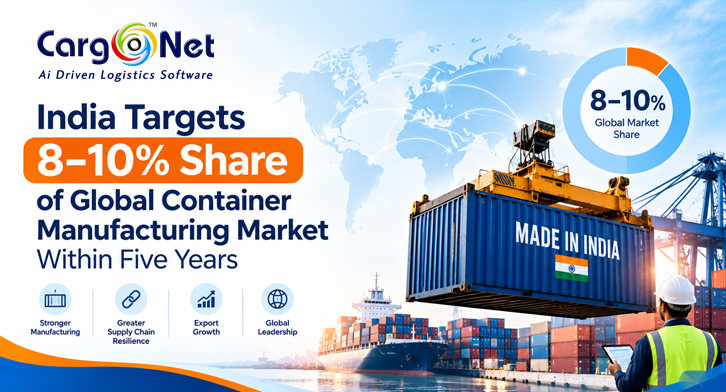
India is positioning itself to become a major global hub for shipping container manufacturing, with the potential to capture 8–10% of the global container production market within the next five years. A joint report by the Federation of Indian Chambers of Commerce and Industry (FICCI) and CRISIL highlights India’s opportunity to reduce dependence on imported containers, strengthen domestic manufacturing and build a more resilient supply chain.
The opportunity comes at a crucial time as India looks to expand its manufacturing capabilities and strengthen its position in international trade. The proposed ₹10,000-crore Container Manufacturing Promotion Scheme (CMPS) is expected to play an important role in accelerating domestic production, attracting investments and developing a competitive container manufacturing ecosystem.
If the proposed expansion targets are achieved, India could produce approximately 4.8 lakh to 6 lakh TEUs annually, creating new opportunities for steel producers, engineering companies, port operators, logistics businesses and shipping stakeholders.
Key Highlights
- Global market opportunity: India could capture 8–10% of global container manufacturing capacity within five years.
- Annual production potential: Estimated at 4.8 lakh–6 lakh TEUs.
- Government support: ₹10,000 crore allocated under the proposed Container Manufacturing Promotion Scheme.
- Domestic capacity target: Expansion from approximately 70,000 TEUs to 7.5 lakh TEUs.
- China’s dominance: China currently accounts for more than 95% of global container production.
- Cost challenge: Indian container manufacturers face an estimated 650–800 per TEU cost disadvantage.
How the ₹10,000-Crore Container Manufacturing Scheme Will Support India
The Union Cabinet approved the Container Manufacturing Promotion Scheme on October 28, 2026, with a total outlay of ₹10,000 crore extending up to FY 2039–40. The programme is designed to address the cost and infrastructure challenges faced by Indian manufacturers while encouraging new investments.
According to the Ministry of Ports, Shipping and Waterways announcement, the scheme has three major financial components:
Scheme component
Financial allocation
Purpose
Interest Subvention Assistance
₹859 crore
3% annual interest support on eligible term loans
Operational Expenditure Assistance
₹8,891 crore
Reduce the production cost gap
Testing and Certification Assistance
₹150 crore
Develop common testing and certification facilities
Total
₹10,000 crore
Build a competitive domestic industry
The largest allocation, ₹8,891 crore, is dedicated to operational expenditure assistance. This is intended to make Indian-made containers more competitive against established international manufacturers. The scheme also provides support for testing facilities and quality certification to help domestic products meet global shipping standards.
India’s Container Manufacturing Opportunity in Numbers
Indicator
Current position / target
India’s existing annual capacity
70,000 TEUs
Government’s annual capacity target
7.5 lakh TEUs
Potential global market share
8–10%
Potential annual production for global share
4.8–6 lakh TEUs
China’s share of global production
More than 95%
Indian manufacturing cost disadvantage
650–800 per TEU
The capacity expansion target represents an approximately tenfold increase from the existing domestic manufacturing base. The FICCI–CRISIL report identifies the opportunity to achieve 8–10% of global production, provided India can address cost competitiveness, raw material availability and manufacturing infrastructure.
Why India Needs to Address the Manufacturing Cost Gap
One of the biggest obstacles to India’s emergence as a global container manufacturing hub is the cost difference between domestic and Chinese production.
The FICCI–CRISIL report estimates that Indian manufacturers face an additional production cost of approximately 650–800 per TEU compared with Chinese manufacturers. Corten steel, a specialised weather-resistant steel used in shipping containers, accounts for around half of this indicative cost gap.
This makes access to competitively priced container-grade steel a critical factor in improving domestic manufacturing economics. Without addressing raw material costs, Indian manufacturers may struggle to compete with established international suppliers, even with government incentives.
The report also highlights the importance of developing specialised manufacturing clusters near ports, strengthening testing infrastructure and securing long-term procurement commitments from shipping lines and container leasing companies.
Measures Required to Build a Competitive Container Manufacturing Ecosystem
The FICCI–CRISIL study recommends a coordinated approach rather than relying exclusively on financial incentives.
- National container manufacturing mission: Establish a coordinated framework involving government agencies, manufacturers, steel producers and shipping companies.
- Port-linked industrial clusters: Develop manufacturing facilities near major ports to reduce transportation and logistics costs.
- Competitive steel procurement: Improve access to affordable Corten and other specialised container-grade steel.
- Testing and certification infrastructure: Establish domestic facilities that meet international container safety and quality requirements.
- Assured procurement commitments: Encourage shipping lines and container leasing companies to purchase containers from Indian manufacturers.
- Technology and manufacturing capabilities: Improve production efficiency, quality standards and the domestic component supply chain.
These measures could help India move beyond import substitution and become a competitive supplier of shipping containers to international markets.
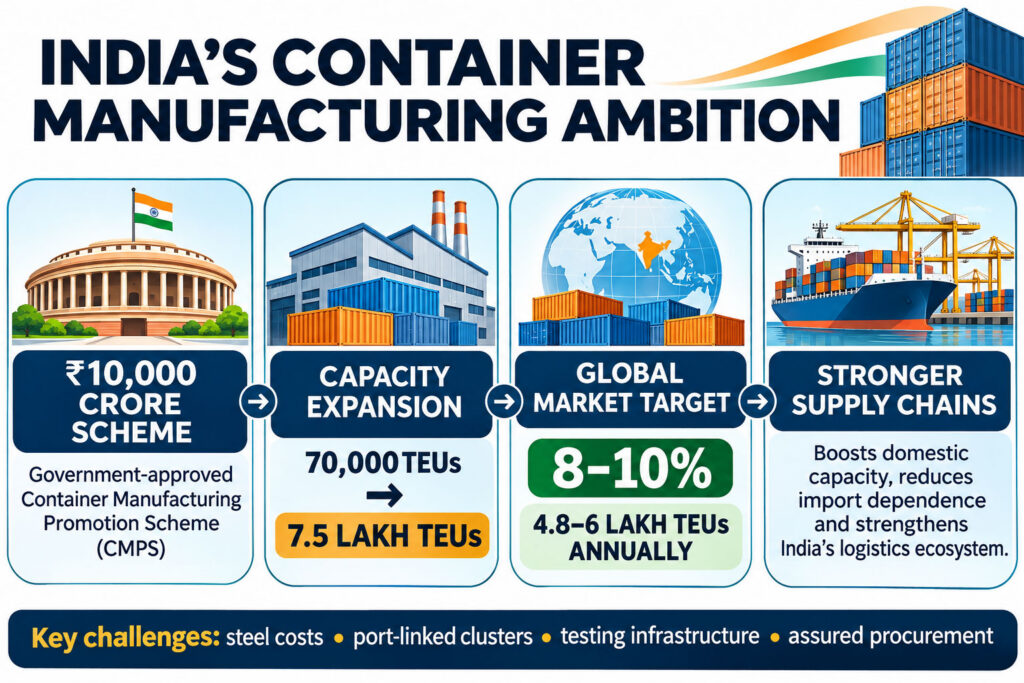
Visual Diagram: India’s Container Manufacturing Growth Strategy
The following infographic illustrates the proposed investment, manufacturing expansion and global market opportunity.
Impact on India’s Shipping, Ports and Logistics Industry
The expansion of container manufacturing could have a wider impact on India’s maritime and logistics ecosystem.
1. Reduced dependence on imported containers
Domestic production could reduce India’s reliance on overseas container suppliers and improve the availability of equipment for exporters, importers and shipping companies.
2. Opportunities for steel and engineering industries
Increased production will create demand for specialised steel, container components, paints, wooden flooring, corner castings and manufacturing equipment.
3. Stronger port-led industrial development
Establishing manufacturing clusters near major ports could improve access to shipping networks, reduce inland transportation costs and encourage industrial investment around port regions.
4. Employment and investment generation
According to the government’s scheme projections, the initiative is expected to create approximately 3,000 direct jobs and more than 50,000 indirect jobs across manufacturing and supporting industries.
5. Improved export competitiveness
A competitive domestic manufacturing ecosystem could help India emerge as a supplier of shipping containers to international shipping lines and leasing companies.
Challenges That Could Influence India’s Global Market Share
Despite the significant opportunity, India will need to overcome several challenges before it can compete with established global manufacturers.
Challenge
Potential impact
Required action
High steel costs
Higher manufacturing expenses
Competitive steel procurement
China’s manufacturing dominance
Strong international competition
Improve production efficiency
Limited testing infrastructure
Certification bottlenecks
Develop common testing facilities
Supply-chain limitations
Higher component costs
Strengthen domestic suppliers
Uncertain procurement demand
Investment risks
Long-term purchase commitments
The availability of affordable raw materials, reliable procurement agreements and globally accepted quality standards will determine how quickly India can scale production.
Conclusion
India’s ambition to capture 8–10% of the global container manufacturing market represents an important development for the country’s maritime and logistics industry. The ₹10,000-crore Container Manufacturing Promotion Scheme provides financial support to address manufacturing cost disadvantages, expand production capacity and develop supporting infrastructure.
However, government incentives alone will not guarantee global competitiveness. Access to affordable specialised steel, advanced manufacturing facilities, port-linked industrial clusters and long-term procurement agreements will be essential.
If these measures are implemented effectively, India could gradually emerge as an important alternative manufacturing destination in the global shipping container industry, strengthening its position in international trade and maritime supply chains.
Frequently Asked Questions
What is India’s target share of global container manufacturing?
India aims to capture approximately 8–10% of global container manufacturing capacity within the next five years, equivalent to annual production of around 4.8 lakh to 6 lakh TEUs.
What is the Container Manufacturing Promotion Scheme?
The Container Manufacturing Promotion Scheme (CMPS) is a ₹10,000-crore government initiative approved in October 2026 to establish a globally competitive container manufacturing ecosystem in India.
What is India’s current container manufacturing capacity?
India’s existing annual container manufacturing capacity is approximately 70,000 TEUs, with a government target of increasing it to 7.5 lakh TEUs.
Why does China dominate global container manufacturing?
China has an established manufacturing ecosystem, extensive specialised steel supply chains, large-scale production capabilities and cost advantages that make it the dominant global container producer.
How will the scheme benefit India’s logistics industry?
The scheme could reduce import dependence, improve container availability, strengthen domestic supply chains, support port-led industrial development and create employment opportunities.