
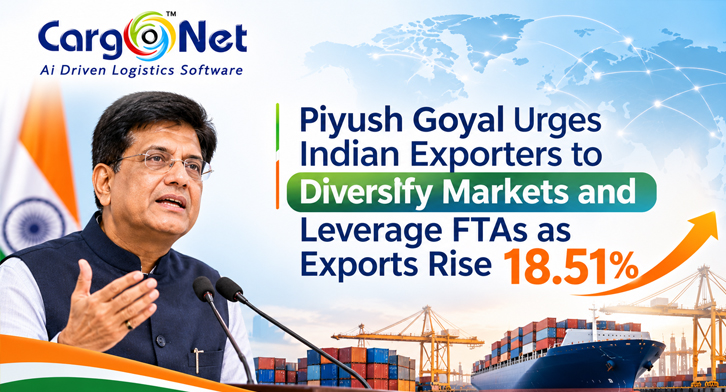
India is strengthening its export strategy as global trade patterns undergo significant changes driven by geopolitical tensions, shifting tariff policies and supply chain realignments. Union Commerce and Industry Minister Piyush Goyal has urged Indian exporters to diversify international markets, explore new product opportunities and make better use of Free Trade Agreements (FTAs) to strengthen the country’s position in global trade.
During a review meeting with representatives of Export Promotion Councils (EPCs) and industry associations, the minister highlighted the importance of coordinated export promotion, market intelligence and stronger international business partnerships.
The government’s renewed focus comes at a time when India’s merchandise exports have recorded strong growth. According to the Ministry of Commerce and Industry’s October 15, 2026 trade report, merchandise exports reached US$259.89 billion during April–September FY2026-27, registering 18.51% year-on-year growth.
The government is encouraging exporters, particularly Micro, Small and Medium Enterprises (MSMEs), to identify emerging markets, improve product competitiveness and use available trade agreements to expand India’s global export footprint.
Key Developments in India’s Export Strategy
- 18.51% growth: Merchandise exports reached US$259.89 billion during April–September FY2026-27.
- US$476.20 billion: Combined merchandise and services exports during the first six months of FY2026-27.
- Market diversification: Exporters are being encouraged to explore new international markets and untapped product categories.
- Greater FTA utilisation: Businesses are being urged to take advantage of preferential tariffs and improved market access.
- ₹25,060 crore Export Promotion Mission: Government support aimed at strengthening export competitiveness.
- MSME participation: Smaller businesses are being encouraged to participate in international exhibitions and buyer-seller meetings.
Government Pushes Exporters to Explore New International Markets
Piyush Goyal emphasised that India’s export growth strategy must extend beyond traditional trading destinations. Export Promotion Councils and industry associations have been asked to identify sector-specific opportunities, assess international demand and help Indian businesses establish stronger connections with overseas buyers.
The global trading environment is changing rapidly due to geopolitical uncertainties, evolving tariff structures, regulatory developments and supply chain realignments. These changes are creating opportunities for Indian manufacturers and exporters to enter new markets and become alternative suppliers in international supply chains.
The minister also stressed the importance of improving coordination between Export Promotion Councils, state governments, industry associations and the Directorate General of Foreign Trade (DGFT).
Greater cooperation between these institutions could help exporters address operational challenges, understand foreign market requirements and identify new business opportunities.
Market Diversification and Trade Intelligence Gain Importance
Market diversification is becoming an important component of India’s export competitiveness strategy. Depending heavily on a limited number of export destinations can expose businesses to tariff changes, regulatory restrictions and sudden disruptions in international demand.
Indian exporters are therefore being encouraged to identify new destinations, expand product portfolios and use market intelligence to make informed business decisions.
The proposed approach includes:
- Identifying products with high international demand and untapped export potential.
- Exploring emerging markets across Asia, Europe, Africa and the Middle East.
- Monitoring international pricing, trade policies and regulatory requirements.
- Establishing partnerships with overseas distributors, importers and buyers.
- Improving product quality, packaging and compliance with international standards.
- Strengthening participation in global supply chains.
For freight forwarders and logistics companies, market diversification could also create new opportunities in international cargo movement, customs clearance, warehousing, multimodal transportation and cross-border supply chain management.
Exporters Encouraged to Leverage Free Trade Agreements
India’s expanding network of Free Trade Agreements is creating additional opportunities for domestic manufacturers and exporters.
FTAs help reduce or eliminate customs duties on eligible products, improve market access and establish clearer trade frameworks between partner economies. However, exporters must understand product-specific tariff concessions, rules of origin and documentation requirements before claiming preferential treatment.
India has strengthened its trade relationships through agreements with countries and economic blocs including Australia, the UAE, Mauritius and the European Free Trade Association (EFTA). More recently concluded agreements and trade negotiations with the United Kingdom, Oman, New Zealand and the European Union are also expanding India’s international trade engagement, although implementation timelines and conditions differ.
According to the Ministry of Commerce and Industry’s overview of India’s trade partnerships, these agreements are designed to improve market access, encourage investment and strengthen India’s integration into international value chains.
Exporters should evaluate the following before using FTA benefits:
- Product-specific tariff concessions in the destination market.
- Applicable rules of origin and origin certification.
- Customs documentation and regulatory requirements.
- Product standards and technical compliance.
- Freight costs and delivery timelines to the target market.
Understanding these requirements can help businesses reduce landed costs and improve their competitiveness against suppliers from other countries.
₹25,060-Crore Export Promotion Mission to Support MSMEs
The government is also focusing on improving the participation of MSMEs in international trade through the Export Promotion Mission (EPM).
With a total financial outlay of ₹25,060 crore for FY2025-26 to FY2030-31, the initiative aims to strengthen India’s export ecosystem through financial assistance, market access support, export readiness and logistics-related interventions.
According to the Press Information Bureau’s announcement of the Export Promotion Mission, the mission operates through two integrated sub-schemes:
Programme
Primary focus
NIRYAT PROTSAHAN
Trade finance and financial assistance for exporters
NIRYAT DISHA
Market access, quality compliance, branding, logistics and export readiness
The Market Access Support initiatives are particularly relevant for smaller exporters seeking to establish an international presence.
Support measures include participation in:
- International trade exhibitions.
- Buyer-Seller Meets (BSMs).
- Reverse Buyer-Seller Meets (RBSMs).
- International trade delegations.
- Overseas market development activities.
The government is also encouraging companies to plan their participation in major international exhibitions three to five years in advance to improve business development opportunities.
India’s Merchandise Exports Rise 18.51% During April–September FY2026-27
India’s export performance during the first half of FY2026-27 indicates continued growth in international trade.
According to the Ministry of Commerce and Industry’s latest trade statistics, merchandise exports increased from US$219.30 billion in April–September FY2025-26 to US$259.89 billion during the corresponding period of FY2026-27.
Services exports also increased, supporting the country’s overall export performance.
India’s export and import performance
Trade category
April–September FY2025-26
April–September FY2026-27
Merchandise exports
US$219.30 billion
US$259.89 billion
Merchandise imports
US$376.17 billion
US$437.53 billion
Services exports
US$199.02 billion
US$216.31 billion
Services imports
US$100.24 billion
US$113.60 billion
Combined exports
US$418.31 billion
US$476.20 billion
Source: Ministry of Commerce & Industry, Government of India, October 15, 2026. Services figures are estimates.
Merchandise export growth comparison
India’s merchandise exports during April–September in US$ billion.
The data highlights the increasing contribution of Indian goods to international trade. However, merchandise imports also increased to US$437.53 billion, resulting in a merchandise trade deficit of US$177.64 billion, compared with US$156.88 billion in the previous corresponding period.
Meanwhile, combined merchandise and services exports reached US$476.20 billion, representing 13.84% year-on-year growth.
These figures indicate that services exports continue to play an important role in supporting India’s overall trade performance.
Export Growth Creates Opportunities for India’s Logistics Sector
The government’s emphasis on market diversification and international trade expansion could have wider implications for India’s logistics and freight forwarding industry.
As exporters explore new destinations, logistics providers will need to support increasingly complex international supply chains involving multiple countries, ports, transportation modes and customs regulations.
Some important areas likely to gain attention include:
1. International freight forwarding
New export destinations could increase demand for sea freight, air freight and multimodal transportation services.
2. Customs clearance and trade compliance
Greater FTA utilisation will require accurate documentation, origin certification, tariff classification and customs compliance.
3. Warehousing and distribution
Exporters entering new markets may require overseas warehousing, inventory management and distribution partnerships.
4. Digital logistics and shipment visibility
Businesses will increasingly need real-time shipment tracking, automated documentation and better coordination between international logistics partners.
5. MSME logistics support
Smaller exporters may require cost-effective freight solutions, consolidated shipments and simplified export documentation processes.
For India’s freight forwarding industry, these developments create opportunities to support businesses expanding into new international markets.
India’s Export Promotion Strategy: What Businesses Should Focus On
The government’s renewed emphasis on trade competitiveness highlights several priorities for Indian exporters.
Priority
What exporters should do
Market diversification
Identify new international buyers and destinations
FTA utilisation
Evaluate preferential tariffs and rules of origin
Product competitiveness
Improve quality, packaging and international compliance
Trade intelligence
Monitor global demand and tariff developments
MSME expansion
Participate in international exhibitions and trade delegations
Logistics efficiency
Reduce transportation costs and improve shipment visibility
Conclusion
India’s export strategy is increasingly focused on building a diversified, competitive and globally connected trading ecosystem. Piyush Goyal’s emphasis on market diversification, effective FTA utilisation and stronger industry coordination reflects the government’s efforts to help Indian businesses respond to changing international trade conditions.
With merchandise exports reaching US$259.89 billion and combined goods and services exports touching US$476.20 billion during April–September FY2026-27, India is demonstrating continued export momentum.
The next phase will depend on how effectively exporters convert new trade agreements, government support and international market opportunities into sustainable business growth. Efficient logistics infrastructure, digital trade processes and stronger supply chain integration will remain important in achieving this objective.
Frequently Asked Questions
Why has Piyush Goyal urged Indian exporters to diversify international markets?
Piyush Goyal has encouraged exporters to explore new destinations and product opportunities to reduce dependence on traditional markets, respond to changing global trade conditions and strengthen India’s international competitiveness.
How much did India’s merchandise exports grow during April–September FY2026-27?
India’s merchandise exports increased by 18.51% year-on-year to US$259.89 billion during April–September FY2026-27, compared with US$219.30 billion in the same period of the previous fiscal year.
What is the Export Promotion Mission?
The Export Promotion Mission is a government initiative with an outlay of ₹25,060 crore for FY2025-26 to FY2030-31. It aims to strengthen export competitiveness through trade finance, market access, compliance support, logistics and other export-related assistance.
How do Free Trade Agreements benefit Indian exporters?
FTAs provide eligible exporters with preferential market access, reduced or eliminated customs duties and opportunities to expand into international markets, subject to product coverage and rules of origin.
What is the role of MSMEs in India’s export growth?
MSMEs contribute to manufacturing, employment and international trade. Government initiatives aim to improve their access to export finance, international exhibitions, overseas buyers and global supply chains.
How can export growth benefit India’s logistics industry?
Higher export activity can increase demand for freight forwarding, customs clearance, warehousing, transportation, cargo tracking and digital supply chain solutions.