
India’s Trade Agreements Could Boost GDP by 1.7% by 2035
India’s expanding network of free trade agreements (FTAs) could generate an estimated US$140 billion in additional economic output by 2035, provided existing agreements and selected concluded or ongoing negotiations are implemented as assumed in the underlying analysis.
The estimate is based on an analysis using a World Trade Organization (WTO) global economic model. It suggests that agreements already in force, together with arrangements concluded or under negotiation with the European Union and New Zealand, could increase India’s GDP by 1.7% by 2035 if the specified agreements are implemented from 2027.
At constant 2025 prices, the projected gain is approximately ₹13.30 lakh crore.
The findings point to the potential economic benefits of wider market access, lower import costs, increased foreign direct investment and improved productivity. They also highlight the role of trade policy in strengthening India’s position in international supply chains.
Read the original report: Bloomberg Economics’ trade analysis, as reported by The Economic Times.
These figures represent modelled scenarios rather than guaranteed economic outcomes.
How Much Could India Gain From Free Trade Agreements?
The analysis outlines several possible outcomes depending on the trade agreements implemented and the additional negotiations concluded.
Scenario
Potential GDP impact by 2035
Estimated economic gain
Selected FTAs implemented, including the EU and New Zealand arrangements specified in the analysis
1.70%
US$140 billion
Additional potential US–India trade agreement
+0.2 percentage points
Additional gain not separately specified
Broader scenario including negotiations with the Eurasian Economic Union, Gulf Cooperation Council and Israel
2.10%
Approximately US$170 billion
The broader scenario could raise the projected GDP gain to around ₹16.15 lakh crore, according to the supplied analysis.
These estimates depend on the assumptions used in the economic model, the implementation of agreements and the outcome of negotiations. They should not be interpreted as confirmed future gains.
Which Trade Agreements Could Support India’s Growth?
India has been expanding its trade relationships to improve market access and diversify export destinations.
The supplied analysis identifies agreements involving the European Free Trade Association (EFTA), the United Kingdom and Oman as having entered into force during 2025–2026. It also refers to existing agreements with Australia and the United Arab Emirates.
Further potential gains are linked to the implementation of agreements involving the European Union and New Zealand, as well as negotiations involving other major trading partners.
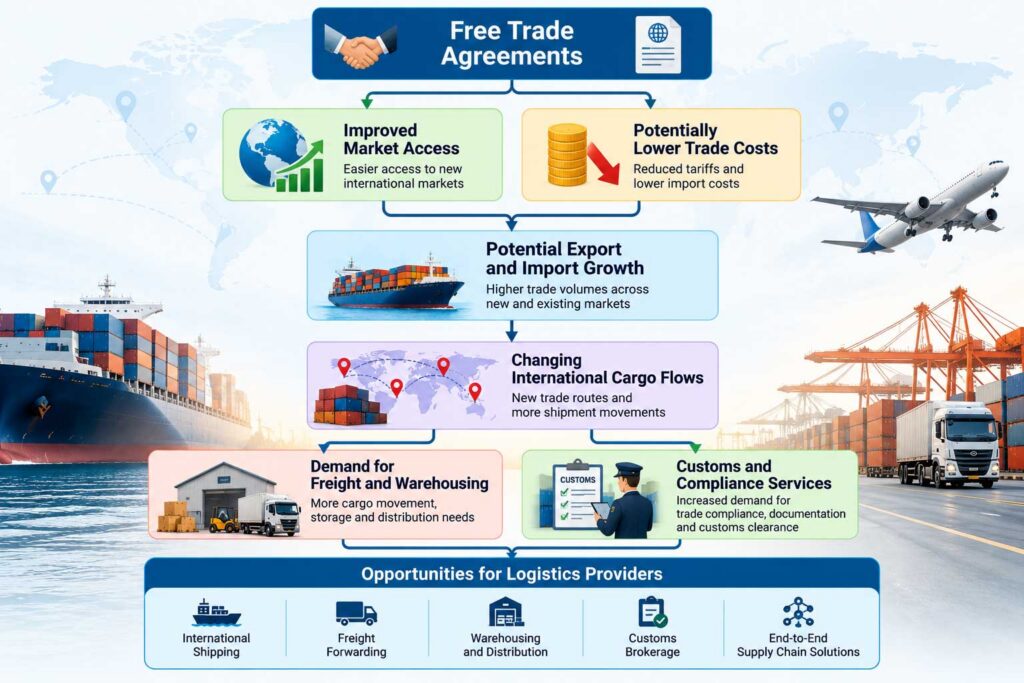
Potential benefits of India’s expanding trade network
- Higher cargo volumes: More competitive exports could generate additional ocean freight and air cargo movements.
- New trade routes: Exporters and importers may explore new markets and sourcing locations.
- Customs compliance demand: Businesses need to assess tariff eligibility, rules of origin and supporting documentation.
- Supply chain diversification: Companies may expand their supplier networks across different countries.
- Digital logistics adoption: Increased trade complexity may encourage businesses to improve document processing, shipment tracking and operational coordination.
Importantly, an FTA does not automatically eliminate all tariffs or customs requirements. Preferential treatment depends on the specific agreement, product classification, applicable rules of origin and other conditions.
What Could Increase the Economic Benefits?
The analysis identifies domestic productivity improvements as an important factor in maximising the gains from trade agreements.
Potential supporting measures include:
- Reducing manufacturing costs and improving productivity.
- Improving access to energy, critical minerals and advanced technologies.
- Strengthening manufacturing competitiveness.
- Supporting the movement of underemployed workers into more productive sectors.
- Improving the implementation and utilisation of trade agreements.
For logistics companies, better infrastructure, efficient customs processes and reliable multimodal transport can help businesses convert market access into actual trade activity.
Frequently Asked Questions
How much could India’s GDP increase through FTAs by 2035?
The analysis estimates that selected trade agreements could raise India’s GDP by about US$140 billion, or 1.7% above the baseline, by 2035.
Could the gains reach US$170 billion?
Yes. Under a broader scenario involving a potential US–India agreement and additional agreements with the EAEU, GCC and Israel, the estimated gain could reach approximately US$170 billion, or 2.1% of GDP.
How could FTAs benefit freight forwarders?
Potential trade expansion could increase demand for international transportation, customs brokerage, warehousing and cross-border supply chain management.
Do free trade agreements remove all customs duties?
No. Preferential tariff treatment depends on the agreement, the product, its origin and the relevant eligibility requirements. Other customs and regulatory obligations may still apply.