
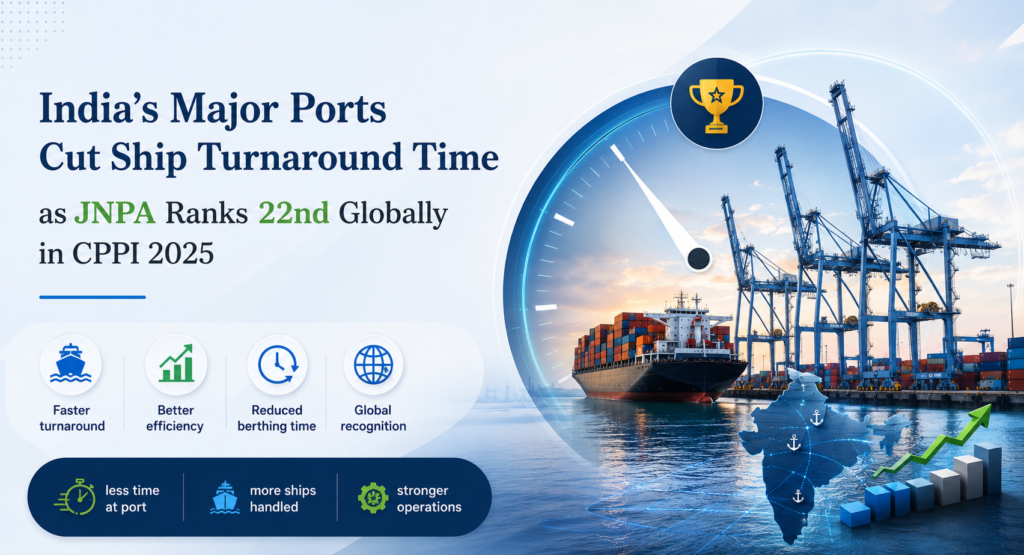
India’s major ports are showing measurable gains in operational efficiency, with average ship turnaround time improving to 48.84 hours in FY 2025-26, down from 52.87 hours in FY 2021-22. The improvement highlights the impact of port modernisation, mechanisation, infrastructure upgrades and streamlined digital processes across India’s maritime gateways.
A major global recognition has also strengthened India’s maritime performance story. Jawaharlal Nehru Port Authority (JNPA) ranked 22nd globally in the World Bank’s Container Port Performance Index (CPPI) 2025, retaining its position as India’s best-performing container port. JNPA was ranked just behind Singapore at 21st and ahead of Shanghai at 23rd.
Major Ports Improve Vessel Turnaround Time
According to the Ministry of Ports, Shipping and Waterways, the average turnaround time across India’s major ports has improved over the past five years:
Financial Year
Average Ship Turnaround Time
2021-22
52.87 hours
2022-23
52.90 hours
2023-24
48.06 hours
2024-25
49.47 hours
2025-26
48.84 hours
Overall, turnaround time has fallen by approximately 4.03 hours, or 7.6%, compared with FY 2021-22.
The latest performance indicates that Indian ports are gradually reducing the time vessels spend in port, an important factor in improving cargo velocity, asset utilisation and supply-chain efficiency.
JNPA Enters the Global Top 25
JNPA’s 22nd position in the CPPI 2025 is one of the strongest indicators of India’s progress in container port efficiency.
The World Bank’s CPPI measures container port performance based on the time vessels spend in port. JNPA also ranked 14th among the world’s top 20 ports showing improvement between 2020 and 2025, according to the port authority.
JNPA’s Global Position
Port
CPPI 2025 Rank
Singapore
21
JNPA, India
22
Shanghai
23
Rotterdam
333
The ranking places JNPA alongside some of the world’s major container gateways and reinforces India’s growing presence in global maritime logistics.
What Is Driving Better Port Performance?
The improvement in India’s port turnaround time is being supported by a combination of physical infrastructure and process reforms.
Key measures include:
- Port modernisation: Upgrading berths, terminals and yards to increase operational capacity.
- Mechanisation: Greater use of mechanised cargo-handling systems to improve productivity.
- Infrastructure expansion: Development of new berths, terminals and supporting facilities.
- Digitalisation: Increasing use of digital systems to simplify documentation and port processes.
- One Nation One Port Process (ONOP): Standardisation of port procedures to reduce inconsistencies and operational delays.
- Better port connectivity: Improvements in road and rail infrastructure supporting cargo evacuation.
- Process optimisation: Streamlining vessel, cargo and documentation workflows.
The government launched One Nation One Port Process in February 2025 to standardise and streamline operations across India’s major ports. The initiative initially reduced container-operation documentation from 143 to 96 documents and bulk-cargo documentation from 150 to 106.
Port Efficiency: Why Turnaround Time Matters
Ship turnaround time is a critical logistics performance indicator. A vessel that spends less time waiting, berthing, loading or unloading can complete more voyages and move cargo through the supply chain faster.
The improvement can create benefits across the wider logistics ecosystem:
For exporters, importers, shipping lines and freight forwarders, faster port operations can translate into more predictable cargo movement and improved schedule reliability.
Implications for India’s Logistics Industry
The latest port performance data is significant for India’s broader logistics sector. As ports handle growing volumes of international trade, operational efficiency becomes increasingly important for controlling logistics costs and improving cargo-flow reliability.
For freight forwarders and logistics companies, faster vessel turnaround can support:
- Better shipment planning and schedule coordination
- Improved cargo visibility and tracking
- More predictable container movement
- Faster documentation and clearance workflows
- Better coordination with shipping lines, terminals and customs
- Improved end-to-end supply-chain planning
India’s progress is therefore not limited to individual port rankings. It reflects a broader shift toward technology-enabled, standardised and data-driven port operations.
India’s Port Performance at a Glance
Indicator
Latest Performance
Average major-port turnaround time
48.84 hours
FY 2021-22 turnaround time
52.87 hours
Improvement
4.03 hours / 7.6%
JNPA CPPI 2025 rank
22nd globally
Singapore CPPI rank
21st
Shanghai CPPI rank
23rd
JNPA improvement ranking
14th among top 20 improving ports, 2020-2025
Frequently Asked Questions
What is India's average ship turnaround time?
India’s major ports recorded an average ship turnaround time of 48.84 hours in FY 2025-26, compared with 52.87 hours in FY 2021-22.
Which Indian port ranks highest in the CPPI 2025?
Jawaharlal Nehru Port Authority (JNPA) is India’s highest-ranked port in the World Bank’s CPPI 2025, ranking 22nd globally.
What is the Container Port Performance Index?
The Container Port Performance Index (CPPI) is a World Bank-published measure that evaluates container port performance based on the time vessels spend in port.
What is One Nation One Port Process?
One Nation One Port Process (ONOP) is an Indian government initiative designed to standardise and simplify port procedures across major ports, reducing documentation inconsistencies and operational delays.
Why is ship turnaround time important?
Lower turnaround time allows vessels to spend less time in port, supporting faster cargo movement, better vessel utilisation and more efficient maritime supply chains.