
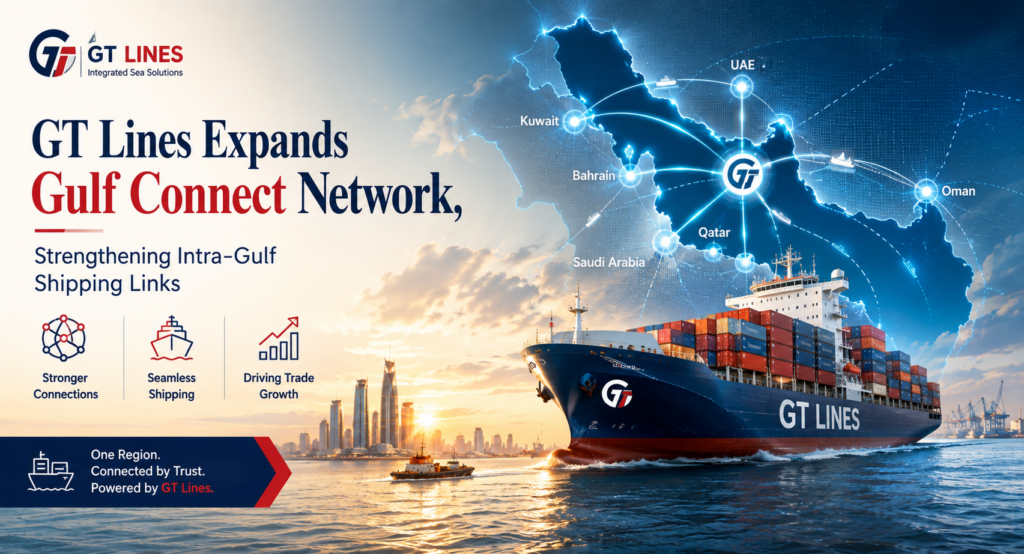
GT Lines is expanding its Gulf Connect intra-Gulf shipping network, strengthening direct container connectivity between key Gulf markets, Iraq and the carrier’s wider international service network.
The expanded network connects major markets across the UAE, Iraq, Kuwait, Saudi Arabia, Qatar and Bahrain, while providing links to international trade corridors serving Pakistan, India, China, wider Asia and East Africa.
The development comes as regional trade flows continue to grow and shippers seek faster, more reliable options for moving cargo between Gulf markets and international destinations.
Key Highlights
- Three dedicated intra-Gulf services operate under the Gulf Connect network.
- The network is supported by six dedicated vessels.
- SIX (Sharjah Iraq Express) operates three departures per week.
- SQX (Sharjah Qatar Express) operates two departures per week.
- SKX (Sharjah KSA Express) provides a weekly connection to Dammam.
- The network connects UAE, Iraq, Kuwait, Saudi Arabia, Qatar and Bahrain.
- International connectivity extends to India, Pakistan, China, Asia and East Africa.
- Sharjah and Khorfakkan serve as strategically positioned hubs within GT Lines' regional network.
- The service is supported by an integrated ecosystem covering shipping, terminals, inland logistics and regional distribution.
GT Lines Gulf Connect Service Network
Service
Route
Frequency
Key Market
SIX – Sharjah Iraq Express
Sharjah → Umm Qasr → Shuwaikh → Sharjah
3 departures/week
Iraq & Kuwait
SQX – Sharjah Qatar Express
Sharjah → Hamad → Bahrain → Sharjah
2 departures/week
Qatar & Bahrain
SKX – Sharjah KSA Express
Sharjah → Dammam → Sharjah
Weekly
Saudi Arabia
Beyond a Conventional Feeder Network
GT Lines says Gulf Connect is designed to operate as more than a conventional feeder service.
The carrier’s network strategy combines container shipping, terminal operations, inland transportation and regional distribution to create an integrated logistics platform for cargo moving within the Gulf and onward to international markets.
Sharjah and Khorfakkan play an important role in this model, providing access to regional markets while connecting Gulf cargo with GT Lines’ broader international service corridors.
The network also provides connectivity to Iraq through Gulftainer ICT, supporting container movements between the UAE and the Iraqi market.
Why the Expansion Matters for Gulf Trade
The Gulf has become an increasingly important logistics and distribution hub linking Asia, the Indian subcontinent, Africa and Europe.
For exporters and importers, stronger intra-Gulf shipping connections can provide additional routing options for cargo moving between regional markets. This can be particularly relevant for businesses using the UAE as a logistics or transshipment base.
GT Lines’ expanded Gulf Connect network therefore adds another layer of regional connectivity while linking intra-Gulf cargo with longer-haul services.
For freight forwarders and logistics operators, the expanded network could create additional options when planning shipments between the Gulf, Iraq and major Asian and African trade lanes.
What It Means for Freight Forwarders
The expanded network could be relevant for freight forwarders managing cargo across multiple GCC markets.
Key potential advantages include:
- More regional routing choices for containerized cargo.
- Improved connectivity between UAE gateways and Gulf markets.
- Access to Iraq, Kuwait, Saudi Arabia, Qatar and Bahrain through dedicated services.
- Opportunities to connect regional cargo with GT Lines' international network.
- Greater flexibility when designing multimodal and transshipment solutions.
- Potential support for regional distribution strategies using the UAE as a logistics hub.
Why It Matters
GT Lines’ Gulf Connect expansion reflects a broader shift toward integrated regional logistics networks, where shipping services are increasingly connected with terminals, inland transportation and distribution infrastructure.
As trade between the Gulf, India, Asia and East Africa continues to develop, regional shipping networks that provide both short-sea connectivity and access to international services could become increasingly important.
For shippers and logistics providers, the expanded Gulf Connect network gives them additional options for moving containers across the GCC and connecting regional cargo with international markets.
GT Lines Strengthens Gulf Shipping Network with Expanded Gulf Connect Services
GT Lines’ expanded Gulf Connect network strengthens intra-Gulf container connectivity by linking the UAE with Iraq, Kuwait, Saudi Arabia, Qatar and Bahrain through three dedicated services.
With six dedicated vessels and connections to wider trade corridors covering India, Pakistan, China, Asia and East Africa, the network positions the UAE as an important regional gateway for cargo moving across the Gulf and beyond.
For freight forwarders, exporters and importers, the expansion means more regional routing options, stronger Gulf connectivity and greater access to international shipping networks.
Frequently Asked Questions
What is GT Lines Gulf Connect?
Gulf Connect is GT Lines’ intra-Gulf container shipping network connecting the UAE with Iraq, Kuwait, Saudi Arabia, Qatar and Bahrain.
Which countries are connected by GT Lines Gulf Connect?
The network connects the UAE, Iraq, Kuwait, Saudi Arabia, Qatar and Bahrain, with onward connections to India, Pakistan, China, Asia and East Africa.
How many Gulf Connect services does GT Lines operate?
GT Lines operates three dedicated intra-Gulf loops: SIX, SQX and SKX.
How frequently does GT Lines Gulf Connect operate?
SIX operates three times weekly, SQX twice weekly and SKX weekly.
Which UAE ports are strategically important to Gulf Connect?
Sharjah and Khorfakkan are key locations within GT Lines’ regional logistics network.