
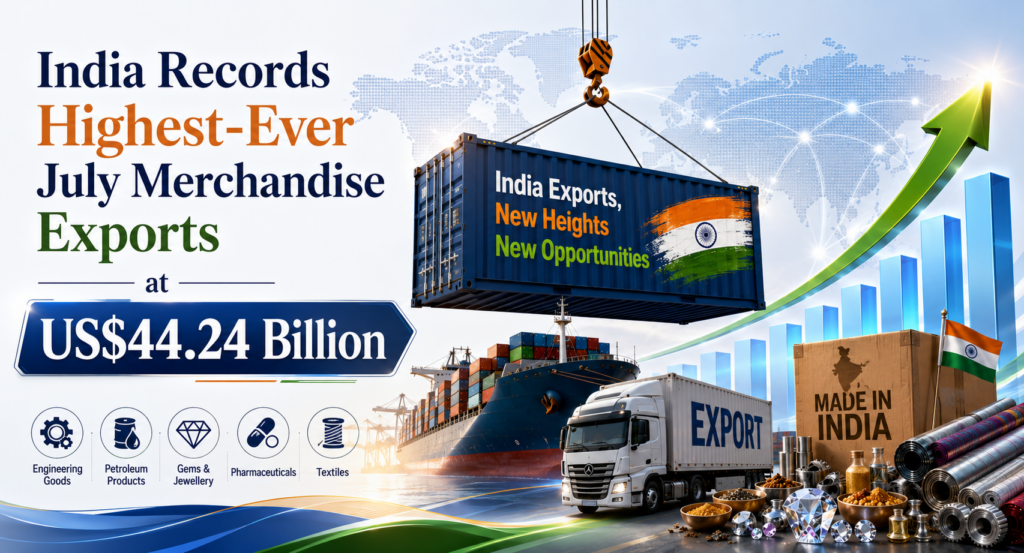
India’s merchandise exports reached a record US$44.24 billion in July 2026, registering growth of more than 19% year-on-year (YoY) and marking the country’s highest-ever merchandise export value for the month of July.
The strong performance comes despite continued pressure on global trade from geopolitical tensions, shipping disruptions, elevated freight costs and volatility across international markets.
The latest export numbers underline the resilience of Indian exporters and the growing contribution of manufacturing and value-added products to India’s international trade.
Key Highlights
- US$44.24 billion: India’s merchandise exports in July 2026.
- 19%+: Year-on-year growth in July merchandise exports.
- US$173.78 billion: Merchandise exports during April-July 2026-27.
- 17.04%: Growth in merchandise exports during April-July.
- US$316.42 billion: Combined merchandise and services exports during April-July.
- 12.79%: Growth in non-petroleum exports.
- US$76.22 billion: Merchandise imports in July.
- US$31.98 billion: Merchandise trade deficit in July.
- US$49.43 billion: Overall trade deficit during April-July.
July Export Growth Signals Stronger Trade Resilience
The July export performance is particularly significant because Indian exporters achieved record shipments while international supply chains continue to face disruptions.
According to Federation of Indian Export Organisations (FIEO) President S. C. Ralhan, the more than 19% increase demonstrates the resilience, competitiveness and adaptability of Indian exporters.
Higher transportation costs, uncertain shipping schedules and changing global trade conditions have created additional challenges for exporters. Despite these pressures, Indian businesses have continued to expand their presence across international markets.
The performance also suggests that India’s export growth is becoming increasingly diversified, with manufacturing and value-added sectors playing a larger role.
India’s April-July Export Performance
The positive momentum extends beyond July.
Between April and July 2026-27, India’s merchandise exports increased 17.04% to US$173.78 billion.
When merchandise and services are combined, India’s total exports reached US$316.42 billion, representing growth of 13.16%.
India Export Performance: April-July 2026-27
Trade Indicator
Value
Growth
Merchandise exports
US$173.78 billion
17.04%
Merchandise + services exports
US$316.42 billion
13.16%
Non-petroleum exports
—
12.79%
Merchandise imports
—
19.27% growth
Overall imports
US$365.85 billion
Increased from US$311.94 billion
Overall trade deficit
US$49.43 billion
Up from US$32.32 billion
The 12.79% growth in non-petroleum exports is particularly important because it points to broader export expansion beyond petroleum-linked trade.
Engineering Goods Lead India’s Export Basket
Engineering goods remained the largest export category, highlighting the increasing importance of India’s manufacturing sector in global trade.
Other major export categories included:
- Engineering goods
- Petroleum products
- Electronic goods
- Drugs and pharmaceuticals
- Organic and inorganic chemicals
- Gems and jewellery
- Readymade garments
- Cotton yarn, fabrics and made-ups
- Rice
- Plastic and linoleum products
The strong representation of engineering, electronics, pharmaceuticals, chemicals and other manufactured products indicates a gradual shift towards higher-value and manufacturing-oriented exports.
Export Category
Significance
Engineering goods
Major manufacturing export
Petroleum products
Gulf-India-East Africa (GIEA)
Electronic goods
Reflects India's expanding electronics manufacturing
Drugs & pharmaceuticals
Strong global demand
Organic & inorganic chemicals
Important industrial export segment
Gems & jewellery
Traditional high-value export
Readymade garments
Labour-intensive export sector
Cotton yarn, fabrics & made-ups
Textile supply chain
Rice
Major agricultural export
Plastic & linoleum
Industrial and consumer products
US, UAE and Singapore Among Key Export Markets
India’s export growth is also supported by a broad geographical spread.
During April-July 2026-27, the United States, UAE, Singapore, China, Netherlands, United Kingdom, Germany, South Africa, Bangladesh and Tanzania were among India’s leading export destinations.
The diversification of export markets is becoming increasingly important as businesses seek to reduce their exposure to individual markets and manage geopolitical and trade-policy risks.
India's Key Export Destinations
The growing presence of Indian products in markets across the Gulf, Europe, Africa and Asia could provide exporters with additional opportunities for market expansion.
Trade Deficit Remains a Major Concern
Despite the strong export performance, India continues to face pressure from rapidly rising imports.
Merchandise imports reached US$76.22 billion in July, resulting in a merchandise trade deficit of US$31.98 billion.
During April-July, merchandise imports increased by 19.27%, faster than the 17.04% growth in merchandise exports.
This gap remains an important issue for policymakers because faster import growth can offset part of the gains achieved through higher exports.
India’s Import and Trade Deficit Snapshot
Indicator
April-July Comparison
Merchandise export growth
17.04%
Merchandise import growth
19.27%
Overall imports
US$365.85 billion
Previous overall imports
US$311.94 billion
Current overall trade deficit
US$49.43 billion
Previous overall trade deficit
US$32.32 billion
India’s Export Growth: From Production to Global Markets
The latest figures illustrate how stronger domestic manufacturing capacity can translate into increased participation in international supply chains.
For freight forwarders, shipping companies and logistics providers, sustained export growth could also translate into higher demand for international freight, customs clearance, documentation, cargo tracking, warehousing and multimodal transportation services.
Logistics Disruptions Remain a Key Risk
The record export figure comes at a time when global logistics remains vulnerable to disruptions.
Exporters continue to deal with:
- Higher freight rates
- Shipping delays
- Geopolitical uncertainty
- Route disruptions
- Port congestion
- Changing trade policies
- Longer supply-chain lead times
- Working-capital pressure
- Fluctuating transportation costs
For exporters, efficient logistics management has therefore become increasingly important.
The ability to compare freight rates, manage documentation, track shipments, coordinate carriers and monitor logistics costs can help businesses respond faster when international supply-chain conditions change.
What Policy Support Do Indian Exporters Need?
FIEO has called for continued government and industry support to sustain the current export momentum.
Key areas requiring attention include:
- Competitive export credit
- Easier access to working capital
- Faster trade facilitation
- Improved shipping infrastructure
- Reduction of logistics bottlenecks
- Greater support for MSMEs
- Support for labour-intensive industries
- Expansion into new international markets
- Faster resolution of shipping and logistics challenges
For smaller exporters and MSMEs in particular, access to affordable finance and efficient logistics can play an important role in maintaining competitiveness.
What Does the Record July Export Figure Mean for India?
India’s July export performance provides a positive signal for the country’s external trade outlook.
The combination of strong merchandise exports, rising non-petroleum exports and broader geographical diversification suggests that Indian exporters are adapting to a rapidly changing global trade environment.
However, the faster pace of import growth and the widening trade deficit remain areas that policymakers will need to monitor closely.
Sustaining export growth will require more than strong demand. India will also need competitive logistics, reliable infrastructure, efficient customs processes, access to finance and continued investment in manufacturing and value-added production.
Outlook: Can India Sustain Export Momentum?
The immediate outlook remains positive, but external risks are significant.
Geopolitical tensions, freight-rate volatility, shipping disruptions and evolving trade policies could influence India’s export performance in the coming months.
Greater diversification of products and markets could help Indian exporters reduce these risks.
For logistics and supply-chain companies, the growing scale of India’s international trade also creates opportunities to improve freight visibility, shipment automation, digital documentation, freight cost management and end-to-end supply-chain coordination.
India’s record July export performance therefore represents not only a trade milestone but also a broader opportunity to strengthen the country’s position in global supply chains.
Frequently Asked Questions
What were India’s merchandise exports in July 2026?
India’s merchandise exports reached US$44.24 billion in July 2026, registering growth of more than 19% year-on-year.
Did India record its highest-ever July merchandise exports?
Yes. July 2026 recorded India’s highest-ever merchandise export value for the month of July, at US$44.24 billion.
How much did India’s merchandise exports grow during April-July 2026-27?
India’s merchandise exports increased 17.04% to US$173.78 billion during April-July 2026-27.
What was India’s merchandise trade deficit in July 2026?
India recorded a merchandise trade deficit of US$31.98 billion in July 2026, with merchandise imports reaching US$76.22 billion.
Which products were among India’s leading export categories?
Engineering goods, petroleum products, electronic goods, drugs and pharmaceuticals, chemicals, gems and jewellery, readymade garments, textiles, rice and plastic products were among the major export categories.
Which countries were major destinations for Indian exports?
The United States, UAE, Singapore, China, Netherlands, UK, Germany, South Africa, Bangladesh and Tanzania were among the leading export destinations during April-July 2026-27.
Why is India's export growth important for the logistics industry?
Higher exports can increase demand for international freight forwarding, shipping, customs clearance, warehousing, cargo tracking, documentation and multimodal logistics services.