All you need to know

Blog - Logistics News

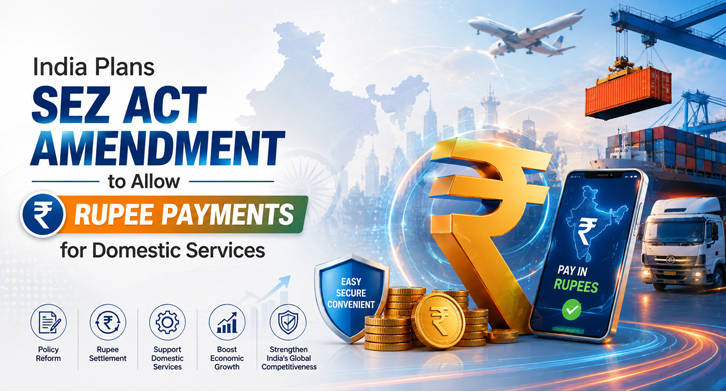
India Plans SEZ Act Amendment to Allow Rupee Payments for Domestic Services

India is considering a major policy change that could make it easier for Special Economic Zone (SEZ) units to serve customers within the country. The Commerce Department is preparing a Cabinet note proposing an amendment to the Special Economic Zones Act, 2005, which would allow SEZ-based companies to receive payments in Indian rupees for eligible services supplied to customers in the Domestic Tariff Area (DTA).

The proposed reform aims to remove a long-standing foreign-exchange requirement that has increased transaction costs and restricted domestic business opportunities for SEZ-based service providers. If approved, the move could particularly benefit maintenance, repair and overhaul (MRO), defence manufacturing, engineering and IT services.

Key Highlights

Why Is the Government Considering the Change?

Under the existing SEZ framework, services supplied by SEZ units to customers in the DTA are subject to a foreign-exchange payment requirement. This creates an additional layer of complexity when the customer and service provider are both operating in India.
In practice, a domestic customer may have to arrange payment in foreign currency even when the underlying service is entirely domestic. The SEZ service provider may then convert the foreign-currency proceeds back into Indian rupees.

Industry representatives say this process creates unnecessary currency-conversion costs, banking charges and administrative procedures, making SEZ-based service providers less attractive to domestic customers.

The proposed amendment seeks to address this issue by removing the foreign-exchange requirement for qualifying services.

What Could Change for SEZ Businesses?

The proposed amendment would create a more practical payment mechanism for SEZ units supplying services to Indian customers.

Current Framework

Proposed Framework

Foreign-exchange payment requirement for specified DTA services

INR payment proposed for eligible domestic services

Currency conversion may be required

Reduced need for currency conversion

Additional banking and transaction costs

Potentially lower transaction costs

Greater complexity for domestic buyers

Greater complexity for domestic buyers

Restrictions on some specialised services

Wider potential domestic market for SEZ service providers

The government is seeking to address what industry stakeholders describe as an imbalance in the current framework: the foreign-exchange condition applies to services, while the same requirement does not operate in the same way for goods.

MRO and Defence Could See Major Benefits

The proposed reform could be particularly significant for India’s MRO and defence manufacturing ecosystem.

Several SEZ-based facilities currently face difficulties in supplying maintenance and overhaul services to domestic organisations because of the foreign-currency payment requirement.
For instance, MRO facilities located in MIHAN Nagpur SEZ and GMR Aero SEZ in Hyderabad have faced challenges in serving domestic airlines under the existing payment framework.
The issue is also relevant to defence manufacturing. L&T MBDA Missile Systems’ SEZ facility in Coimbatore has highlighted difficulties in providing maintenance and overhaul services to the Indian defence establishment when payments have to be structured in foreign currency.
For defence organisations and government departments, paying an Indian service provider in foreign currency can create an unnecessary operational and financial complication.

Potential Impact on India's Logistics and Industrial Ecosystem

Although the proposal primarily concerns SEZ taxation and payment regulations, its effects could extend across India’s wider industrial and logistics ecosystem.
A more flexible domestic market for SEZ-based service providers could encourage greater use of specialised capabilities located within SEZs. This could support sectors such as aviation MRO, engineering services, defence equipment maintenance, technology services and industrial support operations.
Greater domestic sourcing could also reduce the need for organisations to look outside SEZ ecosystems for specialised services.
Potential Impact Chain

IT and Engineering Services Could Also Benefit

The proposed change is not limited to physical industrial services.
SEZ-based IT companies could gain greater flexibility in supplying software development and other technology services to Indian public-sector organisations and government departments.
Engineering companies operating from SEZs could similarly find it easier to serve domestic customers without the additional foreign-exchange payment mechanism.
This could open a larger domestic market for specialised capabilities already operating within India’s SEZ ecosystem.

Stakeholder Consultations Underway

The proposal has reportedly been discussed among the Commerce Department, Reserve Bank of India, Ministry of Finance and representatives of the SEZ sector.
The next major step would be Cabinet consideration. If the Cabinet approves the proposal, the required legislative amendment would then need to go through Parliament before the revised provision could take effect.
Therefore, the proposed change should currently be viewed as a policy proposal rather than an implemented regulatory change.

Key Facts at a Glance

Particular

Details

Proposed reform

Amendment to the SEZ Act

Main change

Allow INR payments for eligible domestic services

Existing issue

Foreign-exchange payment requirement for certain DTA services

Key beneficiaries

MRO, defence, engineering and IT companies

Potential benefit

Lower transaction and currency-conversion costs

Key stakeholders

Commerce Department, RBI, Finance Ministry and SEZ industry

Approval required

Cabinet and Parliament

Expected outcome

Greater domestic sourcing and improved SEZ competitiveness

What the SEZ Reform Could Mean for India

The proposed amendment could help align India’s SEZ framework more closely with the realities of the domestic services economy.
SEZs were established to promote exports, investment and economic activity. However, restrictions that make it difficult for SEZ-based companies to serve Indian customers can limit the utilisation of specialised infrastructure and capabilities already available within these zones.
Allowing eligible domestic services to be paid for in rupees could remove one such barrier.
For sectors such as aircraft MRO, defence maintenance, engineering and technology, the change could help connect SEZ capabilities more effectively with India’s domestic demand.

Outlook: A More Flexible Role for SEZs in India's Domestic Economy

If approved and implemented, the proposed amendment could expand the role of SEZs beyond their traditional export-oriented focus by making it easier for specialised service providers to participate in India’s domestic economy.

The potential benefits include lower transaction costs, easier domestic procurement, improved utilisation of SEZ infrastructure and stronger linkages between SEZ businesses and Indian industries.
For India’s logistics, aviation, defence and manufacturing sectors, greater access to specialised domestic services could contribute to more integrated and cost-efficient supply chains.
The key question now is whether the proposed amendment receives Cabinet and parliamentary approval and what specific services and payment conditions will be covered under the final framework.

Frequently Asked Questions

What is the proposed SEZ Act amendment?
The government is considering an amendment that would allow eligible SEZ units to receive payments in Indian rupees for services supplied to customers in the Domestic Tariff Area.
The proposal aims to reduce currency-conversion costs, banking charges and administrative complications associated with the existing foreign-exchange payment requirement.
MRO, defence manufacturing, engineering and IT services are expected to be among the key beneficiaries.
Easier domestic access to SEZ-based MRO, engineering and specialised industrial services could support aviation, manufacturing, defence and other supply-chain activities.
No. The proposal still requires the necessary government approvals, including Cabinet and parliamentary approval, before it can become law.
cargonet-logo-icon
Cargonet Cargo Software Logo

Feedback & Reward program

Submit the Feedback and avail the Rewards.

1. Your satisfaction & reliability on CargoNet ?

2. Your Rating on Support & co-ordination team?

3. Satisfaction on the look and feel of CargoNet ?

4. Please specify any 2 best features that you feel more helpful in CargoNet?

5. Please specify any 2 best reports that you are taking on regular basis?

6. Are you using Copy Job option in CargoNet Software?

7. Are you using Automatic DSR (Daily Status Report) Option? It automatically sends reports to customer about the shipment status

8. Are you using Automatic Outstanding Reports option? Period Auto outstanding reminders to customer

9. Any other thoughts to improve in CargoNet? Please share.

* Join our Reward Program by recommending CargoNet (Cash Rewards Awaiting)

“Thanks for your feedback. Our goal is to create the best possible product, support & service, and your thoughts, ideas & suggestions play a major role in helping us identify opportunities to improve.”

Cut AI cost ,
not performance

discover how top Freight Forwarding companies  reduce AI-related expense and speed up operation with CargoNet AI, we will show it how
Share your information for instant access :