
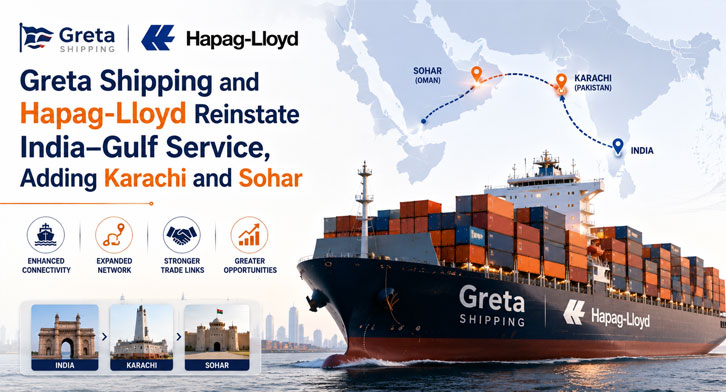
Greta Shipping and Hapag-Lloyd are set to reinstate their joint India Gulf (IG1) container service, strengthening maritime connectivity between India and key markets across the Gulf region.
According to DynaLiners, the revised service will introduce Karachi and Sohar into the rotation, creating a broader regional network connecting India, Pakistan, the UAE and Oman.
The service will operate with three container vessels of approximately 2,500 TEU capacity, providing additional shipping options for exporters and importers moving cargo between the Indian subcontinent and Gulf markets.
Key Highlights
- Service: India Gulf (IG1)
- Operators: Greta Shipping and Hapag-Lloyd
- Vessel deployment: 3 vessels
- Approximate vessel capacity: 2,500 TEU each
- New ports added: Karachi and Sohar
- Regions connected: India, Pakistan, UAE and Oman
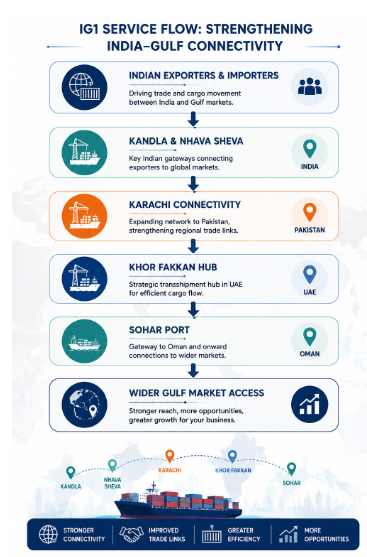
- Service rotation: Kandla → Nhava Sheva → Karachi → Khor Fakkan → Sohar → Kandla
Revised IG1 Service Rotation
The reinstated route will follow the rotation:
Kandla → Nhava Sheva → Karachi → Khor Fakkan → Sohar → Kandla
India–Gulf Shipping Connectivity
Why the IG1 Service Matters
The reinstatement comes as shipping lines continue to adjust regional networks to meet changing cargo flows and improve connections between major trade markets.
Adding Karachi and Sohar expands the geographical coverage of the IG1 service beyond its India–Gulf links. The revised rotation provides a direct network connecting major ports across the western Indian subcontinent and the Gulf.
For freight forwarders and shippers, additional service options can support better routing flexibility, particularly for cargo moving between India, Pakistan, the UAE and Oman.
Area
Potential Impact
Port Connectivity
More direct links between Indian and Gulf ports
Regional Trade
Improved access between India, Pakistan, UAE and Oman
Routing Options
Greater flexibility for exporters and importers
Container Shipping
Additional regional vessel capacity
Freight Forwarding
More options for shipment planning and consolidation
Supply Chains
Stronger maritime connectivity across the region
What Does the 2,500-TEU Deployment Mean?
The deployment of three vessels of around 2,500 TEU indicates a regional container service designed to handle regular cargo flows across the Indian subcontinent and Gulf markets.
For shippers, vessel capacity is particularly relevant because available container slots can influence booking flexibility, transit planning and freight network options.
The reinstated IG1 service could give freight forwarders additional options when planning shipments between India and Gulf destinations.
Key opportunities include:
- More routing choices for India–Gulf cargo
- Improved connectivity with Oman and Pakistan
- Additional options for container bookings
- Greater flexibility when planning multimodal shipments
- Potentially stronger regional consolidation opportunities
- Easier access to multiple Gulf gateways
For freight forwarders, exporters and importers, the expanded rotation could offer greater flexibility, broader port coverage and stronger regional supply-chain connectivity.
FAQs
What is the India Gulf (IG1) service?
The India Gulf (IG1) is a regional container shipping service connecting ports in India with destinations in the Gulf region. The reinstated service will also include Karachi and Sohar in its rotation.
Which ports are included in the revised IG1 rotation?
The revised rotation is Kandla, Nhava Sheva, Karachi, Khor Fakkan and Sohar, before returning to Kandla.
Which shipping companies operate the IG1 service?
The service is jointly operated by Greta Shipping and Hapag-Lloyd.
How many vessels will operate the service?
The reinstated service will operate with three vessels, each with a capacity of approximately 2,500 TEU.
Which countries will the service connect?
The revised network will strengthen maritime links between India, Pakistan, the UAE and Oman.
Why is the addition of Sohar important?
Sohar provides connectivity with Oman’s growing industrial and logistics ecosystem and gives shippers another Gulf gateway for regional cargo movements.