
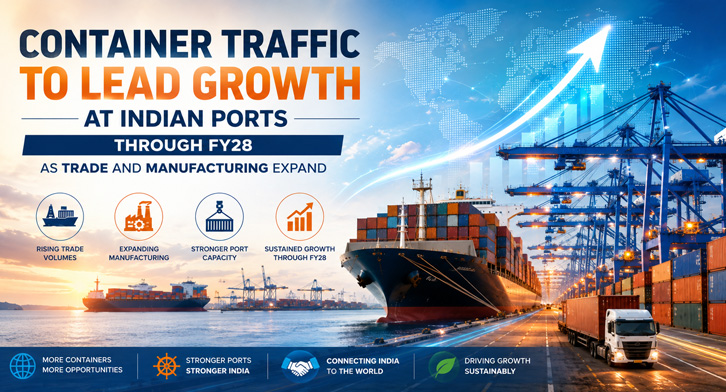
India’s maritime sector is set for another phase of strong expansion, with container cargo expected to become the fastest-growing segment at Indian ports through FY28, according to the latest report by Motilal Oswal. Rising domestic consumption, expanding manufacturing, growing exports, and improved logistics infrastructure are expected to fuel container traffic growth significantly above other cargo categories.
The report projects that container volumes at Indian ports will grow at a CAGR of 7%–9% between FY26 and FY28, supported by higher containerisation of cargo, government-led infrastructure development, and increasing multimodal connectivity across the country.
As India continues investing in ports, dedicated freight corridors, inland logistics networks, and multimodal transport systems, the maritime industry is expected to strengthen its position as a key pillar of the country’s economic growth and global supply chain competitiveness.
Key Highlights
- Container traffic expected to grow at 7–9% CAGR (FY26–FY28)
- Container cargo projected to be the fastest-growing cargo segmentB
- Iron ore cargo expected to increase by 5–7% CAGR
- POL cargo likely to grow at 2–4% CAGR
- Coal cargo expected to decline by 2–4% CAGR
- Major ports handled 915 Million Metric Tonnes (MMT) in FY2025-26
- Overseas cargo increased 6.6%
- Coastal cargo increased 8%
- Government infrastructure investments continue to strengthen maritime logistics
Indian Port Traffic Forecast (FY26–FY28)
Cargo Segment
Expected CAGR
Growth Outlook
Major Growth Driver
Container Cargo
7–9%
Strong Growth
Manufacturing, exports, containerisation
Iron Ore
5–7%
Positive
Coastal steel demand, imports
Petroleum, Oil & Lubricants (POL)
2–4%
Moderate
Stable fuel demand
Coal
-2% to -4%
Declining
Stable fuel demandHigher domestic coal production, renewable energy
Why Container Traffic Will Drive Indian Port Growth
Container cargo is becoming the backbone of India’s maritime trade due to several structural changes in the economy.
1. Manufacturing Expansion
Government initiatives encouraging domestic manufacturing continue to increase the movement of finished goods through containers.
2. Growing Merchandise Trade
Higher exports and imports are creating sustained demand for container shipping services across major Indian ports.
3. Better Logistics Infrastructure
Expansion of highways, rail freight corridors, logistics parks, and multimodal transport networks is improving cargo movement efficiency.
4. Higher Containerisation
Industries are increasingly shifting from bulk cargo to containerised transportation due to improved safety, lower losses, and greater operational efficiency.
Cargo Segment Outlook
Container Cargo
Container traffic is expected to remain the strongest-performing cargo segment over the next three years, driven by expanding industrial production, retail demand, and international trade.
Coal
Coal cargo volumes are forecast to decline as India reduces import dependence through increased domestic coal production while accelerating renewable energy adoption. However, coastal coal transportation is expected to remain relatively stable.
Petroleum, Oil & Lubricants (POL)
POL cargo is projected to witness moderate growth as fuel demand remains stable. Growth may be partially offset by better fuel efficiency and increasing adoption of cleaner energy sources.
Iron Ore
Iron ore cargo is expected to recover steadily due to stronger coastal movement to domestic steel plants and increased imports resulting from elevated domestic ore prices.
FY2025–26 Performance Strengthens Growth Outlook
India’s major ports recorded robust cargo handling during FY2025-26, laying a strong foundation for future growth.
Performance Indicator
FY2025-26
Total Cargo Handled
915 Million Metric Tonnes
Overall Cargo Growth
7% YoY
Overseas Cargo Growth
6.60%
Coastal Cargo Growth
8%
The continued expansion reflects stronger trade activity, infrastructure improvements, and increasing logistics efficiency across India’s port ecosystem.
Market Outlook
India’s ports sector is entering a period of sustained long-term growth, with container traffic expected to remain the primary driver through FY28. Government investments in multimodal connectivity, port modernization, and logistics infrastructure are improving cargo efficiency while supporting manufacturing and export growth. As containerisation continues to increase across industries, Indian ports are expected to strengthen their role in global supply chains and contribute significantly to India’s ambition of becoming a leading global logistics and maritime hub.
Key Takeaways
- Container cargo will be the fastest-growing segment through FY28.
- Manufacturing and exports will continue driving port volumes.
- Iron ore traffic is expected to recover steadily.
- Coal imports may decline due to domestic production and renewable energy.
- India's logistics infrastructure investments are supporting long-term port growth.
- Major ports handled 915 MMT of cargo during FY2025-26.
FAQs
Why is container traffic growing faster at Indian ports?
Container traffic is increasing due to higher manufacturing output, growing exports, rising domestic consumption, and greater adoption of containerised cargo transportation.
Which cargo segment is expected to grow the fastest through FY28?
Container cargo is projected to grow at a CAGR of 7–9%, making it the fastest-growing cargo segment at Indian ports.
Why is coal cargo expected to decline?
Coal traffic is expected to decline because of higher domestic coal production, reduced import dependence, and increasing renewable energy generation.
What was the cargo handled by India's major ports in FY2025-26?
India’s major ports handled approximately 915 million metric tonnes (MMT) of cargo during FY2025-26.
How is the government supporting port sector growth?
The government is investing in port modernization, multimodal logistics, dedicated freight corridors, coastal shipping, and infrastructure projects aimed at reducing logistics costs and improving trade efficiency.