
India and Indonesia have agreed to deepen their Comprehensive Strategic Partnership by expanding bilateral trade through local currency settlements, strengthening maritime security cooperation, and accelerating connectivity initiatives across the Indo-Pacific. The agreement was announced following high-level talks between Prime Minister Narendra Modi and Indonesian President Prabowo Subianto.
The discussions focused on boosting economic resilience, reducing dependence on foreign currencies in bilateral trade, enhancing maritime infrastructure, and promoting regional stability through closer defence and strategic cooperation.
Key Highlights
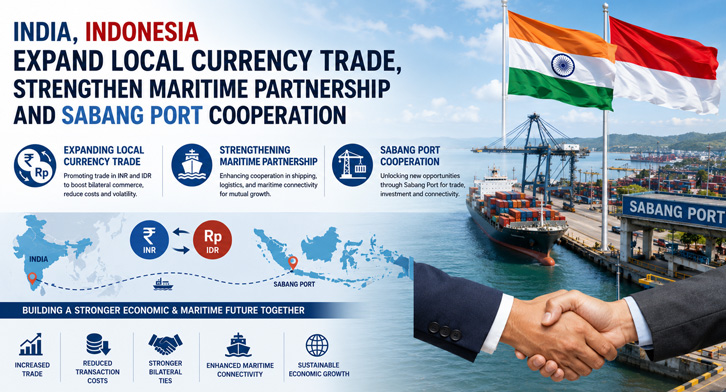
- India and Indonesia to promote trade settlements in national currencies to reduce transaction costs and improve cross-border trade efficiency.
- Joint development of Sabang Port to enhance maritime connectivity near the strategically important Malacca Strait.
- Expanded cooperation in maritime security, defence, shipping, cruise tourism, shipbuilding and energy services.
- Both countries reaffirmed support for UNCLOS, freedom of navigation and peaceful dispute resolution.
- Strong backing for ASEAN Centrality, India's BRICS Presidency, and UN Security Council reforms.
- Agreement to strengthen India-Indonesia-Australia trilateral cooperation in the Indo-Pacific.
- Leaders emphasized safeguarding critical global shipping routes, including the Strait of Hormuz.
- India presented Indonesia with a replica of the historic Nalanda Copper Plate, celebrating centuries-old cultural ties.
- Both leaders will visit the Prambanan Temple restoration project, supported by India.
- President Prabowo accepted Prime Minister Modi's invitation to visit India.
India and Indonesia to Boost Trade Using Local Currencies
India and Indonesia are taking a major step toward making bilateral trade more efficient by encouraging settlements in their respective national currencies. The initiative, currently under discussion between the Reserve Bank of India and Bank Indonesia, is expected to lower foreign exchange costs, reduce currency risks, and simplify trade transactions for businesses operating between the two countries.
The move aligns with India’s broader strategy of promoting international trade using the Indian Rupee while strengthening economic partnerships across Asia.
Sabang Port to Strengthen Maritime Connectivity
A key outcome of the meeting was Indonesia’s positive response to India’s proposal for the joint development of Sabang Port, located near the entrance to the Malacca Strait—one of the world’s busiest maritime trade corridors.
The project is expected to support:
- Regional shipping connectivity
- Cruise tourism development
- Shipbuilding and repair services
- Energy logistics
- Faster connectivity between India's Andaman & Nicobar Islands and Indonesia's Sumatra
The development of Sabang Port could significantly improve regional supply chains while creating new opportunities for maritime trade and logistics.
Maritime Security Remains a Shared Priority
Recognizing growing geopolitical and maritime security challenges, India and Indonesia reaffirmed their commitment to maintaining a free, open and secure Indo-Pacific.
The two nations pledged continued cooperation in:
- Maritime domain awareness
- Naval cooperation
- Freedom of navigation
- Peaceful resolution of maritime disputes
- Compliance with the United Nations Convention on the Law of the Sea (UNCLOS)
Both leaders also stressed the strategic importance of protecting international shipping routes, particularly the Strait of Hormuz, which remains critical for global energy transportation and international commerce.
Stronger Regional and Global Cooperation
India and Indonesia agreed to deepen cooperation on regional and global issues by supporting:
- ASEAN Centrality in regional architecture
- India's BRICS Presidency
- Reform of the United Nations Security Council
- Sustainable development across the Indo-Pacific
The leaders also endorsed stronger trilateral collaboration between India, Indonesia and Australia to enhance regional resilience, economic cooperation and maritime stability.
Celebrating Centuries of Cultural Heritage
Beyond economic and strategic ties, both countries highlighted their deep historical and cultural relationship.
India presented Indonesia with a replica of the Nalanda Copper Plate, dating back to approximately 860 CE, symbolizing centuries of civilizational exchange between the two nations.
Prime Minister Modi and President Prabowo are also scheduled to visit the Prambanan Temple Complex, one of Southeast Asia’s most significant Hindu heritage sites, currently undergoing restoration with Indian support.
Outlook
The latest agreements demonstrate the growing strategic importance of India-Indonesia relations in shaping the future of Indo-Pacific trade, maritime security and regional connectivity.
With initiatives ranging from local currency trade settlements and port development to defence cooperation and cultural diplomacy, both countries are laying the foundation for stronger economic integration and a more resilient regional partnership.
Why This Matters for the Logistics Industry
The announcements have significant implications for logistics, shipping and international trade.
- Lower transaction costs through local currency settlements.
- Increased cargo movement via enhanced maritime connectivity.
- New opportunities for port operators and shipping lines at Sabang Port.
- Stronger India–ASEAN supply chain integration.
- Improved connectivity between the Bay of Bengal and Southeast Asia.
- Greater maritime security supporting uninterrupted global trade.
- Enhanced regional logistics resilience across Indo-Pacific trade routes.
FAQs
Why are India and Indonesia promoting trade in local currencies?
The initiative aims to reduce dependence on third-party currencies, lower transaction costs, minimize exchange rate risks, and make bilateral trade faster and more efficient.
Why is Sabang Port strategically important?
Sabang Port is located near the Malacca Strait, one of the world’s busiest shipping lanes. Its development will improve maritime connectivity, logistics efficiency, tourism, and regional trade between India and Southeast Asia.
How does this agreement benefit the logistics sector?
The partnership is expected to improve port connectivity, facilitate smoother cross-border trade, strengthen maritime security, and create new opportunities for shipping, freight forwarding, and supply chain businesses.
What maritime commitments did India and Indonesia reaffirm?
Both countries reaffirmed their commitment to UNCLOS, freedom of navigation, peaceful dispute resolution, maritime security cooperation, and protecting critical international shipping routes.
Why is the Strait of Hormuz important?
The Strait of Hormuz is one of the world’s most vital energy shipping corridors, carrying a significant share of global oil and LNG exports. Ensuring safe navigation through the strait is essential for global trade and energy security.