All you need to know

Blog - Logistics News

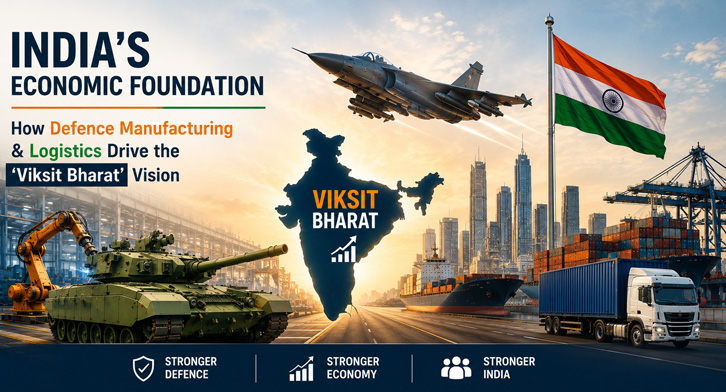
India’s Economic Foundation: How Defence Manufacturing & Logistics Drive the ‘Viksit Bharat’ Vision

India’s ambition to transition into a fully developed nation by 2047—under the foundational banner of Viksit Bharat—is moving away from abstract policy and transforming into a tangible industrial reality. Speaking at the valedictory session of the Vibrant Gujarat Regional Conference (VGRC) in Vadodara, Defence Minister Rajnath Singh emphasized that India’s long-term sovereignty relies on a three-pronged foundation: robust economic growth, technological self-reliance, and uncompromised national security.

What began in 2003 as a state-level investment summit has evolved into a powerhouse of national alignment. The Central Gujarat edition of the conference alone culminated in 3,759 MoUs yielding over ₹3.34 lakh crore in investment commitments, laying down a massive blueprint for India’s upcoming industrial decade.

1. Defence Manufacturing as a Multiplier, Not Just a Shield

Historically, military spending was viewed primarily as an economic drain—a necessary expense for national defense. Today, India’s strategy treats defence manufacturing as a core driver of domestic industrial health.
The government’s aggressive push for Aatmanirbhar Bharat (self-reliance) has systematically expanded local manufacturing ecosystems, reducing critical dependencies on foreign imports while stimulating domestic capital.

The Metric that Matters: Driven by policy overhauls like the Defence Acquisition Procedure (DAP), India’s annual defence production reached an all-time high of ₹1.78 lakh crore in FY 2025–26. Concurrently, defence exports skyrocketed by over 62% in the last fiscal year to hit a record ₹38,424 crore, supplying indigenous hardware to over 80 countries.

This manufacturing surge triggers a massive economic multiplier effect across several domains:

2. Unlocking the Logistics Boom: Connecting Factories to Frontiers
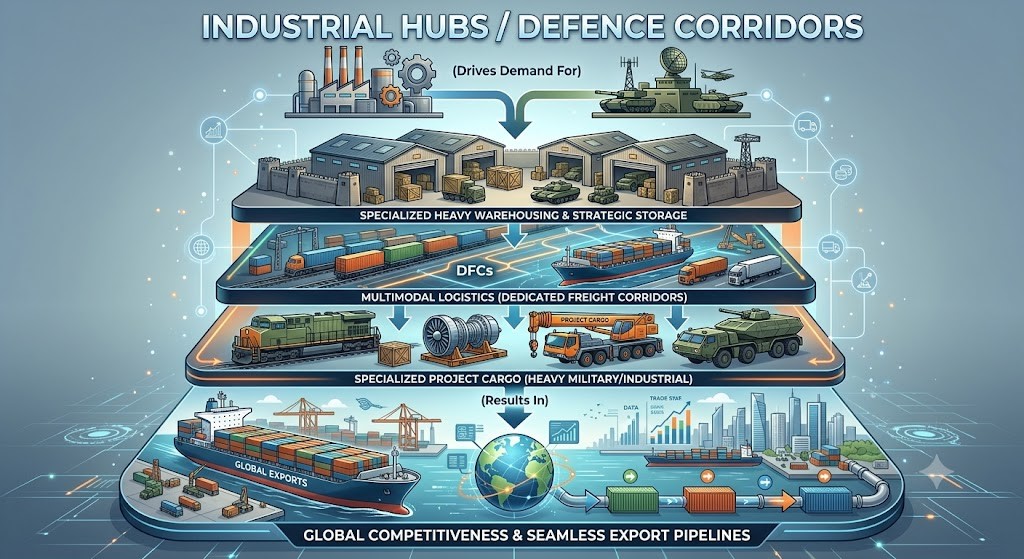
When a nation doubles its domestic industrial output, its physical supply chains must scale accordingly. The growth of major manufacturing hubs—including Central Gujarat’s massive Dholera and Mandal-Becharaji Special Investment Regions—presents an unprecedented growth opportunity for India’s logistics and infrastructure sectors.
As manufacturing scales up, the logistics sector must pivot from traditional retail freight forwarding to handle complex, high-value industrial supply chains. This shift requires immense upgrades in:

Manufacturing Drivers vs. Logistics Demands

Industrial Growth Driver

Logistics Infrastructure Demand

₹38,424 Cr Defence Exports

Advanced port infrastructure, secure cold-chains, and multi-country customs compliance systems.

Dholera & Mandal-Becharaji SIRs

Heavy-haul multimodal rail/road integration via the DMIC corridor to handle high-volume outflows.

Smart GIDC Industrial Estates

Tech-enabled, secure, and strategically located ancillary warehousing hubs for raw components.

3. Technology and Geopolitical Autonomy

The geopolitical realties of 2026 dictate that true national sovereignty is tied directly to technical self-reliance. As global supply chains face ongoing regional disruptions, dependence on foreign intellectual property poses a major national risk.
By reserving 25% of the defence research and development budget for private startups and academia, and running innovation pipelines like iDEX, the government is deliberately anchoring deep-tech R&D within Indian borders. This ensures that the technology powering India’s industrial base remains resilient against global volatility, shaping the modern definition of a developed nation.

FAQs

What are the three pillars of Viksit Bharat?
According to Defence Minister Rajnath Singh, the three interconnected pillars required to build a developed India by 2047 are a strong economy, rapid technological advancement, and robust national security.
Defence manufacturing acts as an economic multiplier. It stimulates domestic industrial production, reduces foreign capital drainage by substituting imports, fosters private sector innovation, creates high-skilled jobs, and integrates local MSMEs into highly technical global supply chains.
The expansion of heavy manufacturing and defense production exponentially increases regional demand for high-capacity freight forwarding, specialized project cargo movement, multimodal port infrastructure, and tech-enabled industrial warehousing.
The VGRC has scaled the ethos of the main global summit down to regional levels. The Central Gujarat edition in Vadodara successfully secured over ₹3.34 lakh crore in investment commitments across heavy industries, pharmaceuticals, green energy, and defense production.
cargonet-logo-icon
Cargonet Cargo Software Logo

Feedback & Reward program

Submit the Feedback and avail the Rewards.

1. Your satisfaction & reliability on CargoNet ?

2. Your Rating on Support & co-ordination team?

3. Satisfaction on the look and feel of CargoNet ?

4. Please specify any 2 best features that you feel more helpful in CargoNet?

5. Please specify any 2 best reports that you are taking on regular basis?

6. Are you using Copy Job option in CargoNet Software?

7. Are you using Automatic DSR (Daily Status Report) Option? It automatically sends reports to customer about the shipment status

8. Are you using Automatic Outstanding Reports option? Period Auto outstanding reminders to customer

9. Any other thoughts to improve in CargoNet? Please share.

* Join our Reward Program by recommending CargoNet (Cash Rewards Awaiting)

“Thanks for your feedback. Our goal is to create the best possible product, support & service, and your thoughts, ideas & suggestions play a major role in helping us identify opportunities to improve.”

Cut AI cost ,
not performance

discover how top Freight Forwarding companies  reduce AI-related expense and speed up operation with CargoNet AI, we will show it how

Share your information for instant access :

Get a Demo Now