
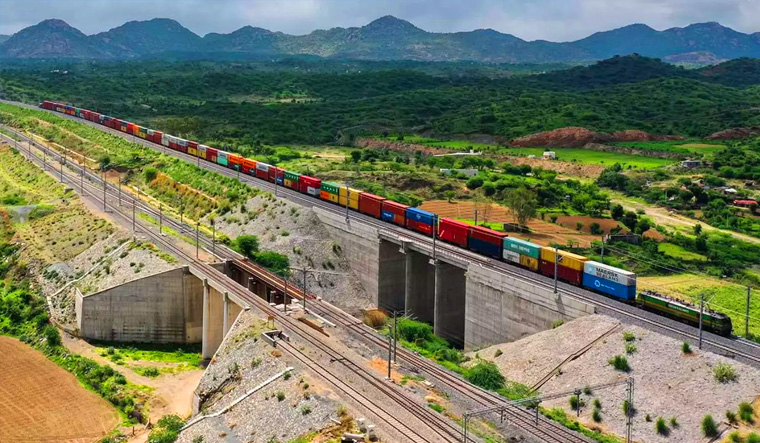
India’s logistics sector is undergoing a major transformation with the rapid development of the Western Dedicated Freight Corridor (WDFC), a 1,506-kilometre freight railway connecting Dadri in Uttar Pradesh to the Jawaharlal Nehru Port Authority (JNPA) near Mumbai. The corridor links some of India’s most important industrial, manufacturing, and agricultural regions with key export gateways, creating a more efficient and reliable freight transportation network.
Designed exclusively for cargo movement, the WDFC is helping reduce transit times, lower logistics costs, and improve supply chain efficiency across multiple industries.
Faster and More Efficient Freight Movement
Unlike conventional rail routes where freight trains share tracks with passenger services, the WDFC operates on dedicated freight lines. This allows trains to run at speeds of up to 100 km/h, compared to the average freight train speed of around 25 km/h on traditional routes.
The corridor also supports double-stacked container trains, significantly increasing cargo capacity while improving operational efficiency. These advantages are enabling businesses to move goods faster and more predictably across the country.
Benefits for Key Industries
The impact of the WDFC is being felt across several sectors. Textile manufacturers in Gujarat, Rajasthan, and Punjab are benefiting from quicker access to major ports such as Mundra and JNPA. Automotive and engineering companies in Haryana and Uttar Pradesh are leveraging lower transportation costs, while agricultural exporters are moving products such as cotton, spices, and pulses more efficiently to global markets.
The pharmaceutical sector is also exploring the corridor’s potential for handling time-sensitive export shipments, supported by improved transit reliability.
Reducing Logistics Costs and Boosting Competitiveness
India’s logistics costs currently account for approximately 13–14% of GDP, significantly higher than the global average of around 8%. By improving freight efficiency and reducing transportation delays, the WDFC is expected to help lower logistics costs and enhance the competitiveness of Indian exporters.
The corridor plays a central role in the government’s PM GatiShakti initiative, which aims to create an integrated, multimodal infrastructure network to support economic growth and trade expansion.
Encouraging Private Sector Innovation
The WDFC is also creating new opportunities for logistics service providers. Recently, logistics technology company Zipaworld Innovation Pvt. Ltd. launched a dedicated warehouse-stuffed full-train service connecting Haryana’s ICD Dhirpur to Mundra Port. The service integrates warehousing, cargo handling, and rail transportation into a single logistics solution, demonstrating how private players are building value-added services around the freight corridor.
Building the Backbone of India's Export Network
Alongside the Eastern Dedicated Freight Corridor (EDFC), the WDFC is set to become a critical pillar of India’s multimodal logistics infrastructure. Together, these corridors will improve connectivity between industrial centers and major ports on both coasts, supporting the country’s ambitions to expand merchandise exports and strengthen its position in global supply chains.
Key Highlights:
- The 1,506-km Western Dedicated Freight Corridor (WDFC) connects Dadri to JNPA near Mumbai.
- Dedicated freight tracks enable train speeds of up to 100 km/h.
- Dedicated freight tracks enable train speeds of up to 100 km/h.
- Textile, automotive, agriculture, and pharmaceutical sectors are among the major beneficiaries.
- The corridor helps reduce logistics costs and improve supply chain reliability.
- WDFC is a key component of the PM GatiShakti infrastructure initiative.
- Private logistics companies are developing innovative end-to-end freight solutions.
- The WDFC and EDFC together will strengthen India's multimodal transport network.
- The project supports India's long-term goals of boosting exports and enhancing global competitiveness.