
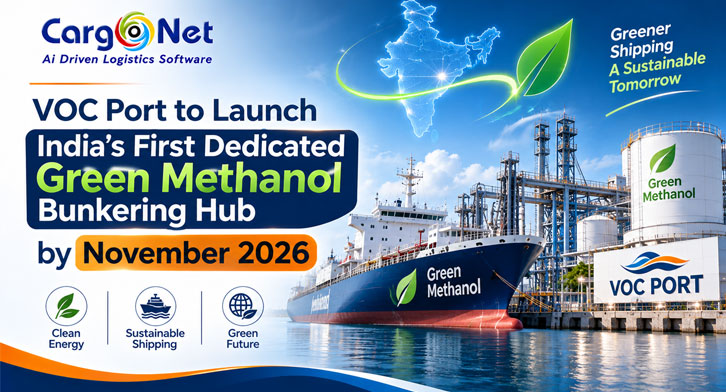
India is preparing to enter a new phase of sustainable maritime operations as V.O. Chidambaranar (VOC) Port in Thoothukudi, Tamil Nadu, gets ready to operationalise the country’s first dedicated green methanol bunkering facility by the end of November 2026. The project is expected to strengthen India’s alternative marine fuel infrastructure and position the port as a potential green bunkering destination for international shipping lines.
Inaugurated by Prime Minister Narendra Modi on October 11, 2026, the facility represents an important development in India’s efforts to reduce emissions from maritime transportation. According to a report by Deccan Chronicle, the port is targeting commercial operations by November-end, subject to the completion of safety arrangements, statutory requirements and operational preparations.
VOC Port Green Methanol Bunkering Hub: Infrastructure and Capacity
The new green methanol bunkering hub has been designed to receive, store and transfer alternative marine fuel to methanol-powered vessels. Its infrastructure includes dedicated storage tanks, a stainless-steel pipeline and specialised transfer equipment to facilitate ship bunkering operations.
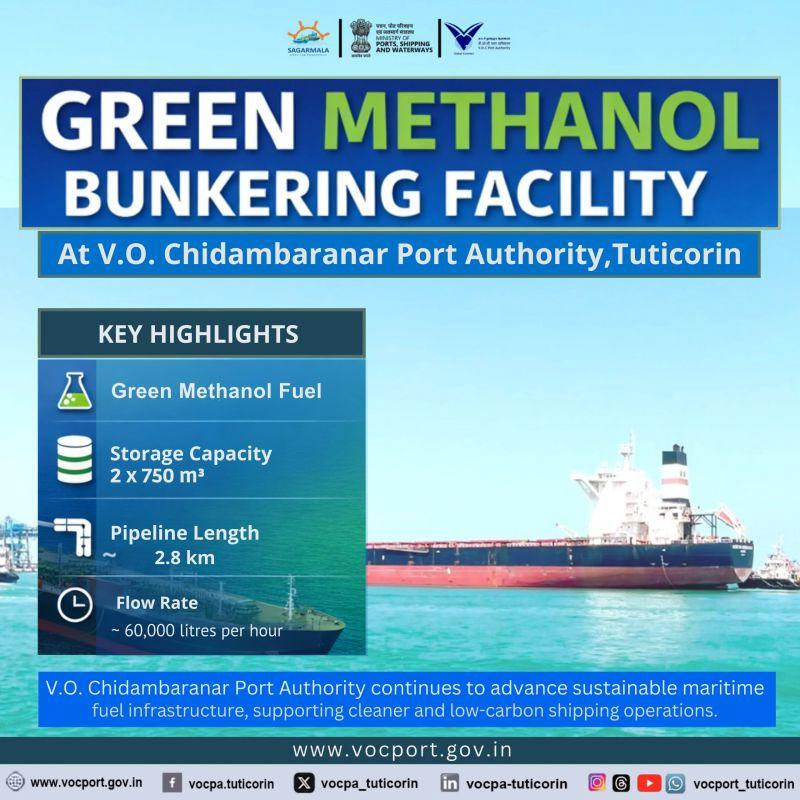
The facility has a total storage capacity of 1,500 cubic metres (m³), divided between two tanks of 750 m³ each. A 2.8-kilometre stainless-steel pipeline connects the storage installation to the jetty bunkering point, enabling green methanol received through road tankers or vessels to be transferred to ships.
According to Maritime Gateway, the project also includes two transfer pumps, each with a handling capacity of 120 m³ per hour, alongside automated controls and safety infrastructure.
Important infrastructure specifications:
- Total storage capacity: 1,500 m³.
- Storage tanks: Two tanks of 750 m³ each.
- Pipeline connectivity: 2.8 km stainless-steel pipeline.
- Transfer pumps: Two pumps with 120 m³/hour capacity each.
- Fuel transportation: Green methanol can be received through road tankers or vessels.
- Safety systems: Automated controls, remotely operated valves, emergency shutdown arrangements and dedicated fire protection systems.
- Expected commercial launch: End of November 2026.
Project Investment and Government Support
The green methanol bunkering project is being implemented under India’s National Green Hydrogen Mission, with financial support of ₹35.34 crore from the Ministry of New and Renewable Energy (MNRE).
The Ministry of Ports, Shipping and Waterways has designated VOC Port Authority as the System Implementing Agency for the project.
The investment highlights India’s growing focus on developing infrastructure for alternative marine fuels, supporting the transition towards lower-emission shipping and strengthening the country’s maritime energy ecosystem.
According to Ship & Bunker, the facility is expected to support India’s efforts to develop green marine fuel infrastructure and attract vessels adopting methanol as an alternative fuel.
Why Thoothukudi Is Strategically Important for Green Methanol Bunkering
VOC Port’s geographical location provides a significant advantage for international maritime fuel services. Situated close to the East-West international shipping route, the port has the potential to serve vessels beyond those making regular cargo calls at Thoothukudi.
According to estimates cited by VOC Port Authority, nearly 80% of cargo vessels operating along the East-West international shipping route pass within 130 nautical miles of Thoothukudi.
The port’s position along the Rotterdam–Thoothukudi–Singapore maritime corridor could help attract international shipping operators looking for alternative marine fuel supplies.
This connectivity could create opportunities for VOC Port to develop additional bunkering business, increase maritime activity and strengthen its position in India’s international shipping network.
Project Status and Upcoming Operational Milestones
Although the facility was inaugurated in October 2026, commercial bunkering has not yet commenced. VOC Port Authority is completing the necessary safety preparations, statutory formalities and trial operations before opening the facility for commercial fuel supply.
The port has also issued an Expression of Interest (EoI) to identify a suitable commercial bunkering operator.
The upcoming operational milestones include:
1. Completion of safety and statutory requirements
Safety systems and statutory approvals must be finalised before commercial supply can begin.
2. Trial bunkering and operational readiness checks
The facility will undergo trial operations to confirm readiness.
3. Selection of a suitable bunkering operator
An Expression of Interest has been issued to identify a commercial operator.
4. Commencement of commercial green methanol supply
Targeted for November-end 2026.
The actual commercial launch will depend on completion of the remaining approvals and operational arrangements.
Key Project Statistics
Parameter
Project Details
Port
V.O. Chidambaranar Port
Location
Thoothukudi, Tamil Nadu
Facility
Green Methanol Bunkering Hub
Total investment support
₹35.34 crore
Total storage capacity
1,500 m³
Number of storage tanks
2
Individual tank capacity
750 m³
Pipeline length
2.8 km
Transfer pumps
2
Capacity per pump
120 m³/hour
Inauguration date
October 11, 2026
Target commercial launch
November 2026
How the Green Methanol Bunkering Hub Will Work
The facility will follow an integrated fuel storage and transfer process:
1. Fuel reception
Green methanol arrives through road tankers or vessels.
2. Storage
The fuel is stored in two dedicated tanks with a combined capacity of 1,500 m³.
3. Pipeline transfer
A 2.8 km stainless-steel pipeline connects the storage facility to the jetty.
4. Ship bunkering
Transfer pumps facilitate the supply of methanol to compatible vessels.
This infrastructure will allow VOC Port to develop dedicated marine fuel supply services for vessels equipped to operate on methanol.
What This Means for India’s Green Shipping Industry
The development of India’s first dedicated green methanol bunkering hub is an important step towards diversifying the country’s marine fuel infrastructure.
As shipping companies explore alternatives to conventional fossil-based marine fuels, ports with reliable alternative fuel storage and bunkering facilities could gain a competitive advantage.
For India’s maritime sector, the VOC Port project could create several opportunities:
- Alternative fuel infrastructure: Expands India’s capacity to handle green marine fuels.
- International shipping connectivity: Creates opportunities to serve methanol-capable vessels operating along major trade routes.
- Port competitiveness: Strengthens VOC Port’s potential as an alternative marine fuel supply destination.
- Industrial investment: Could encourage investments in green methanol production, storage and distribution.
- Maritime decarbonisation: Supports India’s broader efforts to reduce emissions from shipping.
Green methanol’s environmental benefits depend on how it is produced. Methanol manufactured using renewable hydrogen and sustainably sourced carbon can offer lower lifecycle greenhouse gas emissions compared with conventional fossil-based marine fuels.
The VOC Port development therefore represents more than an additional fuel storage facility. It provides an important foundation for India’s emerging green maritime fuel supply chain.
Frequently Asked Questions
Where is India’s first dedicated green methanol bunkering hub being developed?
India’s first dedicated green methanol bunkering hub is located at V.O. Chidambaranar Port in Thoothukudi, Tamil Nadu.
What is the storage capacity of the VOC Port green methanol facility?
The facility has a total storage capacity of 1,500 m³, comprising two storage tanks of 750 m³ each.
How much funding has been allocated to the green methanol bunkering project?
The project has received ₹35.34 crore in financial support from the Ministry of New and Renewable Energy under the National Green Hydrogen Mission.
When will the VOC Port green methanol bunkering facility begin commercial operations?
Commercial operations are targeted for the end of November 2026, subject to completion of statutory approvals, safety preparations and operational arrangements.
Why is VOC Port strategically important for green methanol bunkering?
Its proximity to the East-West international shipping route and the Rotterdam–Thoothukudi–Singapore maritime corridor provides opportunities to serve international methanol-powered vessels.
How will the green methanol be transported to ships?
The facility will receive green methanol through road tankers or vessels and transfer it to ships through dedicated storage infrastructure, pumps and a 2.8 km stainless-steel pipeline.