
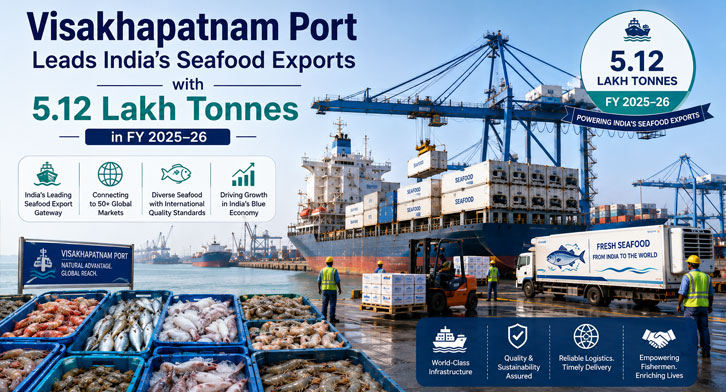
Visakhapatnam Port has emerged as India’s leading seafood export gateway, handling a record 5.12 lakh metric tonnes of marine products during FY 2025–26. The port accounted for more than 26% of India’s total seafood export volume of 19.32 lakh metric tonnes, according to data from the Marine Products Export Development Authority (MPEDA).
The performance reinforces Visakhapatnam’s importance in India’s marine export supply chain, supported by its proximity to a major aquaculture production belt, expanding cold-chain capabilities and improved systems for export traceability and compliance.
Key Highlights
- 5.12 lakh MT of seafood was handled through Visakhapatnam Port in FY 2025–26.
- The port accounted for more than 26% of India’s total seafood export volume.
- India exported 19.32 lakh MT of seafood during the financial year.
- Jawaharlal Nehru Port ranked second with 3.28 lakh MT.
- Kochi Port handled 1.83 lakh MT, supported largely by value-added marine products.
- Kolkata Port recorded 1.44 lakh MT, with Black Tiger shrimp among its key export commodities.
- India’s seafood export value reached a record ₹72,325.82 crore ($8.28 billion) in FY 2025–26.
- Exporters increasingly shifted their focus towards European and Chinese markets amid changing trade conditions in the US market.
Visakhapatnam Strengthens Its Seafood Export Hub Position
Visakhapatnam’s leading position reflects the growing importance of integrated logistics infrastructure in supporting India’s seafood exports.
The port benefits from a strong aquaculture ecosystem in Andhra Pradesh and surrounding regions. This provides exporters with access to large volumes of seafood close to the production source, while established cold-chain infrastructure helps preserve product quality during transportation and port handling.
The rollout of the National Traceability Framework in 2025 has further strengthened compliance and shipment visibility. Traceability is particularly important for exporters targeting markets with stringent food safety, quality and documentation requirements, including the European Union and China.
For temperature-sensitive marine products, efficient movement from farms and processing facilities to refrigerated storage and eventually to the port is critical. Improvements across this cold-chain network can help reduce transit losses and improve the reliability of export shipments.
India’s Leading Seafood Export Ports
Port
Seafood Volume FY 2025–26
Key Export Strength
Visakhapatnam Port
5.12 lakh MT
Aquaculture, seafood and cold-chain logistics
Jawaharlal Nehru Port
3.28 lakh MT
Major West Coast export gateway
Kochi Port
1.83 lakh MT
Value-added marine products
Kolkata Port
1.44 lakh MT
Black Tiger shrimp exports
The leading ports together handled a substantial share of India’s seafood trade, highlighting the concentration of marine export activity around strategically located port and logistics hubs.
Seafood Export Markets Undergo a Shift
India’s seafood exporters also experienced a change in destination markets during FY 2025–26.
According to the figures provided, seafood export value to the United States declined by 14.5%, with reciprocal tariff measures contributing to pressure on shipments. In response, exporters operating through Visakhapatnam increasingly looked towards alternative markets.
Exports to the European Union grew by 37.9%, while shipments to China increased by 22.7%. The shift highlights the growing importance of market diversification for India’s seafood exporters.
For logistics operators, changing trade lanes can influence container demand, reefer movements, shipping schedules, port utilisation and cold-chain requirements.
Why Visakhapatnam Matters to India’s Seafood Logistics
The port’s performance demonstrates how production clusters, processing infrastructure, cold storage, traceability and maritime connectivity can work together to strengthen an export supply chain.
The seafood logistics chain can be represented as:

An efficient connection between these stages is particularly important for seafood because delays or temperature fluctuations can affect product quality, shelf life and export value.
Logistics Implications for Exporters
The rise in seafood volumes through Visakhapatnam could create additional demand for:
- Reefer container capacity
- Temperature-controlled warehouses
- Cold-chain transportation
- Port-based refrigerated handling
- Export documentation and compliance services
- Real-time shipment visibility
- Faster customs and cargo clearance
- Multimodal connectivity between aquaculture clusters and ports
The increasing use of traceability systems also means exporters and logistics providers will need stronger coordination between production, processing, documentation and shipment data.
Record Seafood Export Value Signals Growth Potential
India’s seafood exports reached ₹72,325.82 crore ($8.28 billion) in FY 2025–26, marking a record export value.
While volume remains an important indicator, the growing contribution of processed and value-added marine products could help exporters increase realisations. Ports with strong cold-chain infrastructure, specialised handling capabilities and access to international shipping services are likely to benefit from this trend.
Visakhapatnam’s combination of a strong aquaculture hinterland and established marine logistics infrastructure gives it a strategic advantage in this evolving export landscape.
Outlook: Cold-Chain Strength and Market Diversification Could Drive Further Seafood Export Growth
Visakhapatnam Port is well positioned to remain a major gateway for India’s seafood exports as exporters diversify destination markets and demand for quality-controlled marine products increases.
Continued investment in cold-chain infrastructure, traceability, processing capacity, port connectivity and reefer logistics could further strengthen the port’s role in India’s seafood export ecosystem.
At the same time, expanding access to markets beyond the United States could help Indian exporters build a more diversified and resilient international trade network.
Frequently Asked Questions
Which is India's leading seafood export port?
Visakhapatnam Port was India’s leading seafood export gateway in FY 2025–26 based on the reported volume, handling 5.12 lakh metric tonnes.
How much seafood did India export in FY 2025–26?
India exported approximately 19.32 lakh metric tonnes of seafood during FY 2025–26.
How much seafood did Visakhapatnam Port handle?
Visakhapatnam Port handled 5.12 lakh metric tonnes of seafood during FY 2025–26.
Which ports ranked behind Visakhapatnam?
Jawaharlal Nehru Port ranked second with 3.28 lakh MT, followed by Kochi Port with 1.83 lakh MT and Kolkata Port with 1.44 lakh MT.
What was India's seafood export value in FY 2025–26?
India’s seafood export value reached ₹72,325.82 crore, equivalent to approximately $8.28 billion.
Why is Visakhapatnam important for seafood exports?
Its strategic importance comes from its proximity to a major aquaculture region, established seafood-processing ecosystem, cold-chain infrastructure and maritime export connectivity.
Which international markets are becoming more important for Indian seafood exporters?
The European Union and China are becoming increasingly important destination markets, with the reported data showing significant growth in exports to both regions during FY 2025–26.