
New China-West India service adds direct calls at Nhava Sheva, Hazira and Mundra
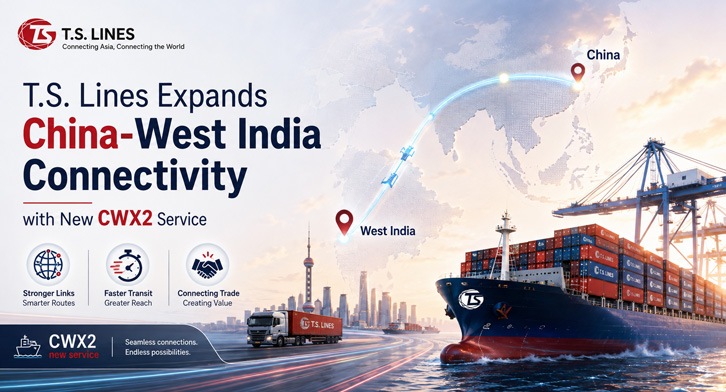
T.S. Lines has strengthened its China–India shipping network with the launch of its China-West India Express 2 (CWX2) service, introducing a more direct connection between major Chinese ports and key gateways on India’s west coast.
The new service made its first call at Hazira on August 5–6, 2026, with the T.S. Lines vessel ESL Dachan Bay handling a parcel exchange of 3,103 TEUs during its stay. T.S. Lines (India) Pvt. Ltd., the carrier’s local agent, marked the occasion by felicitating the vessel’s Master and crew.
Key Highlights
- CWX2 provides a direct China-West India shipping connection.
- The service covers major ports in East and South China and key gateways in western India.
- Nhava Sheva, Hazira and Mundra are included in the India port rotation.
- Hazira has received its first T.S. Lines service call under the new network.
- The service operates on a 42-day rotation.
- The routing is designed to reduce dependence on transhipment hubs and improve schedule efficiency.
- CWX2 complements T.S. Lines’ existing Indian Subcontinent network.
CWX2 Port Rotation
Sequence
Port
1
Shanghai, China
2
Ningbo, China
3
Shekou, China
4
Port Klang (West), Malaysia
5
Nhava Sheva, India
6
Hazira, India
7
Mundra, India
8
Port Klang (West), Malaysia
9
Shanghai, China
The 42-day rotation creates a streamlined loop linking China’s major manufacturing and export centres with three important West India gateways before returning through Port Klang to Shanghai.
Why the CWX2 Service Matters
China remains a major source of cargo for India, particularly for industrial equipment, electronics, machinery, components, chemicals and consumer products. A more direct liner connection between Chinese origin ports and West India can provide shippers with additional options for moving cargo into one of India’s most important industrial and consumption regions.
The inclusion of Nhava Sheva, Hazira and Mundra also gives exporters and importers greater flexibility when selecting gateways based on cargo origin, destination, inland connectivity and operational requirements.
For freight forwarders, the additional service option could support more flexible routing decisions and potentially reduce the need to rely on multiple transhipment legs for China-West India movements.
Hazira Gains Greater Connectivity
The maiden CWX2 call at Hazira is particularly significant for the port’s connectivity with international liner networks.
During its August 5–6 call, ESL Dachan Bay exchanged 3,103 TEUs, highlighting the cargo-handling potential associated with the new service.
The direct inclusion of Hazira alongside Nhava Sheva and Mundra gives shippers another West India gateway for international cargo movements and can support supply chains serving Gujarat and surrounding industrial clusters.
Direct Routing Could Improve Transit Efficiency
One of the key features of CWX2 is its relatively streamlined routing structure.
Rather than relying extensively on transhipment hubs, the service directly links major Chinese loading ports with West Indian gateways. This can help simplify routing for suitable cargo and potentially improve schedule predictability.
CWX2 Network at a Glance
What It Means for the Logistics Industry
The new service could have wider implications for the China-India supply chain:
- Freight forwarders: An additional direct service can expand routing and carrier-selection options.
- Importers: More gateway choices can help optimise inland transportation based on cargo destination.
- Exporters: Direct connectivity can support smoother access to Chinese markets.
- Ports: Additional liner services can strengthen cargo connectivity and gateway competitiveness.
- Transport operators: Increased container flows can generate demand for first- and last-mile movement around West India ports.
- Supply-chain planners: Multiple West India gateways can provide greater flexibility when managing capacity, schedules and inland delivery.
T.S. Lines' Indian Subcontinent Networ
CWX2 is positioned as a complement to T.S. Lines’ existing Indian Subcontinent services rather than an isolated route addition.
By adding another China-West India connection, the carrier is seeking to improve service frequency, routing flexibility and network resilience as China-India trade volumes continue to develop.
For shippers, the growing choice of direct services can become particularly important when supply chains face vessel delays, port congestion, capacity constraints or disruption at transhipment hubs.
Stronger China–West India Connectivity as T.S. Lines Launches CWX2 Service
The launch of T.S. Lines’ CWX2 service adds another direct shipping link between China and India’s strategically important West Coast.
With calls at Nhava Sheva, Hazira and Mundra, the service expands gateway choices while creating a more streamlined China-West India routing. Its maiden Hazira call and 3,103-TEU parcel exchange also underline the growing importance of West India’s ports in China-India container trade.
For the logistics sector, the development is significant not simply because it adds another liner service, but because greater direct connectivity can give shippers and freight forwarders more flexibility in managing transit times, port selection and supply-chain resilience.
Frequently Asked Questions
What is the T.S. Lines CWX2 service?
CWX2, or China-West India Express 2, is a T.S. Lines service connecting major ports in China with key West India gateways.
Which Indian ports are covered by CWX2?
The India rotation includes Nhava Sheva, Hazira and Mundra.
What is the CWX2 port rotation?
The rotation is Shanghai → Ningbo → Shekou → Port Klang (West) → Nhava Sheva → Hazira → Mundra → Port Klang (West) → Shanghai.
How long is the CWX2 rotation?
The service operates on a 42-day rotation.
What happened during the first CWX2 call at Hazira?
T.S. Lines vessel ESL Dachan Bay made its maiden call at Hazira on August 5–6, 2026, handling a parcel exchange of 3,103 TEUs.
Why is the new service important for India-China trade?
CWX2 provides a more direct connection between major Chinese ports and West India, giving importers, exporters and freight forwarders additional routing and gateway options.