
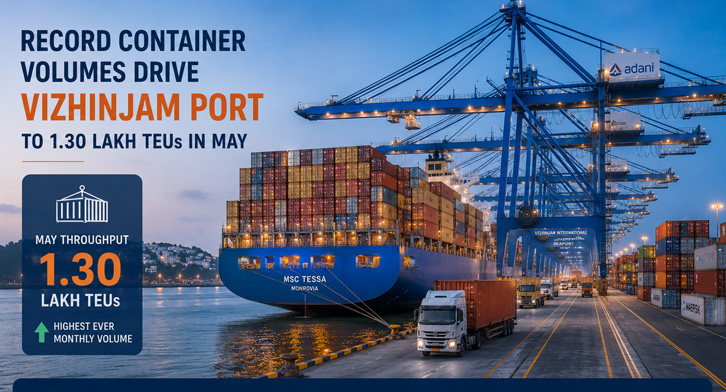
The Adani-operated Vizhinjam International Seaport in Kerala has achieved a significant milestone by recording its highest-ever monthly container throughput. In May 2026, the port handled 130,863 TEUs (Twenty-foot Equivalent Units) across 55 vessel calls, surpassing its previous record of 123,000 TEUs set in January 2026.
The achievement underscores Vizhinjam’s rapid emergence as one of India’s leading transshipment hubs and highlights its growing importance in global maritime trade.
Fastest Indian Port to Reach 2 Million TEUs
With its strong performance in May, Vizhinjam Port crossed the landmark cumulative volume of 2 million TEUs within just 18 months of commencing trial operations.
This makes Vizhinjam the fastest Indian port to achieve the 2-million-TEU milestone, reflecting strong market acceptance and increasing vessel traffic from major international shipping lines.
The rapid growth demonstrates the port’s ability to attract large-scale transshipment cargo and compete with established regional hubs.
High Operational Efficiency Drives Growth
A key factor behind Vizhinjam’s success has been its consistently high operational productivity.
The port maintained:
- More than 30 crane moves per hour.
- Efficient vessel turnaround times.
- High berth productivity levels.
- Reliable cargo handling performance.
These operational efficiencies have enabled the port to handle increasing cargo volumes while maintaining world-class service standards.
Strategic Location Enhances Global Connectivity
Vizhinjam’s competitive advantage lies in its strategic location near one of the world’s busiest maritime trade routes.
Key geographical advantages include:
- Located just 10 nautical miles from the main East-West international shipping corridor.
- Direct access to major global container shipping routes.
- Direct access to major global container shipping routes.
- Enhanced attractiveness for transshipment operations.
The location allows shipping lines to minimize operational costs while improving cargo movement efficiency.
Deep-Water Infrastructure Supports Ultra-Large Container Ships
Vizhinjam Port’s natural deep draft is another major factor contributing to its rapid growth.
Infrastructure Advantages
- Natural water depth of approximately 20 metres.
- Capability to accommodate ultra-large container vessels (ULCVs).
- Reduced dredging requirements.
- High-capacity transshipment infrastructure.
These features enable the port to handle some of the world’s largest container ships, positioning it as a strong alternative to established transshipment hubs such as Colombo and Singapore.
₹16,000 Crore Expansion Project Underway
To support rising cargo volumes and future growth, a major Phase 2 expansion project is currently underway at Vizhinjam Port.
Key Expansion Features
- Investment of ₹16,000 crore.
- Addition of a 1.2-kilometre berth extension.
- Addition of a 1.2-kilometre berth extension.
- Increased vessel accommodation capability.
- Improved operational efficiency and scalability.
The expansion is scheduled for completion by 2028 and is expected to significantly strengthen the port’s position as a global transshipment gateway.
Key Highlights:
- Vizhinjam Port handled a record 130,863 TEUs in May 2026.
- The port serviced 55 vessels during the month.
- The new record surpassed the previous high of 123,000 TEUs achieved in January 2026.
- Vizhinjam crossed 2 million cumulative TEUs within 18 months of trial operations.
- It became the fastest Indian port to reach the 2-million-TEU milestone.
- The port maintained productivity levels exceeding 30 crane moves per hour.
- The port maintained productivity levels exceeding 30 crane moves per hour.
- A ₹16,000 crore Phase 2 expansion project is underway with completion targeted for 2028.