
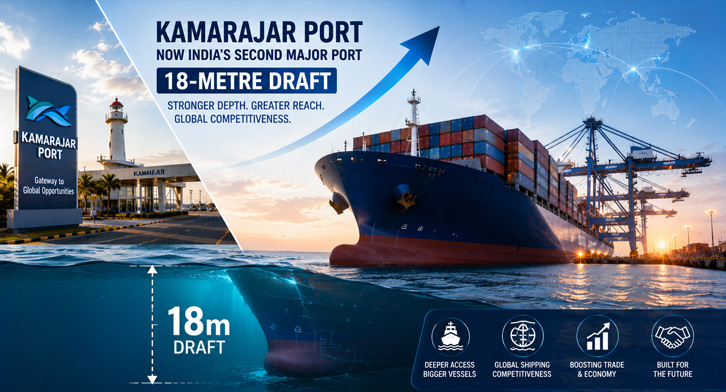
Kamarajar Port has achieved a major milestone in India’s maritime infrastructure development by becoming the country’s second major port with an operational 18-metre draft capability, enabling it to handle fully laden Capesize vessels of up to 170,000 DWT. The development is expected to strengthen India’s position in global shipping, lower logistics costs, and improve export-import (EXIM) trade efficiency.
The achievement follows the successful completion of Capital Dredging Phase VI, a strategic infrastructure project executed under the Government of India’s Maritime India Vision 2030 and Maritime Amrit Kaal Vision 2047, aimed at transforming India into a leading global maritime and logistics hub.
Key Highlights
- Kamarajar Port becomes India's second major port with an 18-metre draft.
- ₹440 crore (Rs.4.4 billion) invested in Capital Dredging Phase VI.
- Outer approach channel deepened from 20 metres to 23 metres.
- Inner entrance channel increased from 19 metres to 22 metres.
- Berths upgraded to accommodate vessels with 18-metre draft.
- Port can now handle fully loaded Capesize vessels up to 170,000 DWT.
- Larger ships will reduce freight costs through economies of scale.
- Improved cargo handling efficiency and faster vessel turnaround.
- Boosts India's EXIM trade and strengthens supply chain competitiveness.
- Positions Kamarajar Port among leading international deep-draft bulk cargo ports.
Kamarajar Port Joins the League of Global Deep-Draft Ports
The dredging project involved widening and deepening the port’s navigational infrastructure, including the outer approach channel, entrance channel, harbour basin, and berth areas.
With an 18-metre operational draft, Kamarajar Port can now receive some of the world’s largest bulk carriers without cargo restrictions. Previously, many Capesize vessels were required to reduce cargo loads before entering Indian ports due to draft limitations.
The new capability enables shipping companies to operate fully laden vessels, improving operational efficiency while reducing transportation costs for exporters and importers.
Major Infrastructure Upgrade Worth ₹440 Crore
The capital dredging project, completed at an investment of approximately ₹440 crore, included:
- Deepening the outer approach channel from 20 metres to 23 metres
- Increasing the inner entrance channel depth from 19 metres to 22 metres
- Upgrading berth depths to support 18-metre draft vessels
- Deepening the harbour basin and associated navigational channels
These upgrades have transformed Kamarajar Port into a Cape Compliant port, capable of accommodating large Capesize bulk carriers carrying commodities such as coal, iron ore, limestone, fertilizers, and other bulk cargo.
Government Highlights Maritime Infrastructure Transformation
Union Minister for Ports, Shipping & Waterways Sarbananda Sonowal described the project as another milestone in India’s maritime transformation under the leadership of Prime Minister Narendra Modi.
According to the Minister, the achievement aligns with the government’s long-term vision of creating world-class ports, improving logistics infrastructure, enhancing ease of doing business, and positioning India as a global maritime powerhouse.
He also congratulated the Kamarajar Port team for successfully delivering the strategically important project that strengthens India’s maritime competitiveness.
Economic Benefits for Trade and Logistics
The enhanced draft offers multiple benefits for India’s logistics ecosystem:
Lower Freight Costs
Shipping companies can deploy larger vessels carrying higher cargo volumes, reducing freight costs through economies of scale.
Improved Cargo Handling
Handling fully loaded Capesize vessels increases cargo throughput while improving port productivity and operational efficiency.
Faster EXIM Movement
Higher vessel capacity and improved navigational infrastructure will support growing export-import volumes and reduce congestion.
Stronger Global Competitiveness
The deep-draft capability makes Kamarajar Port more competitive against leading international bulk cargo ports, attracting larger shipping services and new trade opportunities.
Why This Development Matters
India’s cargo volumes continue to grow alongside manufacturing, energy imports, and exports. Deep-draft ports play a critical role in supporting these requirements by enabling direct calls from large international vessels.
With this upgrade, Kamarajar Port is expected to become a preferred gateway for bulk cargo movement on India’s east coast while supporting the government’s long-term objective of reducing logistics costs and strengthening multimodal connectivity.
As India expands its port infrastructure under the Maritime India Vision 2030, investments in deep-draft capabilities are expected to improve supply chain resilience, attract global shipping lines, and enhance the country’s position in international maritime trade.
FAQs
What is the significance of Kamarajar Port's 18-metre draft?
The 18-metre draft enables Kamarajar Port to accommodate fully loaded Capesize vessels of up to 170,000 DWT, improving cargo capacity, lowering freight costs, and increasing operational efficiency.
How much was invested in the Kamarajar Port dredging project?
The Government of India invested approximately ₹440 crore in Capital Dredging Phase VI to deepen the port’s channels, berths, and harbour basin.
Why is an 18-metre draft important?
A deeper draft allows larger ships to enter the port fully loaded, reducing shipping costs, improving economies of scale, increasing cargo throughput, and enhancing global trade competitiveness.
Which vision supports this project?
The project supports the Government of India’s Maritime India Vision 2030 and Maritime Amrit Kaal Vision 2047, aimed at developing world-class ports and strengthening India’s maritime economy.
How will the upgrade benefit India's EXIM trade?
The deeper draft improves vessel accessibility, reduces logistics costs, increases cargo handling capacity, shortens turnaround times, and strengthens India’s position in global shipping and international trade.