
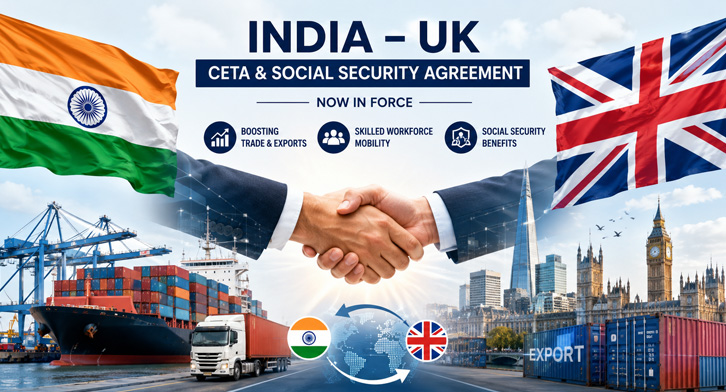
India-UK Trade Relations Enter a New Era
India and the United Kingdom have officially implemented the India-UK Comprehensive Economic and Trade Agreement (CETA) along with the Agreement on Social Security, marking one of the most significant milestones in bilateral economic relations.
The landmark agreements are expected to accelerate bilateral trade, attract new investments, improve market access for Indian exporters, and strengthen workforce mobility between the two countries.
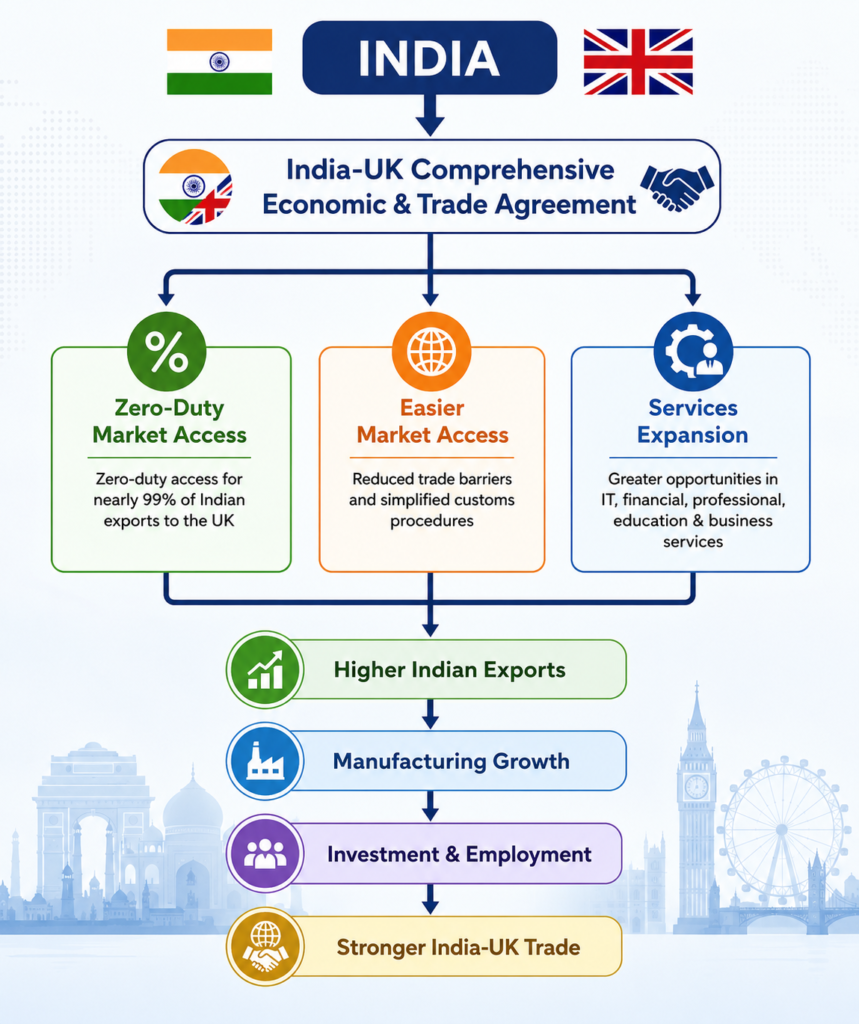
Announcing the development, Union Minister for Commerce & Industry Piyush Goyal said the agreements, concluded under the leadership of Prime Minister Narendra Modi, provide zero-duty access for nearly 99% of India’s exports, covering almost the entire value of bilateral merchandise trade.
Key Highlights
- India receives zero-duty market access for nearly 99% of exports to the UK.
- Covers almost 100% of bilateral trade value.
- Major boost for textiles, leather, engineering, chemicals, agriculture and MSMEs.
- Greater opportunities for IT, financial, education and professional services.
- Social Security Agreement eliminates double social security contributions for eligible Indian professionals working temporarily in the UK.
- Professionals can avoid dual contributions for up to five years.
- Expected to increase bilateral trade, investments and technology partnerships.
- Strengthens long-term India-UK economic cooperation.
India-UK CETA at a Glance
Agreement
Major Benefit
Comprehensive Economic & Trade Agreement (CETA)
Zero-duty access for 99% of Indian exports
Social Security Agreement
Exemption from dual social security payments
Export Coverage
Nearly 100% of trade value
Professional Mobility
Easier movement of skilled Indian professionals
Investment
Increased bilateral investment opportunities
MSMEs
Better access to UK market
Manufacturing
Enhanced export competitiveness
Sectors Expected to Benefit the Most
The trade agreement is expected to generate substantial export opportunities across several high-growth industries.
Sector
Expected Impact
Textiles & Apparel
Higher exports through duty-free access
Leather Products
Improved competitiveness in UK market
Gems & Jewellery
Larger market access
Engineering Goods
Increased manufacturing exports
Marine Products
Better export opportunities
Chemicals
Expanded international trade
Agriculture
Greater market penetration
Processed Food
Stronger export demand
MSMEs
Lower trade barriers
Manufacturing
Improved global competitiveness
Strong Push for India's Services Industry
Apart from merchandise exports, India’s globally competitive services sector is expected to benefit significantly.
Industries likely to witness stronger demand include:
- Information Technology (IT)
- Software Services
- Financial Services
- Education
- Business Consulting
- Professional Services
- Digital Services
The agreement is expected to enhance cross-border service exports while encouraging deeper business collaboration between Indian and British companies.
Social Security Agreement Reduces Employment Costs
A major highlight of the bilateral package is the Agreement on Social Security.
Under this arrangement, Indian professionals temporarily working in the United Kingdom will not have to contribute simultaneously to both Indian and UK social security systems.
Benefits include
- Lower employment costs
- Higher take-home earnings
- Reduced compliance burden
- Improved mobility for skilled professionals
- Better competitiveness for Indian companies operating in the UK
The exemption is applicable for assignments of up to five years, making overseas deployments more cost-effective.
How the Agreement Benefits Indian Exporters
Benefit
Impact
Zero Import Duty
More competitive pricing in UK
Better Market Access
Higher export volumes
Reduced Trade Barriers
Reduced Trade Barriers
Stronger Supply Chains
Improved logistics efficiency
Increased Investments
Manufacturing growth
Export Diversification
Reduced dependence on existing markets
Trade Flow Diagram
Impact on the Logistics and Supply Chain Industry
The implementation of the India-UK CETA is expected to generate higher cargo volumes across multiple logistics segments.
Expected logistics impact
- Growth in containerized exports
- Higher demand for freight forwarding
- Increased air cargo for high-value goods
- Expansion in cold chain logistics for food exports
- Increased customs clearance activities
- Higher warehousing demand
- Stronger multimodal transportation
- Growth in port and shipping operations
Freight forwarders, customs brokers, logistics technology providers and warehousing companies are expected to benefit from increased trade flows between the two countries.
Industry Outlook
The India-UK Comprehensive Economic and Trade Agreement represents a major strategic step toward strengthening economic cooperation between two of the world’s largest economies. By reducing trade barriers, improving market access and facilitating skilled workforce mobility, the agreement is expected to unlock new growth opportunities for exporters, manufacturers, logistics providers and service companies.
As implementation progresses, businesses across sectors are likely to benefit from improved competitiveness, stronger supply chains and expanded international market access, reinforcing India’s position as a key global trading partner.
FAQs
What is the India-UK CETA?
The India-UK Comprehensive Economic and Trade Agreement (CETA) is a bilateral free trade agreement that provides preferential market access, reduces tariffs, promotes investments, and strengthens economic cooperation between India and the United Kingdom.
What percentage of Indian exports receive zero-duty access?
Nearly 99% of India’s exports to the UK will receive zero-duty market access, covering almost 100% of bilateral trade value.
Which sectors benefit the most?
Major beneficiaries include textiles, leather, gems & jewellery, engineering goods, marine products, chemicals, agriculture, processed foods, manufacturing, MSMEs, IT services, financial services, education, and professional services.
What is the benefit of the Social Security Agreement?
Indian professionals temporarily working in the UK are exempt from making double social security contributions for up to five years, reducing costs for both employees and employers.
How will the agreement impact logistics?
The agreement is expected to increase export volumes, boost container traffic, enhance freight forwarding, expand warehousing demand, and strengthen air, sea, and multimodal logistics between India and the UK.