
India’s textile and apparel industry is setting an ambitious target of reaching US$350 billion by 2030, supported by rising domestic consumption, manufacturing investments, export recovery and government-led modernisation initiatives. Valued at approximately US$190 billion in FY2025–26, the sector is looking to strengthen India’s position in the global textile supply chain.
However, rising cotton yarn prices, international trade uncertainty and dependence on major export markets remain important challenges for manufacturers and exporters.
According to a report by Rubix Data Sciences, the industry could nearly double in size by 2030. The latest export figures also indicate improving overseas demand, creating opportunities for Indian textile manufacturers, apparel exporters, freight forwarders and logistics service providers.
India’s Textile Industry: US$350 Billion Growth Ambition
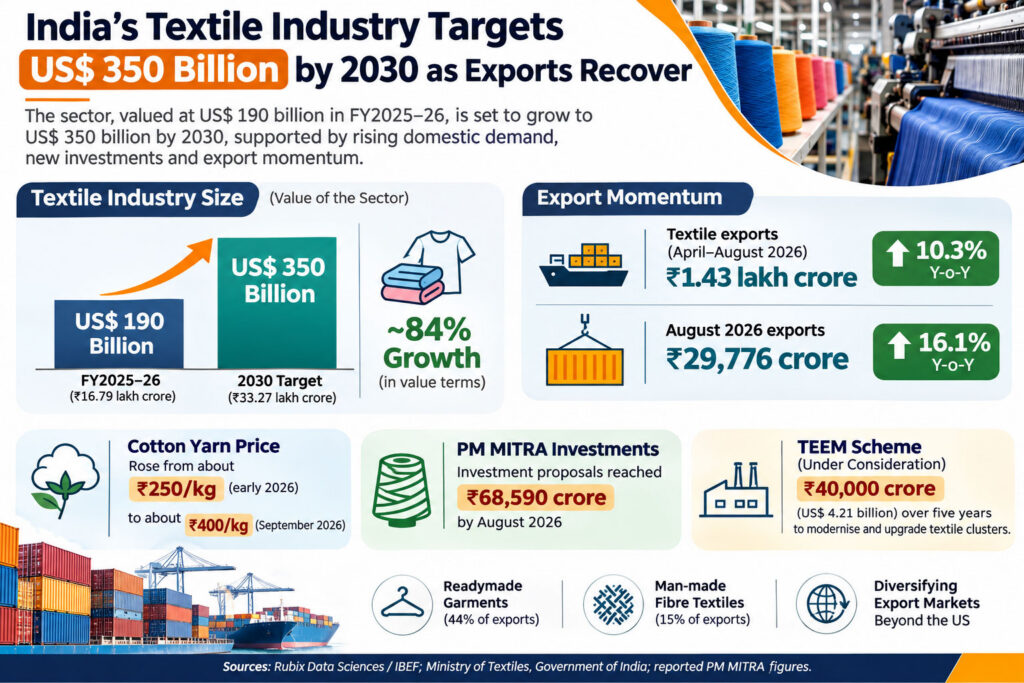
India’s textile industry is targeting growth from approximately US$190 billion in FY2025–26 to US$350 billion by 2030. This expansion is expected to be driven by domestic consumption, investments in manufacturing infrastructure, technological upgrades and increasing access to international markets.
The sector is also an important employment generator, connecting cotton farmers, yarn producers, textile mills, garment manufacturers, exporters and logistics companies.
The proposed five-year Textile Expansion and Employment (TEEM) Scheme, with an estimated allocation of ₹40,000 crore (US$4.21 billion), could provide additional support for modernising machinery, introducing advanced production technologies and upgrading traditional textile clusters.
These investments could help manufacturers improve productivity, reduce production costs and strengthen their competitiveness against major textile-exporting countries.
Textile Exports Rebound 10.3% During April–August 2026
India’s textile export performance has shown encouraging signs of recovery during the first five months of FY2026–27.
According to the Ministry of Textiles, India’s textile exports increased by 10.3% year-on-year during April–August 2026, reaching approximately ₹1.43 lakh crore. In August alone, exports rose 16.1% to ₹29,776 crore, compared with ₹25,656 crore in August 2025.
The growth was supported by multiple product categories, including cotton textiles, man-made fibre products, carpets, handicrafts and readymade garments.
According to the Ministry’s September 17, 2026 export update, cumulative exports of cotton textiles increased by 18%, man-made textiles by 13.6%, carpets by 11.9% and handicrafts by 44% during April–August 2026.
Textile Export Performance by Product Category
The export recovery reflects stronger demand across both traditional cotton-based products and emerging man-made fibre segments. The following figures highlight the performance of major categories.
Textile category
Export growth (April–August 2026)
Cotton textiles
+18.0%
Man-made textiles
+13.6%
Carpets
+11.9%
Handicrafts
+44.0%
Source: Ministry of Textiles, Government of India, September 2026.
The August figures also demonstrate the strength of India’s value-added textile exports, with cotton yarn, fabrics, made-ups and handloom products recording 24.1% growth, while man-made yarn, fabrics and made-ups increased by 19.9%.
Rising Cotton Prices Put Pressure on Textile Manufacturers
Despite improving export demand, rising raw material costs are creating challenges for India’s textile manufacturing industry.
Cotton yarn prices increased by approximately 60%, rising from ₹250 per kg in early 2026 to around ₹400 per kg in September 2026. This increase has raised production costs for spinning mills, fabric manufacturers and garment exporters.
The pressure comes amid declining domestic cotton production. India’s cotton output for the 2025–26 season was estimated at 290.91 lakh bales, compared with 297.24 lakh bales in 2024–25, according to government figures.
To improve raw material availability, the government provided an exemption from the 11% import duty on cotton imports between June 1 and October 31, 2026. The measure was intended to help domestic mills access cotton at more competitive prices.
According to the Ministry of Textiles’ cotton production data, the decline in domestic output makes raw material availability an important consideration for the industry’s next phase of expansion. The cotton yarn price increase has also been reported by The Economic Times.
US and European Markets Drive India’s Textile Export Strategy
International markets continue to play a major role in India’s textile export growth. The United States remained the largest destination for Indian textile and apparel exports in FY2025–26, accounting for approximately 31% of total shipments. The European Union followed with nearly 16%.
However, changing trade conditions and market uncertainties are encouraging manufacturers to diversify their export destinations.
The reported decline in exports to the US, alongside growth in shipments to major European markets, highlights the importance of reducing dependence on a limited number of international buyers.
Indian exporters are increasingly looking at opportunities in Europe, the Middle East, Africa and other emerging markets to expand their international customer base.
India’s expanding free trade agreement network could also support market access and improve the competitiveness of textile and apparel products. The Ministry of Textiles has highlighted the role of trade agreements in strengthening export opportunities and supply-chain integration in its FY2025–26 export review.
PM MITRA Parks Attract Investment Proposals Worth ₹68,590 Crore
Manufacturing infrastructure is expected to play an important role in achieving India’s US$350 billion textile industry target.
Investment proposals under the seven approved PM Mega Integrated Textile Region and Apparel (PM MITRA) Parks reached ₹68,590 crore by August 2026.
These integrated textile parks are designed to bring different stages of textile production together, including:
- Spinning and yarn manufacturing.
- Weaving and fabric processing.
- Garment and apparel production.
- Technical textiles and value-added manufacturing.
- Warehousing, transportation and supporting infrastructure.
Integrated manufacturing facilities can help reduce operational inefficiencies, improve production coordination and strengthen connections between textile manufacturers and export markets.
The proposed ₹40,000 crore TEEM Scheme could provide further support through machinery upgrades, technological adoption and improvements to traditional textile clusters.
What India’s Textile Industry Growth Means for Logistics and International Trade
The expansion of India’s textile and apparel industry could create additional opportunities across the country’s freight forwarding, shipping, warehousing and export logistics ecosystem.
As textile production capacity increases and exporters enter new international markets, the movement of raw materials and finished goods will become increasingly important.
Some of the major logistics areas likely to benefit include:
1. Containerised export transportation
Higher garment and textile shipments could increase demand for containerised cargo movement through India’s major ports.
2. International freight forwarding
Exporters entering new markets may require stronger ocean freight, air cargo and multimodal transportation networks.
3. Warehousing and distribution
Integrated textile parks could generate demand for storage, inventory management and distribution facilities.
4. Supply-chain visibility
Manufacturers and exporters will need better shipment tracking, documentation management and coordination with international buyers.
5. Customs and export documentation
Higher international trade volumes could increase the need for efficient handling of shipping bills, commercial invoices, packing lists and other export documents.
For India’s logistics sector, textile industry expansion represents an opportunity to support a growing export-oriented manufacturing ecosystem.
Key Industry Statistics at a Glance
Indicator
Latest reported figure
Textile industry size (FY26)
US$190 billion
Target by 2030
US$350 billion
Export growth (April–August 2026)
10.3%
Textile exports in August 2026
₹29,776 crore
FY26 textile imports
US$9.60 billion
Readymade garments’ export share
44%
Man-made fibre textiles’ export share
15%
PM MITRA investment proposals
₹68,590 crore
Proposed TEEM allocation
₹40,000 crore
Cotton yarn price increase
Approximately 60%
India’s Textile Industry: Growth Opportunities and Challenges
India’s ambition to build a US$350 billion textile industry by 2030 reflects the country’s growing manufacturing capabilities and export potential. Improving overseas demand, investments in integrated textile parks and technological modernisation could strengthen India’s position in global textile and apparel supply chains.
However, achieving this target will depend on controlling raw material costs, improving manufacturing productivity, expanding export destinations and strengthening international trade competitiveness.
For manufacturers, exporters and logistics providers, the next few years could create significant opportunities as India works towards becoming a more competitive global textile sourcing and manufacturing destination.
Frequently Asked Questions
What is the target size of India’s textile industry by 2030?
India aims to expand its textile industry from approximately US$190 billion in FY2025–26 to US$350 billion by 2030.
How much did India’s textile exports grow in April–August 2026?
India’s textile exports increased by 10.3% year-on-year, reaching approximately ₹1.43 lakh crore during April–August 2026.
Which country is India’s largest textile export market?
The United States was India’s largest textile export destination in FY2025–26, accounting for approximately 31% of total textile and apparel exports.
What is the proposed TEEM Scheme?
The Textile Expansion and Employment Scheme is a proposed five-year government initiative with an estimated ₹40,000 crore allocation to modernise textile machinery, introduce advanced technologies and upgrade traditional textile clusters.
What are PM MITRA Parks?
PM MITRA Parks are integrated textile manufacturing facilities designed to bring different stages of textile production together, from fibre and yarn manufacturing to garment production and exports.
What are the major challenges facing India’s textile industry?
Key challenges include rising cotton yarn prices, raw material availability, international trade uncertainty, manufacturing costs and dependence on major export markets.