
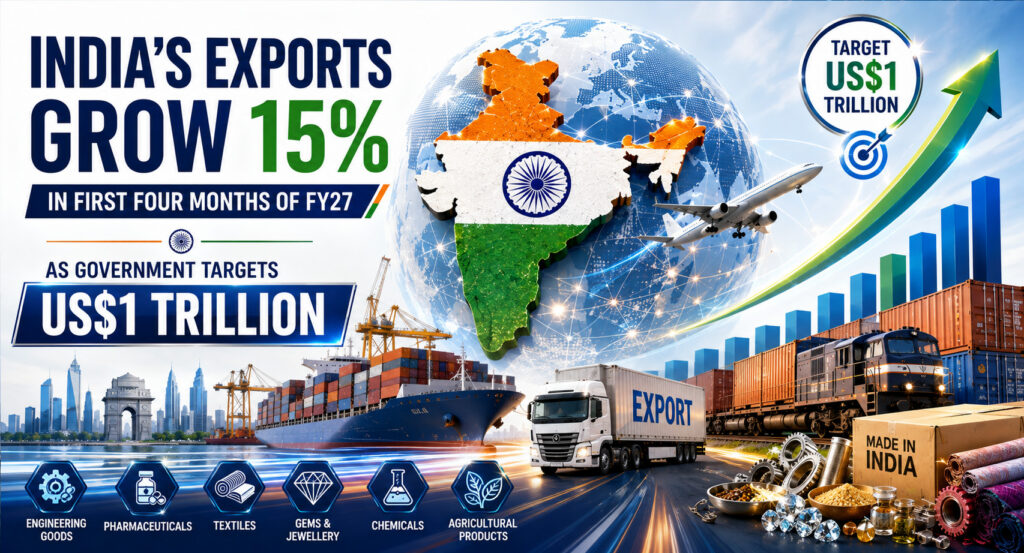
India’s exports are maintaining strong momentum in FY2026-27, with exports growing by around 15% during the first four months of the financial year, according to Union Minister of Commerce and Industry Piyush Goyal.
The government is targeting US$1 trillion in total exports during FY2026-27, as India seeks to strengthen its position in global trade despite geopolitical tensions, economic uncertainty and changing international supply chains.
Speaking at the Bharatiya Vyapar Mahotsav 2026, Goyal highlighted the need for Indian businesses to expand their international footprint, improve competitiveness and make greater use of technology, innovation and digitalisation.
Key Highlights
- Exports grew by around 15% during the first four months of FY27.
- India has set a US$1 trillion export target for FY2026-27.
- India recorded US$863 billion in exports in FY2025-26.
- FY26 merchandise exports stood at approximately US$442 billion.
- Services exports reached approximately US$421 billion.
- India’s exports have increased by around 73% over the past six years.
- Nine Free Trade Agreements have been signed during the past four years.
- These FTAs cover economies representing a combined GDP of approximately US$60 trillion.
- Greater participation from MSMEs, manufacturers, farmers, fishermen and service providers will be important for achieving the export target.
India’s US$1 Trillion Export Ambition
India’s latest export performance comes as the country attempts to significantly scale up its presence in international markets.
The country recorded total exports of approximately US$863 billion in FY2025-26, comprising both merchandise and services exports.
Export Segment
FY2025-26
Merchandise exports
US$442 billion
Services exports
US$421 billion
Total exports
US$863 billion
FY27 target
US$1 trillion
The target would require India to build on its recent export momentum while navigating a challenging global environment.
India’s Export Growth at a Glance
India’s Export Growth Journey
Free Trade Agreements Expand Market Access
India’s trade integration has also accelerated through new Free Trade Agreements.
The country has signed nine FTAs over the past four years, covering economies with a combined GDP of around US$60 trillion and providing preferential access to international trade valued at approximately US$25 trillion.
These agreements can help Indian exporters gain improved market access, reduce trade barriers and compete more effectively in international markets.
MSMEs and Manufacturers Key to Export Expansion
Achieving the US$1 trillion export ambition will require broader participation across India’s economy.
The government is encouraging manufacturers, MSMEs, farmers, fishermen and service-sector businesses to explore international markets and strengthen their export capabilities.
For smaller businesses, digital tools can play an increasingly important role in areas such as international sales, documentation, compliance, payments, logistics and supply-chain management.
Quality, Innovation and Digitalisation Take Centre Stage
India’s export strategy is increasingly moving beyond simply increasing volumes.
Businesses are being encouraged to focus on:
- Product quality and international standards
- Design and innovation
- Digitalisation of business operations
- Good manufacturing practices
- Efficient supply-chain management
- Sustainable production
- Recycling and reuse
- Circular-economy practices
- Fair and transparent trading practices
These factors can help Indian companies move towards higher-value exports and build stronger positions in global supply chains.
What India’s Export Growth Means for Logistics
Higher exports could create additional demand across India’s logistics ecosystem.
More international cargo will require efficient ports, container terminals, shipping services, air cargo networks, warehousing facilities, road and rail connectivity and freight-forwarding operations.
For logistics companies and freight forwarders, this creates opportunities to improve efficiency through automation, digital documentation, shipment visibility and integrated freight management systems.
Sustainability Becomes Part of Export Competitiveness
Sustainability is also becoming increasingly important for exporters targeting global markets.
Indian businesses are being encouraged to adopt practices involving recycling, reuse, resource efficiency and circular-economy models.
As global buyers increasingly assess environmental performance alongside price and quality, sustainable production and logistics could become important factors in determining export competitiveness.
What Comes Next for Indian Exports?
India’s approximately 15% export growth in the first four months of FY27 provides a positive starting point for the country’s US$1 trillion export ambition.
However, sustaining this growth will require coordinated efforts across manufacturing, agriculture, services, logistics and trade infrastructure.
Greater use of technology, stronger global market access, improved product quality and efficient logistics networks could help Indian businesses compete more effectively in international markets.
The focus is therefore shifting from simply exporting more
to building an ecosystem capable of producing, moving and delivering globally competitive Indian products and services at scale.
Key Takeaway
India’s 15% export growth in the first four months of FY27 strengthens the country’s ambition to reach US$1 trillion in exports. Achieving the target will depend not only on stronger overseas demand but also on competitive manufacturing, MSME participation, innovation, digitalisation, trade agreements and an efficient logistics ecosystem.
Frequently Asked Questions
What is India’s export target for FY2026-27?
India is targeting approximately US$1 trillion in total exports during FY2026-27.
How much did India export in FY2025-26?
India recorded approximately US$863 billion in total exports in FY2025-26, including merchandise and services exports.
How fast did India’s exports grow in the first four months of FY27?
India recorded around 15% export growth during the first four months of FY2026-27.
How much were India’s merchandise exports in FY2025-26?
Merchandise exports were approximately US$442 billion in FY2025-26.
How much were India’s services exports in FY2025-26?
Services exports reached approximately US$421 billion in FY2025-26.
How can logistics support India’s US$1 trillion export target?
Efficient ports, multimodal transportation, warehousing, freight forwarding, shipment tracking, digital documentation and integrated supply-chain management can help exporters move cargo faster and more efficiently.