

India and Canada are looking to strengthen bilateral trade and investment ties as negotiations for a Comprehensive Economic Partnership Agreement (CEPA) gain momentum. Union Commerce and Industry Minister Piyush Goyal met Canada’s Minister of International Trade, Maninder Sidhu, and a Canadian delegation in New Delhi on November 11, 2026, to discuss the progress of the proposed trade agreement.
The meeting signals renewed efforts by both countries to establish a balanced trade framework, improve market access and create fresh opportunities for businesses across key sectors. A successful CEPA could strengthen commercial cooperation, encourage investment flows and expand opportunities for exporters, importers and logistics service providers in both markets.
Key Developments
- High-level trade discussions: Piyush Goyal met Canadian International Trade Minister Maninder Sidhu in New Delhi on November 11, 2026.
- CEPA negotiations: Both sides discussed advancing negotiations for the India–Canada Comprehensive Economic Partnership Agreement.
- Improved market access: Discussions highlighted the importance of reducing trade barriers and creating opportunities for businesses.
- Investment opportunities: The proposed agreement aims to encourage stronger bilateral investment and commercial partnerships.
- Balanced trade framework: Both countries emphasised the importance of a mutually beneficial agreement.
India–Canada Trade: Current Figures and Economic Significance
India and Canada have significant opportunities to expand their commercial relationship, although the proposed CEPA is still under negotiation.
According to India’s Directorate General of Commercial Intelligence and Statistics (DGCI&S), bilateral merchandise trade reached approximately US$8.97 billion in FY2024–25, comprising Indian exports of US$4.22 billion and imports of US$4.74 billion. DGCI&S – India–Canada Trade Profile.
Trade indicator
Value
India’s exports to Canada (FY25)
US$4.22 billion
India’s imports from Canada (FY25)
US$4.74 billion
Total merchandise trade (FY25)
US$8.97 billion
Bilateral merchandise trade (FY26)
US$7.95 billion
India’s stated bilateral trade target by 2030
US$50 billion
Sources: DGCI&S and Moneycontrol trade report. Figures are reported on different financial-year bases.
How the India–Canada CEPA Could Influence Logistics
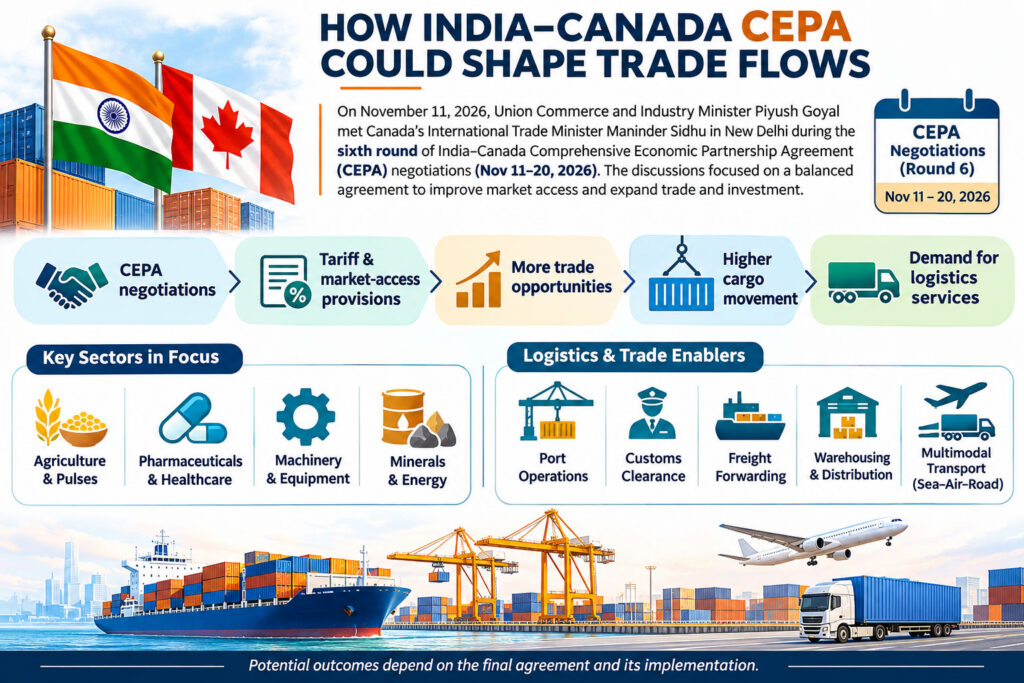
The proposed agreement could create opportunities across several logistics activities:
1. Sea freight
Increased merchandise trade could generate additional containerised cargo movement.
2. Air cargo
Greater commercial exchange could support demand for faster international shipments.
3. Customs clearance
Changes to tariff and trade procedures could influence customs documentation and compliance requirements.
4. Warehousing
Expanding bilateral trade could create demand for inventory management and distribution services.
5. Freight forwarding
Greater cross-border business activity could increase demand for shipment coordination and multimodal transportation.
Sixth Round of CEPA Negotiations
The November meeting coincided with the sixth round of India–Canada CEPA negotiations, scheduled in New Delhi from November 11 to 20, 2026. Both governments have expressed their intention to conclude the agreement by the end of 2026, according to Global Affairs Canada.
The negotiations cover important areas including trade in goods, services, investment and market access. India–Canada CEPA negotiation update.
What This Means for India’s Logistics Industry
Progress in India–Canada CEPA negotiations represents an important development for India’s international trade and supply chain ecosystem. If successfully concluded and implemented, the agreement could strengthen export-import activity, improve commercial connectivity and create opportunities for freight forwarders, shipping companies, customs brokers and logistics technology providers.
However, the actual impact will depend on the final agreement, tariff commitments and implementation timelines.
Frequently Asked Questions
What is the India–Canada CEPA?
The India–Canada Comprehensive Economic Partnership Agreement is a proposed trade agreement intended to improve market access, facilitate trade in goods and services, and strengthen investment cooperation.
Who participated in the November 11, 2026 meeting?
India’s Commerce and Industry Minister Piyush Goyal and Canada’s International Trade Minister Maninder Sidhu participated in the meeting in New Delhi.
How could CEPA benefit Indian exporters?
The agreement could improve access to Canadian markets, reduce certain trade barriers and create opportunities for Indian exporters across multiple industries.
How could the agreement affect India’s logistics industry?
Potential benefits include increased freight movement, demand for international shipping, customs brokerage, warehousing, freight forwarding and supply chain management services.