

India and Brazil are strengthening their economic partnership, with bilateral trade expected to reach a historic US$20 billion, driven by growing energy cooperation, renewable fuel development, offshore oil exploration and industrial investments.
The expanding relationship is creating new opportunities for international trade, energy transportation, infrastructure development and logistics connectivity between India and Latin America.
Speaking to ANI on the sidelines of the Bharat RE Summit and Expo 2026, Brazil’s Ambassador to India, Kenneth Félix Haczynski da Nóbrega, highlighted energy as one of the central pillars of bilateral cooperation. He pointed to collaboration in biofuels, deep-sea oil exploration, sustainable aviation fuel (SAF) and electrical infrastructure.
Key Developments in India–Brazil Trade Relations
- Trade target: Bilateral trade is expected to reach a record US$20 billion.
- Crude oil supply: Brazil is currently India’s fifth-largest supplier of crude oil.
- Investment: India’s foreign direct investment stock in Brazil is conservatively estimated at US$10 billion.
- Renewable energy: Both countries are expanding cooperation in ethanol, sustainable aviation fuel and biofuel technology.
- Offshore exploration: India and Brazil are exploring technical cooperation in deep-sea oil extraction, including activities around the Andaman and Nicobar Islands.
- Industrial presence: Brazilian company WEG manufactures wind turbines, transformers and electrical grid equipment in India.
India–Brazil Trade Reaches US$15.21 Billion in 2025
The growing partnership is supported by strong trade flows across petroleum products, pharmaceuticals, chemicals, agricultural commodities and engineering goods.
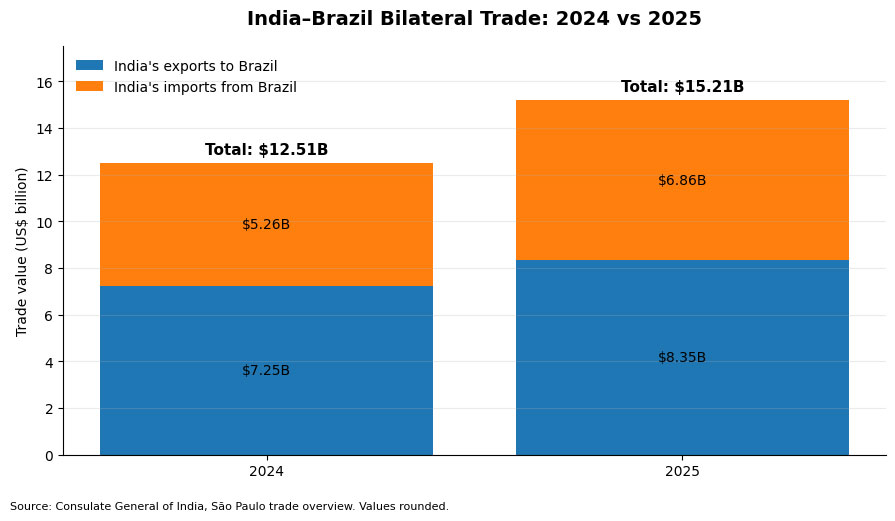
According to the Consulate General of India in São Paulo’s trade overview, bilateral trade reached US$15.21 billion in 2025, compared with US$12.51 billion in 2024, representing approximately 21.6% growth.
India exported goods worth US$8.35 billion to Brazil, while imports from Brazil reached US$6.86 billion. This resulted in a trade surplus of approximately US$1.49 billion for India.
The major traded commodities include:
- Indian exports: Refined petroleum products, pharmaceuticals, chemicals, agrochemicals, engineering goods, aluminium and textile products.
- Indian imports: Crude oil, soybean oil, raw sugar, cotton, iron ore, gold and wood products.
The increase in bilateral trade reflects growing demand for industrial inputs, energy commodities and manufactured products across both markets.
India–Brazil Bilateral Trade Statistics
Trade indicator
Value
Total trade in 2024
US$12.51 billion
Total trade in 2025
US$15.21 billion
Indian exports in 2025
US$8.35 billion
Indian imports in 2025
US$6.86 billion
India’s trade surplus
US$1.49 billion
Expected trade milestone
US$20 billion
Source: Consulate General of India, São Paulo. Figures are in US dollars.
Energy Cooperation Strengthens Strategic Partnership
Energy is emerging as one of the most important areas of cooperation between India and Brazil. Both countries are exploring opportunities across conventional energy, renewable fuels and advanced energy technologies.
Brazil remains India’s fifth-largest crude oil supplier, creating opportunities for deeper collaboration in oil exploration, offshore technology and energy transportation.
The two countries are also discussing technical cooperation in deep-sea oil drilling, including exploration activities planned around the Andaman and Nicobar Islands.
Alongside conventional energy, biofuels are becoming an important component of bilateral cooperation. Brazil has extensive experience in ethanol production, while India is expanding its ethanol-blending programme and participating in international initiatives through the Global Biofuel Alliance.
The partnership also covers sustainable aviation fuel (SAF). Under the renewable energy cooperation framework, both countries are exchanging knowledge on fuel-blending policies, regulatory standards and technology development.
Brazilian Investments and Industrial Cooperation in India
Industrial investment is another important factor supporting India–Brazil economic relations.
Brazilian engineering company WEG has established an industrial presence in India, manufacturing equipment such as wind turbines, transformers and electrical infrastructure products. These investments support India’s renewable energy manufacturing ecosystem and electricity transmission requirements.
Indian companies are also expanding their business presence in Brazil, particularly in sectors such as energy, automotive manufacturing, pharmaceuticals, information technology and engineering.
The Brazilian Ambassador indicated that Indian foreign direct investment stock in Brazil could reach approximately US$10 billion, describing this as a conservative estimate. He also highlighted more than 150 Brazilian business missions to India over three years.
What the Growing India–Brazil Trade Means for Logistics
The expansion of trade between India and Brazil could create new opportunities for freight forwarders, shipping companies, port operators and supply chain service providers.
The two countries exchange a diverse range of commodities, including crude oil, petroleum products, agricultural goods, chemicals, pharmaceuticals and industrial machinery. These products require different transportation arrangements, handling capabilities and compliance procedures.
The following developments could influence logistics demand:
1. Higher ocean freight demand
Growing trade volumes could increase demand for container shipping and bulk cargo transportation between Indian and Brazilian ports.
2. Energy logistics expansion
Crude oil imports and offshore exploration activities could create additional requirements for tanker transportation, offshore support vessels and specialised energy logistics.
3. Agricultural commodity transportation
Increased movement of soybean oil, sugar and cotton could support demand for bulk shipping, storage and port-handling infrastructure.
4. Industrial supply chain growth
Machinery, transformers, engineering products and electrical equipment could increase demand for project cargo and specialised freight services.
5. Trade documentation and customs
Expanding cross-border transactions will increase the importance of accurate documentation, customs clearance, cargo visibility and regulatory compliance.
For Indian freight forwarders, Brazil represents an important Latin American trade market where stronger commercial relationships could create opportunities for new customers, shipping partnerships and international freight services.
Recent Trade Momentum and the US$20 Billion Milestone
The trade outlook is supported by further momentum in 2026. According to the Embassy of India in Brasília, bilateral trade during January–June 2026 reached US$8.774 billion, marking a 36.95% increase compared with the corresponding period in 2025.
Separately, India and Brazil have established a longer-term ambition to increase bilateral trade to US$30 billion by 2030, reaffirmed at the eighth Trade Monitoring Mechanism meeting in August 2026, according to the Press Information Bureau.
The US$20 billion figure should therefore be understood as the ambassador’s near-term expectation, rather than an already achieved trade figure or the latest official long-term target.
Frequently Asked Questions
How much is India–Brazil bilateral trade in 2025?
India–Brazil bilateral trade reached US$15.21 billion in 2025, compared with US$12.51 billion in 2024.
Why is India–Brazil trade expected to reach US$20 billion?
Growing cooperation in crude oil, renewable energy, pharmaceuticals, chemicals, engineering products and agricultural commodities is supporting bilateral trade expansion.
What are India’s major exports to Brazil?
India primarily exports petroleum products, pharmaceuticals, chemicals, agrochemicals, engineering products, aluminium and textile products.
What does India import from Brazil?
India imports crude oil, soybean oil, raw sugar, cotton, iron ore, gold and other commodities from Brazil.
How will growing India–Brazil trade affect the logistics sector?
Higher trade volumes could increase demand for ocean freight, bulk cargo transportation, container shipping, port handling, customs clearance and specialised energy logistics.
What is the India–Brazil trade target for 2030?
Both countries have reaffirmed their objective of expanding bilateral trade to US$30 billion by 2030.