
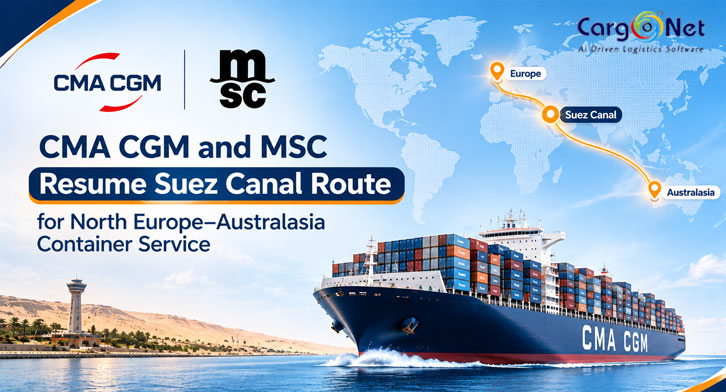
CMA CGM and Mediterranean Shipping Company (MSC) have resumed container ship movements through the Suez Canal on their joint North Europe–Australasia service, marking an important development in global maritime trade and container shipping operations.
The decision brings the service back to the shorter route connecting Europe, the Middle East and Australasia, replacing the longer diversion around the Cape of Good Hope. According to the report by DynaLiners, the change will allow the carriers to streamline vessel deployment and reduce the number of ships required to maintain the service.
The service is marketed as Newmo by CMA CGM and Australia Express by MSC.
Key Developments in the Shipping Service
- Suez Canal routing restored: CMA CGM and MSC have resumed transits through the Suez Canal in both directions.
- Smaller fleet requirement: The number of vessels deployed will decrease from 18 to 16.
- Vessel capacity: The revised fleet will consist of vessels averaging approximately 9,000 TEUs.
- Port coverage unchanged: The service will continue to connect major European, Indian Ocean, Australian and Asian ports.
- Operational efficiency: The shorter route is expected to reduce sailing distances and vessel requirements.
- Red Sea security remains important: Shipping lines continue to assess regional security and operational risks before making routing decisions.
North Europe–Australasia Service: Port Rotation
The revised service will retain its existing port coverage, connecting major European gateways with Indian Ocean hubs, Australia and Southeast Asia.
Sequence
Port
Country / Region
1
London Gateway
United Kingdom
2
Rotterdam
Netherlands
3
Hamburg
Germany
4
Antwerp
Belgium
5
Le Havre
France
6
Valencia
Spain
7
La Spezia
Italy
8
Marseille
France
9
Port Réunion
Réunion
10
Port Louis
Mauritius
11
Sydney
Australia
12
Melbourne
Australia
13
Adelaide
Australia
14
Fremantle
Australia
15
Singapore
Singapore
16
Ennore
India
17
Colombo
Sri Lanka
18
London Gateway
United Kingdom
Source: Reported service rotation. Individual voyage schedules and port calls may vary.
Shipping Capacity and Operational Changes
The return to the Suez Canal is expected to improve vessel utilisation by reducing the sailing distance compared with the Cape of Good Hope diversion.
Operational indicator
Previous arrangement
Revised arrangement
Vessels deployed
18
16
Average vessel capacity
—
Approx. 9,000 TEU
Port coverage
Existing rotation
Unchanged
Routing
Cape of Good Hope diversion
Suez Canal
Vessel requirement
Higher
Lower
What do the numbers indicate?
- The fleet requirement falls by two vessels.
- This represents an approximately 11.1% reduction in the number of deployed vessels.
- The service retains its existing port network.
- The shorter routing can help carriers use their vessel capacity more efficiently.
Suez Canal Traffic Shows Signs of Recovery in 2026
The return of the CMA CGM–MSC service comes as container shipping activity through the Suez Canal continues to recover.
According to the Suez Canal Authority’s September 16, 2026 update, container ship net tonnage passing through the canal reached approximately 72.1 million tonnes between January and August 2026, compared with 46.7 million tonnes during the same period in 2025.
This increase indicates improving container shipping activity through the canal. The authority has also highlighted the return of major carriers, including CMA CGM, MSC, Maersk, Hapag-Lloyd and COSCO, on selected services.
What Does This Mean for India–Europe and Australia Trade?
The revised routing is particularly relevant to Indian exporters, importers and freight forwarders because the service includes Ennore Port, providing a connection within the Europe–Australasia network.
Potential implications include:
1. Improved trade connectivity
The Suez route restores a shorter maritime connection between North Europe, the Indian Ocean and Australia.
2. Indian port connectivity
Ennore’s inclusion provides an important connection for cargo moving through India’s east coast.
3. Vessel utilisation
Reducing the fleet requirement could improve deployment efficiency for the carriers.
4. Freight planning
Shippers may benefit from revised transit schedules, subject to actual vessel rotations and carrier announcements.
5. Supply chain visibility
Freight forwarders will need to monitor revised ETAs, transshipment connections and booking schedules.
However, the return to Suez should not automatically be interpreted as a guarantee of lower freight rates or faster delivery for every shipment. Actual transit times depend on vessel schedules, port congestion, canal conditions and security-related contingencies.
Red Sea Security Remains a Deciding Factor
Despite the gradual return of shipping lines, the Red Sea remains an important operational consideration.
MSC announced on August 24, 2026, that it was partially restoring Suez Canal transits on selected East–West services after reviewing security and operational conditions. The company also stated that the transition would take place service by service, with contingency arrangements remaining available. Read MSC’s official advisory.
For shippers, this means that routing decisions must still be checked against individual vessel movements rather than assuming that all services have returned to the Suez Canal.
Frequently Asked Questions
Why have CMA CGM and MSC resumed Suez Canal routing?
The carriers are returning to the shorter Suez Canal route to reduce sailing distances and improve vessel deployment efficiency compared with the longer Cape of Good Hope route.
How many vessels will operate on the revised service?
The number of deployed vessels will decrease from 18 to 16, representing an approximately 11.1% reduction.
What are the names of the CMA CGM and MSC services?
CMA CGM markets the service as Newmo, while MSC operates it under the Australia Express name.
Which Indian port is included in the service rotation?
Ennore Port in India is included in the reported North Europe–Australasia port rotation.
Will the Suez Canal route reduce shipping transit times?
The shorter route is expected to reduce sailing distances and potentially transit times. Actual savings will depend on vessel schedules and operational conditions.
Have all shipping lines resumed Suez Canal operations?
No. Shipping lines are restoring selected services based on security assessments and operational conditions. Not every carrier or trade lane has returned to the route.
Will this development reduce container freight rates?
Not necessarily. Shorter routes can reduce vessel operating requirements, but freight rates also depend on market demand, available capacity, fuel costs and other operational factors.