India Remains a Strategic Growth Market as Maersk Reaffirms Long-Term Commitment

Global shipping and logistics leader A.P. Moller–Maersk has reaffirmed its long-term commitment to India following a high-level meeting between Maersk Chairman Robert Maersk Uggla and Prime Minister Narendra Modi in Sweden. The discussions highlighted the growing strategic partnership between India and Maersk, with a focus on ports, logistics infrastructure, maritime development, workforce expansion, and global trade opportunities.

Strengthening India–Maersk Strategic Partnership

Maersk emphasized its continued support for India’s ambitions to become a global maritime and logistics hub, aligning with the country’s long-term trade and infrastructure vision.

Key Highlights:

India Set to Lead G20 Growth in FY27: Moody’s Projects 6.4% GDP Expansion

India is expected to remain the fastest-growing major economy in the world.

In its latest outlook, Moody’s Ratings has projected India’s GDP to grow at 6.4% in FY27, the highest among all G20 economies. The growth outlook reflects strong domestic demand, policy momentum, and a resilient banking system — all critical indicators for the logistics and freight sector.

For businesses in shipping, freight forwarding, warehousing, and cross-border trade, this signals continued expansion opportunities.

What’s Driving India’s Growth?

Moody’s highlights several structural strengths powering the Indian economy:

This steady macroeconomic foundation creates a positive outlook for trade volumes, cargo movement, and infrastructure investment.

GDP Forecast: How It Compares

Here’s how the projections stack up:

While Moody’s estimate is slightly conservative compared to government expectations, India still outpaces other G20 economies in projected growth.

Banking System Outlook: A Key Signal for Trade & Logistics

A stable banking system is critical for working capital, trade finance, and freight credit cycles.
Moody’s notes:
For logistics businesses, this means continued access to funding and trade finance, especially important for freight forwarders and exporters.

Credit Growth & Interest Rate Environment

Lower borrowing costs could further stimulate:

What This Means for the Logistics Sector

For freight forwarders, transporters, and supply chain players:
This macro momentum directly supports sectors like:

How CargoNet Helps Logistics Businesses Capture This Growth

As volumes rise and operations scale, logistics companies need greater visibility, control, and financial clarity. Digital logistics platforms like CargoNet play a critical role in enabling this transition.
CargoNet helps logistics and freight businesses:

Key Takeaways

As India’s economic momentum drives higher trade volumes and more complex supply chains, logistics businesses must evolve with speed and precision. CargoNet enables freight forwarders and logistics companies to operate smarter, stay compliant, and scale confidently in the world’s fastest-growing major economy.

India Targets Middle Eastern and Asian Nations to Diversify Steel Exports

India is accelerating its push to diversify steel export destinations, turning its focus toward fast-growing markets in the Middle East and Asia as global trade dynamics continue to shift.

With demand softening and protectionist policies tightening in traditional markets such as Europe and North America, India is strategically repositioning its steel exports to tap into regions driven by infrastructure growth, urbanisation, and industrial expansion.

A Strategic Shift in Global Steel Trade

Indian steelmakers are increasingly eyeing the Gulf Cooperation Council (GCC) and emerging Asian economies to sustain export volumes and strengthen long-term market presence.
In the Middle East, massive investments in infrastructure and energy transition projects are driving strong demand for:
Countries such as United Arab Emirates, Saudi Arabia, and Qatar are rolling out mega projects that present fresh opportunities for Indian exporters.

Asia Opens New Trade Corridors

Across Asia, rapid construction activity and manufacturing growth are reshaping steel demand. Markets including Vietnam, Thailand, Indonesia, and Malaysia are emerging as key focus areas.
Indian mills are also targeting specialised and higher-margin segments such as:
This approach helps differentiate Indian exports from regional competitors.

Policy Support and Competitive Advantage

Government-backed trade negotiations and diplomatic engagement are reinforcing this export push by:

Industry estimates continue to rank India among the world’s top steel producers, with expanding capacity making export diversification critical—especially during periods of subdued domestic demand.
Outlook: Opportunities Amid Volatility
Despite ongoing volatility caused by geopolitical tensions and raw material price fluctuations, analysts believe India’s:

Key Takeaways

With targeted marketing and strategic partnerships, Indian steelmakers aim to secure long-term contracts and strengthen trade ties—reinforcing India’s role in the evolving global steel landscape.

India’s Agri Exports to the US Set for Major Boost as 75% of Products Get Zero Tariff: SBI Report

India’s agricultural exports to the United States are poised for a significant upswing, as nearly 75% of Indian agri-export items now enjoy zero-tariff access, according to a recent report by the State Bank of India (SBI).
This major tariff relaxation marks a positive shift in India–US trade relations, making Indian agricultural products far more competitive in one of the world’s largest consumer markets.

Why This Matters

Lower tariff barriers mean reduced costs for exporters, better pricing power, and improved access to high-demand US markets. As a result, India’s agri-export ecosystem—from farmers to logistics providers—is expected to see tangible gains.

Key Export Categories Likely to Benefit

The SBI report highlights increased shipment potential for:
With improved price competitiveness, Indian exporters are better positioned to compete with global suppliers across these categories.

Logistics & Quality Will Be the Game Changers

SBI notes that export growth could exceed earlier projections, provided:
This opens opportunities for logistics players, cold-chain operators, and agri-export-focused freight forwarders.
Broader Economic Impact
According to the report, the zero-tariff advantage could lead to:

The Bigger Picture

With feeder networks becoming more central to regional trade, platforms like CargoNet help logistics providers coordinate feeder and mainline connections, manage port operations, automate documentation, and track cargo movement end-to-end, ensuring visibility and control across short-sea and transshipment routes.

India Opens Insurance Sector to 100% FDI Under Automatic Route

In a major reform aimed at boosting foreign investment and deepening financial inclusion, the Government of India has officially notified 100% Foreign Direct Investment (FDI) in the insurance sector under the automatic route.
The move, formalized by the Department for Promotion of Industry and Internal Trade (DPIIT), marks a structural shift in India’s insurance landscape. With this, private insurance companies can now access full foreign ownership without prior government approval — a decision expected to attract global insurers and long-term capital into the country.

The move, formalized by the Department for Promotion of Industry and Internal Trade (DPIIT), marks a structural shift in India’s insurance landscape. With this, private insurance companies can now access full foreign ownership without prior government approval — a decision expected to attract global insurers and long-term capital into the country.

However, the reform comes with clear governance safeguards to ensure Indian management oversight.
The notification follows the passage of the Sabka Bima Sabki Raksha (Amendment of Insurance Laws) Bill, 2025, which received Presidential assent and has now been operationalised through amendments to the Consolidated FDI Policy.

What’s Changing?

Under Press Note No. 1 (2026 Series):

Why This Matters

This reform is expected to:

For global insurers, India now becomes one of the most open large markets in the insurance sector. For domestic players, it signals a more competitive, capital-rich environment.
Impact on Logistics & Trade
For businesses — including logistics, freight forwarding, warehousing, and supply chain companies — this move could mean:
As India strengthens its position as a global trade and manufacturing hub, deeper insurance reforms add another layer of confidence for investors and supply chain stakeholders.:

Adani Ports Launches Weekly Rail Service from ICD Patli to Pipavav Port, Boosting Multimodal EXIM Connectivity

Adani Ports and Special Economic Zone Ltd (APSEZ) has launched a new weekly rail service connecting ICD Patli to Pipavav Port, further strengthening its multimodal logistics network and export–import (EXIM) supply chain capabilities.
The new service enhances direct rail connectivity between North India’s industrial clusters and a key western gateway port, offering exporters and importers a more predictable and efficient cargo movement option.

Strengthening North–West India Trade Links

Designed to simplify cargo planning, the weekly rail service provides end-to-end connectivity that helps reduce transit uncertainty and improve schedule reliability—two critical factors for EXIM customers operating in time-sensitive global supply chains.
With ICD Patli serving as a major inland logistics hub for the NCR and surrounding manufacturing regions, the dedicated rail link is expected to:

Part of a Broader Multimodal Strategy

APSEZ stated that the initiative aligns with its broader strategy of integrating ports, rail, and inland logistics infrastructure to create seamless and resilient supply chain ecosystems.
By combining port operations with rail connectivity and inland container depots, Adani Ports aims to deliver logistics solutions that balance speed, reliability, and scale, helping Indian businesses remain competitive in global trade lanes.

Key Highlights at a Glance

What This Means for EXIM Customers

The service is now operational and available to exporters and importers seeking streamlined, rail-led connectivity between northern manufacturing centres and Pipavav Port’s maritime network—especially beneficial for customers looking to optimise costs while maintaining delivery reliability.

How CargoNet Complements Multimodal Rail–Port Connectivity

As rail-linked port services expand, digital coordination becomes essential. Platforms like CargoNet help logistics providers and freight forwarders manage rail and sea movements, documentation, billing, and real-time cargo visibility on a single system—ensuring better planning, fewer delays, and tighter control across multimodal EXIM supply chains.

Straits Orient Lines Strengthens Bay of Bengal Trade with New Feeder Service

Straits Orient Lines has launched a dedicated Bay of Bengal feeder service, marking a significant step forward in regional maritime connectivity across South Asia.
Designed to meet the growing trade and logistics demands of the region, this service enhances access to global shipping routes while strengthening intra-regional supply chains.

Key Highlights

By connecting emerging and established maritime hubs, the new feeder service plays a critical role in supporting exporters, importers, and logistics providers seeking dependable and scalable shipping solutions.
Straits Orient Lines reaffirmed its commitment to expanding regional trade lanes and stated that further updates on network expansion, operational capabilities, and new service offerings will be shared as the company continues to grow its footprint across South Asia.

How CargoNet Adds Value

By connecting emerging and established maritime hubs, the new feeder service plays a critical role in supporting exporters, importers, and logistics providers seeking dependable and scalable shipping solutions.

India Poised to Become the World’s Hub for Large-Scale Organic Farming

India is rapidly positioning itself as a global powerhouse for large-scale organic food production, as the government sharpens its focus on sustainable agriculture and export-led growth.
Speaking on India’s organic farming potential, Commerce Secretary Rajesh Agrawal said the country is well-placed to meet rising global demand for organic food, while deepening trade ties with key partners such as the European Union.
Over the past decade, India’s exports of organic products have tripled, and the government has now set an ambitious target to triple them again within the next five years —signaling strong confidence in the sector’s scalability and global appeal.

India’s vast agricultural base gives it a natural advantage. Out of 150.3 million hectares of total cropped land, around 4.7 million hectares are already under organic farming, supported by nearly 2.4 million farmers. While organic farming currently accounts for about 3% of total agricultural output, the scope for expansion remains significant.

To strengthen India’s credibility in global markets, the government is focusing on robust certification systems, farmer cooperatives, and supply chain transparency. The long-running National Programme for Organic Production (NPOP) has played a key role in aligning domestic standards with international norms—helping Indian organic products gain trust worldwide.
India’s growing influence was evident at BIOFACH 2026, where nearly 100 exhibitors from 20 Indian states showcased a wide range of organic products, reinforcing the country’s reputation as a reliable sourcing destination for global buyers.
As global demand for environmentally friendly and sustainably produced food continues to rise, organic farming is emerging as a strategic export sector—with India aiming to strengthen supply chains, improve market access, and build end-to-end trust in certification and traceability.

Key Highlights at a Glance

India’s Cold Chain Market Poised for Five-Fold Growth to $75 Billion by 2033

India’s cold chain industry—long considered the invisible backbone of food and pharmaceutical supply chains—is entering a decisive growth phase. As consumption patterns shift and demand for temperature-sensitive products surges, cold logistics is fast becoming one of India’s most critical infrastructure priorities.
According to a study by market intelligence platform Grand View Horizon, India’s cold chain market is expected to expand nearly five times, growing from around $13 billion today to $75 billion by 2033. The sector is projected to register close to 25% compound annual growth, driven by rising consumption of perishables, pharmaceuticals, vaccines, biologics, and e-grocery services.

From Behind-the-Scenes to Centre Stage

Despite its growing importance, India’s cold chain ecosystem has historically remained fragmented, capacity-led, and under-digitised. A report by Amicus Growth Advisors notes that increasing demand for dairy, fresh agricultural produce, meat, and high-value medicines is now colliding with outdated infrastructure and inconsistent service standards.
While billions of dollars are flowing into cold storage facilities, transport fleets, and warehousing, the report cautions that capacity expansion alone will not unlock sustainable value.
“The real opportunity lies in building integrated, end-to-end cold logistics platforms,” the report states, highlighting that technology-led, compliance-driven, and data-enabled operations will attract higher valuations and long-term capital.

Why Cold Chains Are Now Strategic Infrastructure

Sanjeev Jain, Managing Partner at Amicus Growth Advisors, describes cold chain logistics as the thin line between value creation and value erosion.
“India feeds more people than any other democracy, supplies vaccines globally, and produces one of the most diverse food baskets in the world. Yet, between the farm, factory, hospital, and home, value quietly melts away,” said Sanjeev Jain.
Jain stressed that cold chains are no longer just physical assets but economic enablers, directly influencing farmer incomes, food safety, export competitiveness, and pharmaceutical efficacy.

“For agriculture, cold chains prevent distress sales and improve price realisation. For dairy, they enable freshness at national scale. For pharmaceuticals and vaccines, they are the difference between regulatory compliance and catastrophic failure,” he added.

Consumption, Compliance, and Capital Are Reshaping the Sector

The report highlights that India’s consumption landscape is rapidly evolving:
At the same time, regulatory scrutiny is intensifying, customers are less tolerant of failures, and investors are becoming more selective—favouring operators who can deliver reliability, transparency, and end-to-end control.

Key Highlights

The Road Ahead

Covering the full cold chain spectrum—from temperature classifications and growth drivers to policy support such as Kisan Sampada subsidies and evolving regulatory frameworks—the report concludes that the next phase of growth will be defined by platform-led cold logistics models.
Those who secure reliability, leverage data-driven insights, and deliver consistent quality across the supply chain are set to define India’s emerging cold chain renaissance, supported by digital logistics platforms like CargoNet that enable end-to-end visibility, compliance, and intelligent cold chain control.

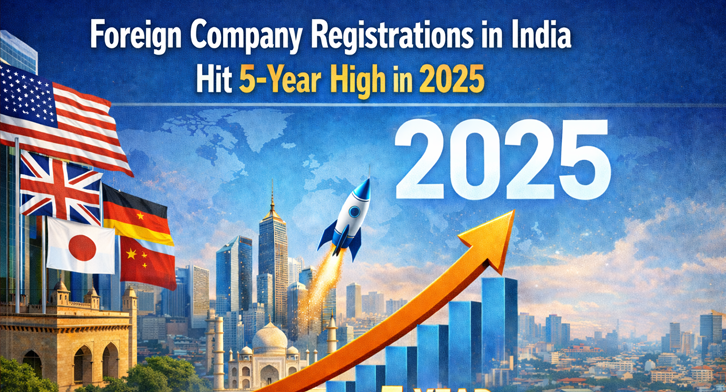
Foreign Company Registrations in India Hit 5-Year High in 2025

Services Sector Commands 87% Share — Global Confidence in India Strengthens

India is once again firmly on the global investment radar.
Foreign company registrations in India surged to a five-year high in 2025, signaling renewed global confidence in the country’s economic growth, regulatory stability, and expanding market opportunities.
According to data from the Ministry of Corporate Affairs, 92 overseas companies registered operations in India in 2025 — a sharp rise compared to 53 in 2024.
The last comparable peak was in 2020, when 93 foreign firms entered the Indian market.

Registrations Jump Sharply in 2025

Here’s how the trend unfolded:
Most new entities were incorporated in:
Under the Companies Act, 2013, a foreign company is defined as an entity incorporated outside India that establishes a place of business within the country.
Services Sector Leads the Surge

The biggest story? The overwhelming dominance of the services sector

This includes companies in:


For logistics and supply chain stakeholders, the strong participation in transport, storage, and trading signals continued integration of India into global value chains.

Manufacturing Sees Revival
While services dominate, industrial registrations are showing early signs of revival.
This could indicate growing interest aligned with India’s production-linked incentive (PLI) schemes and supply chain diversification strategies
Bigger Picture: India’s Expanding Corporate Base
As of December 2025:
Meanwhile, India’s overall corporate ecosystem is expanding rapidly:

What This Means for Logistics & Trade

For freight forwarders, 3PLs, warehouse operators, and logistics tech providers, this trend is significant:

For freight forwarders, 3PLs, warehouse operators, and logistics tech providers, this trend is significant:

cargonet-logo-icon
Cargonet Cargo Software Logo

Feedback & Reward program

Submit the Feedback and avail the Rewards.

1. Your satisfaction & reliability on CargoNet ?

2. Your Rating on Support & co-ordination team?

3. Satisfaction on the look and feel of CargoNet ?

4. Please specify any 2 best features that you feel more helpful in CargoNet?

5. Please specify any 2 best reports that you are taking on regular basis?

6. Are you using Copy Job option in CargoNet Software?

7. Are you using Automatic DSR (Daily Status Report) Option? It automatically sends reports to customer about the shipment status

8. Are you using Automatic Outstanding Reports option? Period Auto outstanding reminders to customer

9. Any other thoughts to improve in CargoNet? Please share.

* Join our Reward Program by recommending CargoNet (Cash Rewards Awaiting)

“Thanks for your feedback. Our goal is to create the best possible product, support & service, and your thoughts, ideas & suggestions play a major role in helping us identify opportunities to improve.”

Cut AI cost,
not performance

discover how top Freight Forwarding companies  reduce AI-related expense and speed up operation with CargoNet AI, we will show it how
Share your information for instant access :

Get a Demo Now