Kamarajar Port Welcomes Large RoRo Vessel, Strengthening Automotive Logistics

Kamarajar Port Limited marked a significant achievement with the arrival of MV Höegh Aurora, the world’s largest Pure Car and Truck Carrier (PCTC) by capacity. The vessel berthed at General Cargo Berth-1 on May 24, 2026, highlighting the port’s capability to handle next-generation RoRo (Roll-on/Roll-off) vessels and strengthening its position in the global automotive logistics sector.

Setting New Standards in Sustainable Shipping

The vessel represents a major advancement in green maritime transportation, combining high cargo capacity with sustainable technologies designed to reduce emissions and improve operational efficiency.
Equipped with dual-fuel LNG propulsion and future-ready capabilities for ammonia and methanol fuels, the vessel supports the shipping industry’s transition toward cleaner energy solutions.

Key Features of MV Höegh Aurora

Record-Breaking Capacity
Advanced Cargo Handling
Green Technology Integration

Strengthening Automotive and RoRo Logistics

The successful handling of MV Höegh Aurora demonstrates Kamarajar Port’s growing capability to accommodate some of the world’s largest automotive carriers. The port continues to play a key role in supporting vehicle exports, automotive supply chains, and international trade through efficient RoRo operations.
Its strategic location and modern infrastructure make it an important gateway for automotive manufacturers and logistics providers operating in India.

Supporting Kamarajar Port's Sustainability Vision

The vessel’s arrival also aligns with Kamarajar Port’s broader sustainability and infrastructure development goals. The port is actively working to strengthen environmentally responsible maritime operations while positioning itself as a future LNG bunkering hub on India’s east coast.
By supporting advanced low-emission vessels and green shipping initiatives, Kamarajar Port is reinforcing its commitment to sustainable growth and global maritime competitiveness.

Key Highlights:

Ganga Expressway to Boost Freight Efficiency, Saving Rs. 30,000 Crore in Logistics Costs Every Year

The newly operational 594-km Ganga Expressway is expected to significantly enhance logistics efficiency and industrial growth in Uttar Pradesh. According to state government estimates and industry experts, the expressway could generate between Rs. 25,000 crore and Rs. 30,000 crore in annual logistics and supply chain savings by reducing transit times, fuel consumption, vehicle operating costs, and transportation overheads.

The mega infrastructure project is poised to strengthen connectivity across the state while improving the movement of goods between manufacturing hubs, distribution centers, and export gateways.

Industrial Development Along the Corridor

To maximize the economic benefits of the expressway, the Uttar Pradesh government is developing 12 dedicated industrial nodes covering more than 6,500 acres along the corridor. These industrial clusters are expected to attract investments across manufacturing, logistics, warehousing, electronics, and allied sectors.
The corridor has already witnessed strong investor interest, with 987 investment proposals worth approximately Rs. 46,660 crore submitted for projects ranging from manufacturing facilities to logistics parks and distribution centers.

Boost to Manufacturing and Supply Chains

The improved connectivity offered by the Ganga Expressway is expected to reduce delivery times and enhance supply chain reliability for businesses operating in the region. Industries such as electronics, textiles, consumer goods, and food processing are likely to benefit from faster and more cost-efficient transportation networks.
The corridor is also expected to strengthen Uttar Pradesh’s position as a key manufacturing and logistics destination, supporting industrial expansion and job creation.

Faster Access to Air Cargo and Export Markets

A major advantage of the expressway is its improved connectivity to northern India’s air cargo hubs, which collectively handle more than 31% of the country’s total air freight traffic. This will enable faster movement of time-sensitive exports, including textiles, electronics, pharmaceuticals, and perishable agricultural products.
Enhanced road-to-air connectivity is expected to improve export competitiveness by reducing delivery timelines and ensuring more predictable logistics operations.

Driving Economic Growth and Investment

The Ganga Expressway is emerging as a strategic infrastructure asset that supports Uttar Pradesh’s broader industrialization and economic development goals. By improving freight mobility, attracting private investment, and enabling efficient supply chains, the corridor is expected to play a crucial role in boosting trade, manufacturing output, and regional economic growth.

Key Highlights:

India’s Business Environment Drives Foreign Company Registrations to Nine-Year High in FY26

India recorded a sharp increase in foreign company registrations during FY26, reflecting rising global confidence in the country’s economic growth and investment climate. According to data from the Ministry of Corporate Affairs (MCA), 101 foreign companies registered operations in India during FY26, the highest level in nine years, compared with 57 registrations in FY25.
Singapore led the list of new foreign entrants with 13 registrations, followed by the United States (10) and the United Kingdom (9). South Korea and Germany also recorded strong growth, while Japan remained among the major contributors. The rise in registrations highlights India’s growing attractiveness as a consumer market, manufacturing hub, and investment destination.
The data also showed increasing diversification, with companies from South Africa, Ghana, and Uzbekistan registering operations in India for the first time during FY26.

Key Highlights:

India’s Export Performance Reaches Four-Year Peak in May

India’s exports recorded their strongest growth in four years during May, supported by robust demand for engineering goods, electronics, pharmaceuticals, and petroleum products. The strong performance signals improving global demand and increased competitiveness of Indian manufacturing sectors.
Despite the export surge, India’s trade deficit widened as imports rose sharply due to higher purchases of crude oil, gold, machinery, and electronic goods. While stronger imports indicate healthy domestic demand and industrial activity, rising import costs continue to pressure the country’s trade balance.
The government remains focused on boosting exports through Production-Linked Incentive (PLI) schemes, trade agreements, and infrastructure development aimed at strengthening India’s role in global supply chains.

Key Highlights:

₹832 Crore JSW Infra Investment Set to Enhance Kolkata Dock System Capacity

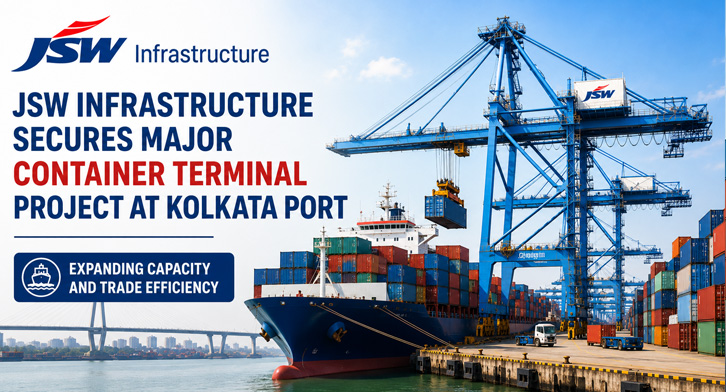
JSW Infrastructure Ltd. is set to secure the rights for the integrated development of two new outer container terminals and five existing berths at the Netaji Subhas Dock (NSD) within the Syama Prasad Mookerjee Port, Kolkata. The project involves an investment of approximately ₹832.25 crore and marks another significant step in the company’s expansion within India’s port and logistics sector.
The company emerged as the highest bidder by quoting a royalty of ₹3,701 per twenty-foot equivalent unit (TEU), positioning itself to undertake one of the key container infrastructure projects on India’s eastern coast.

Expanding Container Handling Capacity

The project includes the construction of two new outer container handling berths along with the operation and modernization of five existing berths at Netaji Subhas Dock. Once completed, the facility will have the capacity to handle approximately 930,230 TEUs annually, in addition to accommodating multipurpose cargo.
The expansion is expected to enhance cargo handling efficiency, increase container throughput, and strengthen the port’s ability to support growing trade volumes in eastern and northeastern India.

Strengthening Presence at Syama Prasad Mookerjee Port

This will be JSW Infrastructure’s second major project at Syama Prasad Mookerjee Port. In 2025, the company secured a project for the reconstruction of Berth No. 8 and the mechanization of Berths 7 and 8 at Netaji Subhas Dock.
That project involved the installation of advanced Rail Mounted Quay Cranes (RMQCs) to improve container handling operations and increase productivity. The investment for the earlier project was also valued at approximately ₹832 crore, demonstrating the company’s long-term commitment to strengthening port infrastructure in Kolkata.

Boosting Eastern India's Maritime Logistics

The latest development is expected to support the modernization of the Kolkata Dock System and improve maritime connectivity across eastern India. Enhanced container handling capabilities will facilitate smoother cargo movement, reduce turnaround times, and improve logistics efficiency for exporters and importers using the port.
The project also aligns with India’s broader objective of upgrading port infrastructure and increasing capacity to support growing international trade and supply chain requirements.

Key Highlights:

India’s Pharma Supply Chain Industry Positioned to Benefit from Global Patent Cliff

India’s pharmaceutical logistics industry is preparing for significant growth as the global healthcare sector approaches a major wave of drug patent expirations, commonly known as the patent cliff. The expiry of patents on several blockbuster medicines is expected to boost demand for generic drugs, creating new opportunities for Indian pharmaceutical manufacturers and logistics providers.
As one of the world’s leading producers and exporters of generic medicines, India is well-positioned to benefit from the increasing global demand for affordable healthcare solutions.

Rising Demand for Specialized Pharma Logistics

The expected increase in generic drug production and exports is driving greater demand for advanced pharmaceutical logistics services. Logistics companies are strengthening their capabilities in temperature-controlled transportation, warehousing, and regulatory-compliant distribution to meet the strict requirements of global pharmaceutical supply chains.
Investments are also being made in cold chain infrastructure, digital monitoring systems, and multimodal transportation networks to ensure the safe and efficient movement of pharmaceutical products.

Strengthening Supply Chain Infrastructure

Industry experts believe higher pharmaceutical export volumes will place additional demands on air cargo facilities, seaports, and inland transportation networks. Efficient logistics will be critical for handling time-sensitive and high-value pharmaceutical shipments destined for international markets.
To address these challenges, logistics providers are focusing on improving supply chain visibility, reducing transit times, and enhancing last-mile delivery capabilities while maintaining compliance with global quality and safety standards.

Investment in Pharma Logistics Hubs

The evolving market landscape is expected to accelerate investments in specialized pharma logistics hubs, advanced packaging solutions, and integrated supply chain services across India. These developments will help support the country’s growing pharmaceutical exports and strengthen its position in the global healthcare ecosystem.
Industry stakeholders also emphasize the importance of collaboration between pharmaceutical manufacturers, freight operators, and logistics technology providers to build more resilient and efficient supply chains.

Key Highlights

Record Cargo Achievement: VOC Port Handles Highest-Ever Parcel Size

V. O. Chidambaranar Port Authority (VOC Port), Tuticorin, has achieved a significant milestone by handling the highest-ever cargo parcel size in the port’s history. The achievement highlights the port’s growing operational capabilities and its increasing role in supporting India’s maritime trade and logistics sector.
The record was set with the arrival of the Liberia-flagged vessel MV Star Eva, which berthed at North Cargo Berth-2 carrying 1,04,099 tonnes of coal from Richards Bay, South Africa.

Surpassing the Previous Benchmark

The latest achievement surpasses the port’s previous cargo handling record established on August 29, 2021, when the vessel MV Ince Ankara handled 93,719 tonnes of cargo.
The successful handling of a larger parcel size demonstrates VOC Port’s ability to accommodate bigger vessels and manage higher cargo volumes efficiently, further strengthening its position as a key maritime gateway on India’s east coast.

Collaborative Effort Behind the Achievement

The operation involved multiple stakeholders across the maritime logistics chain. Tata International Limited served as the consignee for the cargo, while Port and Sea Experts acted as the steamer agent. Cargo handling operations were carried out by BL Transport, ensuring smooth and efficient vessel turnaround.
The coordinated efforts of port authorities, shipping agents, and logistics partners contributed to the successful execution of this record-breaking operation.

Strengthening India's Maritime Trade Ecosystem

The achievement reflects VOC Port’s continued focus on enhancing cargo handling infrastructure, improving operational efficiency, and supporting growing trade volumes. Increased handling capacity enables the port to serve larger vessels and meet the evolving requirements of global shipping and bulk cargo transportation.
As India’s maritime sector continues to expand, milestones such as this reinforce the importance of modern port infrastructure in facilitating international trade and strengthening supply chain connectivity.

100 Industrial Parks Under BHAVYA Scheme to Receive ₹33,660 Crore Infrastructure Push

The Department for Promotion of Industry and Internal Trade (DPIIT), under the Ministry of Commerce and Industry, has released the operational guidelines for the implementation of the BHAVYA Scheme, a major Central Sector initiative aimed at developing investment-ready, world-class industrial parks across India.
The BHAVYA Scheme has been launched to strengthen India’s manufacturing ecosystem through the creation of integrated industrial infrastructure aligned with flagship initiatives such as Make in India and PM Gati Shakti. The scheme is expected to play a crucial role in positioning India as a globally competitive manufacturing and investment destination.

₹33,660 Crore Allocation for 100 Industrial Parks

Under the scheme, 100 industrial parks will be developed over a six-year period from FY 2026-27 to FY 2031-32 with a total financial outlay of approximately ₹33,660 crore.
In the first phase, up to 50 industrial parks will be selected through a challenge-based competitive process. The newly released guidelines establish a comprehensive framework covering eligibility criteria, project selection, funding mechanisms, governance structures, monitoring systems, and implementation procedures.

Focus on Investment-Ready Industrial Infrastructure

The primary objective of the BHAVYA Scheme is to create investment-ready industrial ecosystems equipped with:
These features are designed to attract domestic and global manufacturing investments while enhancing ease of doing business.

Greenfield and Brownfield Industrial Parks Eligible

The scheme allows for the development of both greenfield and eligible brownfield industrial parks.
Land requirements under the scheme include:

Competitive Selection Based on Infrastructure and Connectivity

Project proposals will be assessed through a transparent, challenge-based evaluation framework focusing on:
Infrastructure quality assessments will cover underground utilities, water and waste management systems, common effluent treatment plants, renewable energy infrastructure, worker housing, testing laboratories, skill development centers, and digital single-window platforms.

SPV-Based Development Model

Projects under the BHAVYA Scheme will be implemented through Special Purpose Vehicles (SPVs) incorporated under the Companies Act, 2013.
The SPVs will oversee:
Financial assistance will be provided in the form of equity contributions linked to land value transferred to the SPV and achievement of predefined project milestones.

NICDC Appointed as Project Management Agency

The National Industrial Corridor Development Corporation (NICDC) has been designated as the Project Management Agency (PMA) for overseeing implementation and monitoring of the scheme.
The guidelines also encourage participation from private developers through project-specific SPVs supported by clearly defined governance, transparency, and accountability mechanisms.

Technology-Driven Monitoring and Transparency

To ensure efficient implementation, the BHAVYA Scheme incorporates:
The scheme also promotes convergence with Central and State Government initiatives related to logistics, renewable energy, skilling, sustainability, utility infrastructure, and industrial development.

Key Highlights of the BHAVYA Scheme

ICD Dhirpur–Mundra Port Rail Corridor Strengthened with Hind Terminals Dedicated Train

Hind Terminals Private Limited has successfully launched a dedicated warehouse business train service from ICD Dhirpur (Kurukshetra) to Mundra Port in partnership with Zipaworld, strengthening its integrated logistics and rail-led supply chain capabilities. The initiative highlights the growing importance of multimodal logistics, warehouse integration, and rail connectivity in improving cargo movement efficiency and supporting India’s logistics infrastructure.

Strengthening Rail-Led Supply Chain Operations

The cargo was warehoused, stuffed, and containerized at ICD Dhirpur before being transported via rail to Mundra Port, showcasing Hind Terminals’ end-to-end logistics expertise and operational efficiency.

Key Highlights:

First Dedicated Reefer Train by Adani Logistics to Support HyFun Foods Supply Network

Adani Logistics has launched a dedicated reefer rail corridor connecting ICD Virochannagar to Mundra Port, enabling efficient temperature-controlled transportation of frozen cargo from Gujarat to international markets. Developed in partnership with HyFun Foods and Evergreen Marine Corporation, the initiative is expected to improve export efficiency, supply chain resilience, and cold chain logistics infrastructure while supporting India’s growing export ecosystem.

Strengthening India’s Cold Chain and Export Network

The new reefer rail service reflects the increasing role of integrated logistics solutions in enhancing cargo movement and supporting export-driven growth.

Key Highlights:

cargonet-logo-icon
Cargonet Cargo Software Logo

Feedback & Reward program

Submit the Feedback and avail the Rewards.

1. Your satisfaction & reliability on CargoNet ?

2. Your Rating on Support & co-ordination team?

3. Satisfaction on the look and feel of CargoNet ?

4. Please specify any 2 best features that you feel more helpful in CargoNet?

5. Please specify any 2 best reports that you are taking on regular basis?

6. Are you using Copy Job option in CargoNet Software?

7. Are you using Automatic DSR (Daily Status Report) Option? It automatically sends reports to customer about the shipment status

8. Are you using Automatic Outstanding Reports option? Period Auto outstanding reminders to customer

9. Any other thoughts to improve in CargoNet? Please share.

* Join our Reward Program by recommending CargoNet (Cash Rewards Awaiting)

“Thanks for your feedback. Our goal is to create the best possible product, support & service, and your thoughts, ideas & suggestions play a major role in helping us identify opportunities to improve.”

Cut AI cost ,
not performance

discover how top Freight Forwarding companies  reduce AI-related expense and speed up operation with CargoNet AI, we will show it how
Share your information for instant access :

Get a Demo Now