
India’s dedicated freight rail network is demonstrating stronger operational performance, with the Dedicated Freight Corridor Corporation of India Limited (DFCCIL) reporting record freight train interchanges, increased daily train movements and a significant rise in double-stack operations.
The latest operational figures highlight the growing importance of the Eastern Dedicated Freight Corridor (EDFC) and Western Dedicated Freight Corridor (WDFC) in strengthening India’s freight transportation infrastructure. Higher train movements and improved corridor utilization are helping expand rail freight capacity, support industrial supply chains and improve connectivity between major logistics and commercial centres.
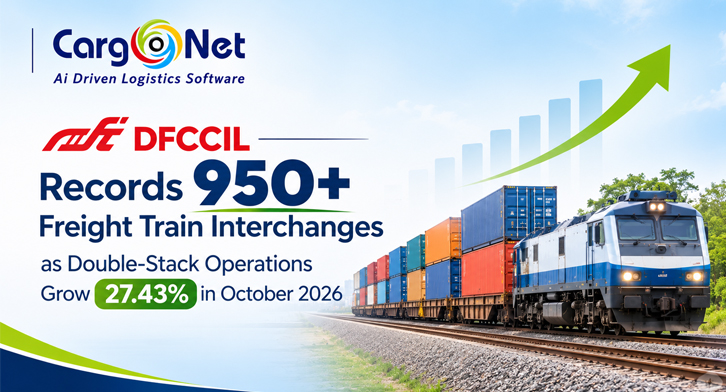
One of the most significant developments is the 27.43% year-on-year increase in double-stack freight train operations in October 2026. DFCCIL also achieved its highest-ever interchange of more than 950 freight trains on November 7, 2026, marking an important operational milestone for India’s dedicated freight corridor network.
Double-Stack Freight Train Operations Increase 27.43%
DFCCIL operated 1,203 double-stack freight trains in October 2026, compared with 944 trains during the corresponding month in 2025. This represents an increase of 259 trains, translating into 27.43% year-on-year growth.
Double-stack operations allow freight containers to be transported in two vertical layers on specially designed rail wagons, increasing container-carrying capacity per train movement. This operating model can improve rail freight productivity, particularly for containerized cargo moving across long-distance routes.
The increase in double-stack train movements indicates stronger utilization of dedicated freight infrastructure and growing demand for higher-capacity rail transportation.
Average Daily Freight Train Movements Rise to 472
DFCCIL has also reported an increase in average daily freight train movements across its dedicated corridors. The number rose from 385 trains per day in October 2025 to 472 trains per day in October 2026.
The reported year-on-year growth is 22.78%, reflecting an increase in freight train activity and improved utilization of the dedicated rail network. Higher daily train movements indicate that the corridors are handling a greater volume of rail operations, strengthening their role in India’s domestic freight transportation and EXIM logistics.
For freight forwarders, shipping companies and cargo operators, increased rail capacity can create more opportunities for integrating rail transportation into multimodal supply chains, particularly for long-distance container movement.
DFCCIL Sets New Record with 951 Freight Train Interchanges
Another major milestone came on November 7, 2026, when DFCCIL recorded 951 freight train interchanges in a single day across the Eastern and Western Dedicated Freight Corridors.
The corridor-wise breakdown was:
- Eastern Dedicated Freight Corridor (EDFC): 516 train interchanges.
- Western Dedicated Freight Corridor (WDFC): 435 train interchanges.
- Combined total: 951 train interchanges.
An interchange occurs when a freight train transfers between the Dedicated Freight Corridor network and the conventional Indian Railways network. These connections are important because they enable freight trains to access terminals, industrial locations, ports and other destinations beyond the dedicated corridors.
The latest record surpassed the previous benchmark of 946 interchanges recorded on October 6, 2026. According to Maritime Gateway’s report on DFCCIL’s record performance, the November milestone reflects growing coordination between dedicated freight infrastructure and the wider railway network.
Key Operational Statistics: DFCCIL October–November 2026
Performance indicator
October 2025
October 2026 / November 2026
Growth
Double-stack train operations
944
1,203
+27.43%
Average daily train movements
385
472
+22.78% reported
Highest daily interchange
946 (Oct 6, 2026)
951 (Nov 7, 2026)
New record
EDFC interchange
—
516
—
WDFC interchange
—
435
—
Source: DFCCIL performance figures reported in November 2026. Note: The published daily averages of 385 and 472 imply approximately 22.6% growth when calculated from the rounded figures; 22.78% is the reported growth rate.
How the Latest DFCCIL Milestones Strengthen India’s Logistics Network
The increasing utilization of dedicated freight corridors has implications beyond railway operations. It can strengthen the connections between manufacturing centres, inland container depots, ports and distribution hubs.
Three developments are particularly relevant to India’s logistics sector:
1. Improved container transportation capacity
The rise in double-stack train operations indicates greater use of high-capacity container transportation. This can help move more containers through suitable rail infrastructure and improve the utilization of freight assets.
2. Stronger port and inland connectivity
The Western Dedicated Freight Corridor supports freight movement between northern India’s industrial and logistics centres and the western port network, including Jawaharlal Nehru Port. Improved rail connectivity can support EXIM cargo movement and inland distribution.
3. Better integration with conventional railways
The 951-train interchange milestone highlights the importance of coordination between DFCCIL and Indian Railways. Efficient interchange operations help connect dedicated freight routes with the wider railway network.
The Ministry of Railways’ explanation of Dedicated Freight Corridor operations and freight efficiency provides additional context on how dedicated freight infrastructure supports higher operational efficiency and reduces pressure on conventional railway routes.
Conclusion
DFCCIL’s latest operational achievements demonstrate the growing importance of dedicated freight rail infrastructure in India’s logistics transformation. The 951-train interchange record, 27.43% growth in double-stack operations and increase in average daily train movements reflect stronger utilization of the Eastern and Western freight corridors.
As India’s freight transportation requirements continue to expand, dedicated freight corridors will remain important for improving rail connectivity, supporting containerized cargo movement and strengthening multimodal supply chains.
Frequently Asked Questions
What is DFCCIL’s latest freight train interchange record?
DFCCIL recorded 951 freight train interchanges on November 7, 2026, across the Eastern and Western Dedicated Freight Corridors.
How much did double-stack train operations increase in October 2026?
Double-stack train operations increased by 27.43% year-on-year, rising from 944 trains in October 2025 to 1,203 trains in October 2026.
How many freight trains does DFCCIL operate daily?
DFCCIL reported an average of 472 freight train movements per day in October 2026, compared with 385 in October 2025.
What is the difference between EDFC and WDFC?
EDFC refers to the Eastern Dedicated Freight Corridor, while WDFC refers to the Western Dedicated Freight Corridor. Both are designed to facilitate high-capacity freight transportation and improve railway logistics connectivity.
How do double-stack trains benefit India’s logistics industry?
Double-stack trains transport containers in two vertical layers on suitable wagons, increasing container-carrying capacity per train and supporting more efficient rail freight transportation.