
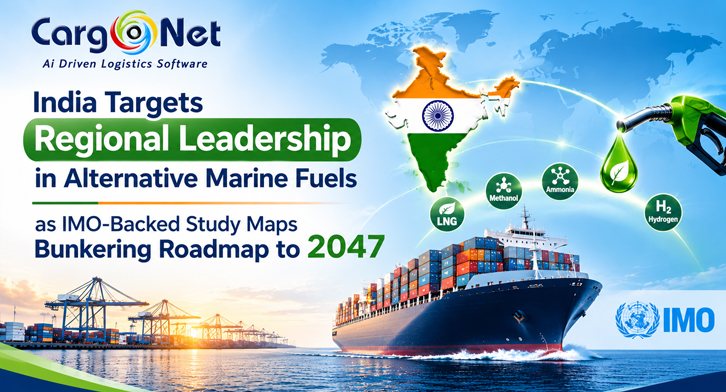
India is positioning itself to become a competitive regional hub for alternative marine fuels, with a proposed development strategy focusing on biofuels, methanol and ammonia. An IMO-supported study has outlined a phased roadmap extending to 2047, identifying four strategic ports and highlighting the commercial opportunities emerging from the global shipping industry’s transition towards cleaner energy.
The study, titled Potential Demand and Pricing of Alternative Marine Fuels in India, was initiated by India’s Directorate General of Maritime Administration (DGMA) and the Ministry of Ports, Shipping and Waterways (MoPSW), with support from the International Maritime Organization’s (IMO) GreenVoyage2050 Programme.
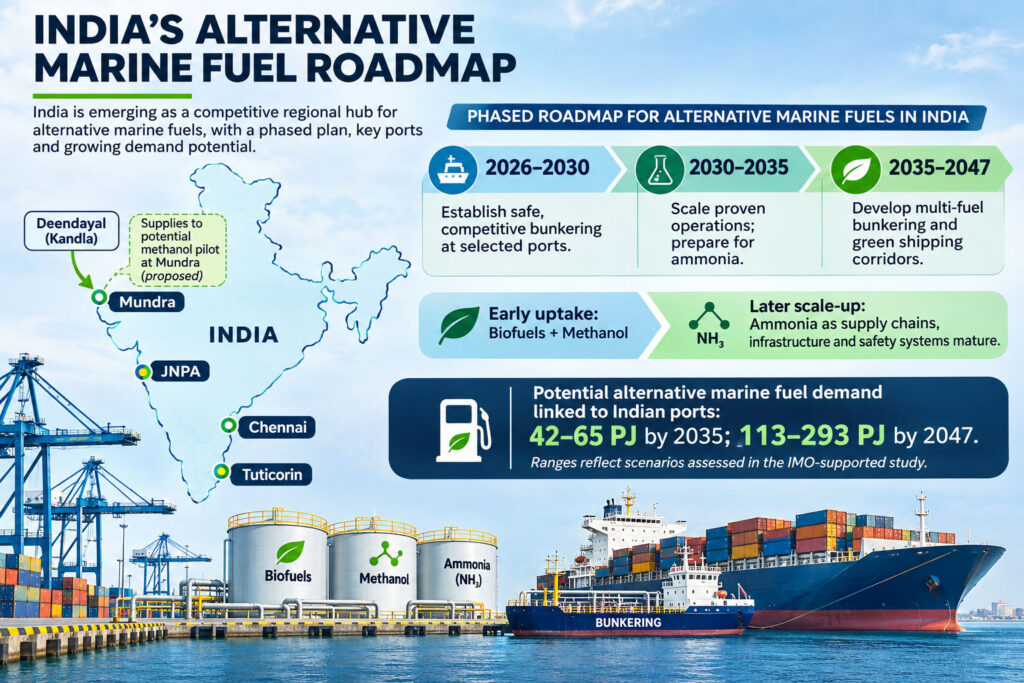
According to the study, India’s alternative marine fuel demand linked to its ports could reach 42–65 petajoules (PJ) by 2035, increasing to 113–293 PJ by 2047, depending on the scenarios assessed. The findings underline the potential for India to develop new maritime energy infrastructure, attract investment and strengthen its position in international shipping and bunkering markets. These projections were reported by the IMO-supported GreenVoyage2050 study.
India’s Alternative Marine Fuel Demand Could Reach 293 PJ by 2047
The transition towards cleaner marine fuels is creating new opportunities for countries with established port infrastructure, strong shipping connectivity and the ability to develop reliable fuel supply chains.
India’s maritime sector could benefit from this transition by developing alternative fuel bunkering facilities at selected ports. However, the study emphasises that geographical advantages alone will not make India a preferred bunkering destination.
Shipping companies are expected to consider the total cost and efficiency of refuelling, including:
- Delivered alternative fuel prices.
- Port charges and additional service costs.
- Availability of fuel when vessels require it.
- Bunkering infrastructure and operational efficiency.
- Safety standards and regulatory approvals.
- Reliability of fuel supply and turnaround times.
This means Indian ports will need to compete not only on location but also on the overall commercial value they offer shipowners and shipping operators.
Four Indian Ports Identified for Alternative Fuel Bunkering
The study recommends concentrating initial development efforts at four strategic ports: Mundra, Jawaharlal Nehru Port (JNPA/JNPT), Chennai and Tuticorin.
These locations have established cargo-handling operations and shipping activity, providing opportunities to develop alternative marine fuel demand from vessels that already call at Indian ports.
Rather than depending primarily on ships passing through international shipping routes, the proposed approach focuses on serving existing port traffic and building a commercially sustainable bunkering market.
Strategic port
Proposed role in the development strategy
Mundra Port
Potential location for India’s initial methanol bunkering pilot
Jawaharlal Nehru Port (JNPA)
Strategic port for developing alternative fuel bunkering
Chennai Port
Potential centre for alternative fuel supply and bunkering
Tuticorin (VOC Port)
Potential location for expanding alternative fuel bunkering
The study identifies Mundra as a potential starting point for methanol bunkering, with fuel supply proposed from Deendayal Port (Kandla). This could help establish an initial operational model before similar facilities are expanded to other strategic ports.
Biofuels and Methanol Expected to Lead India’s Marine Fuel Transition
India’s alternative marine fuel strategy is expected to follow a multi-fuel approach rather than depend on a single energy source.
Biofuels and methanol are identified as potential early contributors because they could support the initial stages of market development. Ammonia is expected to become more relevant as production capacity, storage infrastructure, supply chains and maritime safety frameworks mature.
The proposed fuel transition can be understood through the following comparison:
Alternative marine fuel
Expected role
Development priority
Biofuels
Support early adoption of alternative marine fuels
Near-term
Methanol
Potential starting fuel for commercial bunkering pilots
Near-term
Ammonia
Support future alternative fuel requirements as infrastructure matures
Medium to long-term
The proposed approach gives ports, fuel suppliers and shipping companies time to develop infrastructure, operational capabilities and commercial partnerships before introducing more complex fuel pathways.
India’s Alternative Marine Fuel Roadmap: Three Phases from 2026 to 2047
The IMO-supported study outlines a three-stage development strategy for establishing India’s alternative marine fuel bunkering ecosystem.
Phase 1: Establish bunkering infrastructure (2026–2030)
The initial phase will focus on introducing safe and commercially competitive alternative fuel bunkering at selected ports.
Key priorities include:
- Developing initial methanol bunkering operations.
- Establishing reliable fuel supply arrangements.
- Creating clear regulatory approval procedures.
- Improving port-level safety and operational standards.
- Supporting the deployment of bunkering infrastructure.
Phase 2: Expand operations and prepare for ammonia (2030–2035)
Once initial bunkering operations become commercially viable, India can expand successful models and prepare selected ports for additional alternative fuels.
Key priorities include:
- Scaling proven bunkering operations.
- Strengthening fuel storage and distribution networks.
- Developing ammonia-related safety and handling capabilities.
- Encouraging investment from fuel suppliers and infrastructure operators.
- Improving coordination between ports, shipping companies and energy producers.
Phase 3: Develop multi-fuel bunkering hubs (2035–2047)
The final phase aims to establish India as a more developed regional alternative marine fuel hub, with multi-fuel bunkering capabilities and connections to green shipping corridors.
Key priorities include:
- Expanding biofuel, methanol and ammonia bunkering.
- Developing integrated maritime energy infrastructure.
- Strengthening international shipping partnerships.
- Supporting green shipping corridor development.
- Positioning Indian ports within emerging global clean-fuel supply networks.
Alternative Marine Fuel Development Timeline
Timeline
Development milestone
Main objective
2026–2030
Initial bunkering infrastructure
Establish safe and competitive operations
2030–2035
Expansion and ammonia preparation
Scale proven operations and prepare infrastructure
2035–2047
Multi-fuel bunkering ecosystem
Develop green shipping corridors and regional competitiveness
What This Development Means for India’s Shipping and Logistics Industry
The development of alternative marine fuel infrastructure could create opportunities across India’s maritime logistics and energy supply chains.
1. New investment opportunities in port infrastructure
Ports may require specialised fuel storage facilities, pipelines, bunkering vessels and safety systems. This could attract investment from port operators, energy companies and infrastructure developers.
2. New opportunities for fuel suppliers
Biofuel and methanol producers could find new commercial opportunities by supplying marine fuel to shipping companies operating through Indian ports.
3. Greater competitiveness in international shipping
Competitive fuel prices, faster bunkering services and reliable port operations could make Indian ports more attractive to international shipping operators.
4. Growth in green maritime logistics
The development of alternative fuel infrastructure could support shipping companies seeking to reduce the environmental impact of their operations and strengthen sustainable supply chains.
5. Development of green shipping corridors
India’s proposed multi-fuel bunkering ecosystem could support future partnerships between domestic ports and international shipping networks.
National Green Shipping Policy to Support Maritime Decarbonisation
The findings are also expected to contribute to the development of India’s National Green Shipping Policy, which aims to accelerate maritime decarbonisation while improving the competitiveness of the country’s shipping sector.
The initiative aligns with the broader maritime decarbonisation agenda being pursued by the International Maritime Organization. Through its GreenVoyage2050 Programme, the IMO supports developing countries with technical assistance, policy development and pilot projects to reduce greenhouse gas emissions from shipping.
India has also been advancing its maritime decarbonisation planning through its Maritime India @ Net Zero initiative, which provides a framework for policy development, green fuel implementation and port-level sustainability measures.
Challenges India Must Address to Become a Regional Marine Fuel Hub
Despite the opportunities, establishing a competitive alternative marine fuel market will require coordinated efforts from government authorities, port operators, fuel suppliers and shipping companies.
The major areas requiring attention include:
- Infrastructure investment: Developing storage, transportation and bunkering facilities for different fuel types.
- Fuel price competitiveness: Ensuring delivered fuel costs remain attractive compared with established regional bunkering hubs.
- Safety regulations: Establishing clear procedures for handling, storing and supplying methanol and ammonia.
- Reliable fuel availability: Building dependable supply chains to meet shipping operators’ requirements.
- Skilled workforce: Training maritime personnel in alternative fuel handling and emergency response.
- Commercial demand: Encouraging shipping companies to adopt alternative fuels and establish long-term supply agreements.
The IMO-supported assessment highlights the importance of integrating bunkering with cargo handling and other port services to improve the overall efficiency of vessel calls.
Frequently Asked Questions
Can India become a regional hub for alternative marine fuels?
Yes. An IMO-supported study identifies India as a potential regional hub for alternative marine fuels, supported by its existing port infrastructure, shipping activity and opportunities to develop competitive bunkering services.
Which Indian ports have been identified for alternative marine fuel bunkering?
The four strategic ports identified are Mundra, Jawaharlal Nehru Port (JNPA), Chennai and Tuticorin.
Which alternative marine fuel is expected to be introduced first in India?
Methanol has been identified as the most suitable starting fuel for initial bunkering development, with a potential pilot at Mundra supplied from Deendayal Port (Kandla).
What is India’s projected alternative marine fuel demand by 2047?
The IMO-supported study estimates potential demand linked to Indian ports at approximately 113–293 petajoules (PJ) by 2047, depending on the scenarios assessed.
When will India develop multi-fuel bunkering infrastructure?
The proposed roadmap targets the development of multi-fuel bunkering capabilities and green shipping corridors during 2035–2047.
Why are alternative marine fuels important for the shipping industry?
Alternative marine fuels can help shipping companies reduce greenhouse gas emissions, support maritime decarbonisation and diversify their energy sources. Their environmental benefits depend on fuel production pathways and lifecycle emissions.