
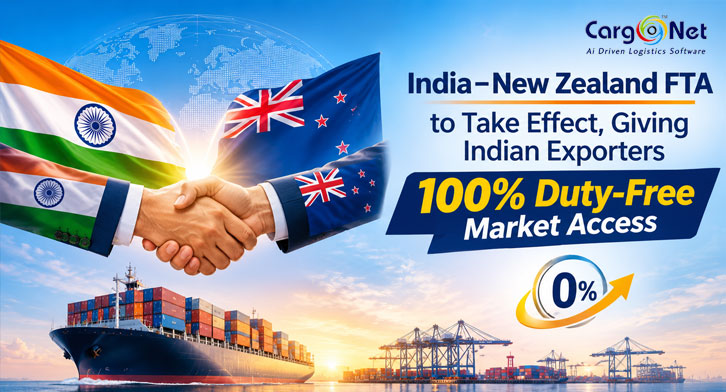
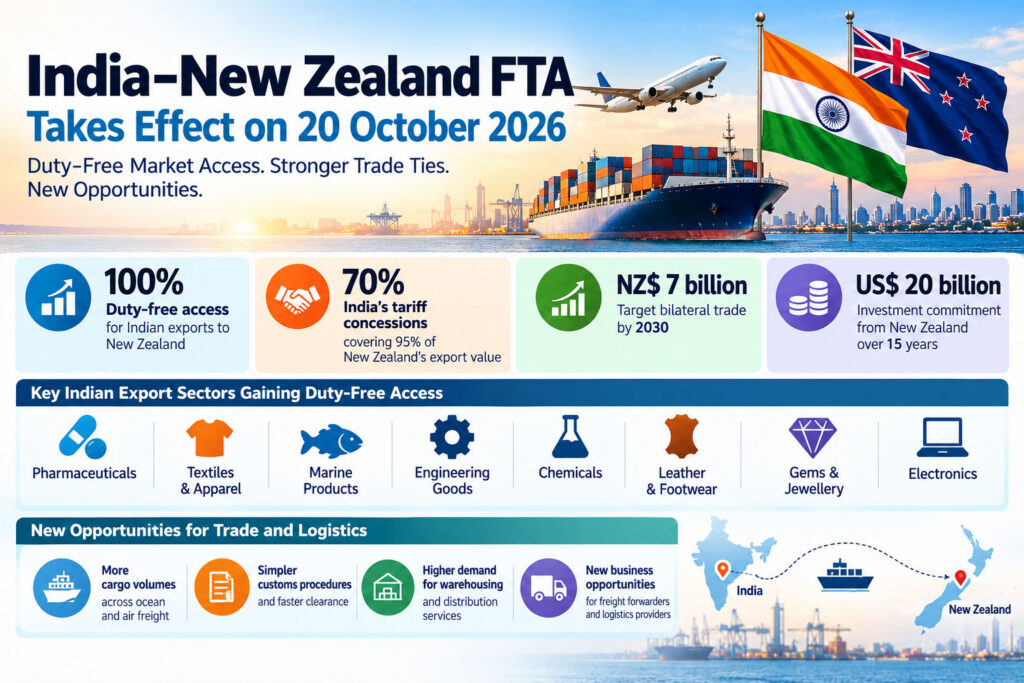
India and New Zealand are set to strengthen their bilateral trade relationship as the India–New Zealand Free Trade Agreement (FTA) takes effect, providing Indian exporters with duty-free access across 100% of New Zealand’s tariff lines for qualifying Indian-origin goods. The agreement officially entered into force on 20 October 2026.
Major sectors expected to benefit include pharmaceuticals, textiles, apparel, leather, footwear, marine products, engineering goods, chemicals, gems and jewellery, and electronics.
India has offered tariff concessions on 70% of its tariff lines, covering 95% of New Zealand’s export value. Certain sensitive sectors are excluded, while selected products receive conditional concessions. Both countries aim to increase bilateral trade in goods and services to NZ$7 billion (approximately ₹35,000 crore) by 2030, and New Zealand has committed to facilitate US$20 billion in investment into India over 15 years.
What the FTA Means for Logistics and Freight Forwarding
- Ocean freight: Increased movement of textiles, engineering products, chemicals and manufactured goods could support additional containerised cargo volumes.
- Air freight: Pharmaceuticals, electronics and high-value shipments may create demand for time-sensitive air cargo services.
- Customs clearance: Exporters and importers will need accurate HS classification, rules-of-origin documentation and preferential tariff claims.
- Freight forwarding: Forwarders may handle more export enquiries, shipment bookings, carrier coordination and cross-border documentation.
- Warehousing and distribution: Greater trade activity could create opportunities for consolidation, inventory management and last-mile distribution.
- Digital freight operations: Accurate documentation, shipment visibility and automated customs workflows could become increasingly important as trade volumes expand.
Important for freight forwarders:
Zero-duty access does not mean zero logistics costs. Exporters must still account for freight charges, insurance, customs compliance, product standards, certification and applicable non-tariff requirements.
How the FTA Could Reshape India–New Zealand Trade Flows
The agreement could strengthen trade connectivity between Indian export centres and New Zealand’s import and distribution network.
What Indian Exporters Should Do to Benefit from the Agreement
Businesses planning to export to New Zealand should prepare for the operational and regulatory requirements associated with preferential trade.
- Identify eligible products: Check the relevant HS codes and tariff commitments under the agreement.
- Verify rules of origin: Ensure products satisfy the FTA’s origin criteria before claiming preferential duties.
- Arrange Certificates of Origin: Obtain the required origin documentation through the authorised process.
- Review New Zealand regulations: Check product-specific safety, labelling, certification and import requirements.
- Calculate landed costs: Factor in freight, insurance, customs charges and other applicable costs.
- Build distribution partnerships: Explore importers, distributors and logistics partners in New Zealand.
The New Zealand Customs Service explains that preferential tariff treatment depends on compliance with rules of origin and the applicable customs procedures. Read the New Zealand Customs FTA guidance.
Frequently Asked Questions
When did the India–New Zealand Free Trade Agreement come into effect?
The India–New Zealand FTA officially entered into force on 20 October 2026.
What benefits does the FTA provide to Indian exporters?
Indian exporters receive duty-free access across 100% of New Zealand’s tariff lines for qualifying Indian-origin goods, improving the price competitiveness of eligible exports.
Which Indian products benefit from the agreement?
Major sectors include pharmaceuticals, textiles, apparel, leather, footwear, marine products, engineering goods, chemicals, gems and jewellery, and electronics.
What is the bilateral trade target between India and New Zealand?
Both countries aim to increase bilateral trade in goods and services to NZ$7 billion (approximately ₹35,000 crore) by 2030.
How much investment has New Zealand committed to India?
New Zealand has committed to facilitate US$20 billion in investment into India over 15 years.
Does India provide duty-free access to all New Zealand products?
No. India has offered tariff concessions on 70% of tariff lines covering 95% of New Zealand’s export value. Certain sensitive sectors are excluded, while selected products receive conditional concessions.
How will the agreement affect the logistics industry?
The agreement could create additional opportunities in ocean freight, air cargo, customs brokerage, freight forwarding, warehousing and cross-border supply chain management.
Do exporters automatically qualify for zero customs duty?
No. Products must meet the applicable rules of origin and documentation requirements. Other regulatory and import compliance requirements also continue to apply.