
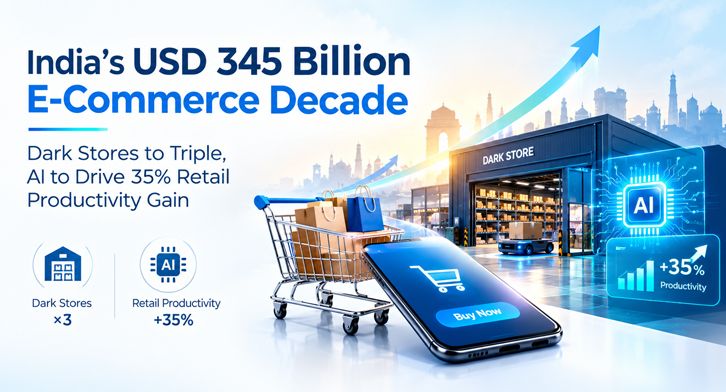
India’s digital retail market is on course to expand nearly three-fold — from USD 125 billion in 2024 to USD 345 billion by 2030 — at a compound annual growth rate of 18.4%, according to Infisum’s Smart Growth in a Fast Market report. The catalyst is quick commerce: sub-30-minute delivery platforms projected to capture 45–50% of all incremental e-retail growth over the next five years, reaching a market size of USD 65–70 billion by 2030.
Supporting this rapid delivery architecture requires hyperlocal fulfilment nodes — dark stores. India’s dark store network is expected to nearly triple from 2,525 locations in 2025 to approximately 7,500 by 2030. Blinkit currently dominates the quick commerce segment with 44% market share, having processed 900 million orders in FY26. Zepto holds 25%, Swiggy Instamart 20%.
India E-Commerce & Quick Commerce — 2024 vs. 2030 Projections (Source: Infisum)
Metric
2024 / FY26 Baseline
2030 Projection
Geopolitical E-commerce market
USD 125B
USD 345B
CAGR
—
18.4%
Quick commerce market
Growing
USD 65–70B
Quick commerce share of growth
—
45–50% of incremental e-retail
Dark store count
2,525 (2025)
~7,500
Online shopper base
Current cohort
420–440 million
E-com % of total retail
~5%
10–12%
Contribution to national GDP
—
~2.5%
AI productivity improvement (retail)
—
35–37% by 2030
Tier II/III share of new D2C orders
66% currently
Growing
Gen Z already accounts for roughly one-third of Indian online shoppers and is projected to become the country’s largest digital-spending cohort by 2030. More significantly for logistics operators, 66% of new direct-to-consumer orders now originate from Tier II and Tier III cities — meaning the inland freight network, not just metro distribution, determines who wins in the next growth phase.
Frequently Asked Questions
Why is India's e-commerce market expected to reach USD 345 billion by 2030?
India’s e-commerce is forecast to grow from USD 125 billion (2024) to USD 345 billion by 2030 at 18.4% CAGR, driven by quick commerce capturing 45–50% of incremental growth, a tripling of dark stores from 2,525 to 7,500, AI-powered retail productivity improvements of 35–37%, and 420–440 million online shoppers by 2030. Gen Z is the fastest-growing buyer segment; 66% of new D2C orders already come from Tier II and III cities, pulling inland freight demand beyond the metro core.
What is quick commerce and how does it affect last-mile logistics in India?
Quick commerce refers to on-demand delivery platforms (Blinkit, Zepto, Swiggy Instamart) promising sub-30-minute delivery from hyperlocal dark stores. Blinkit leads with 44% market share after processing 900 million FY26 orders. For logistics operators, quick commerce drives dark store build-out (tripling to 7,500 by 2030), dense urban inventory positioning, micro-fleet last-mile operations, and high-frequency replenishment cycles from regional distribution centres.