
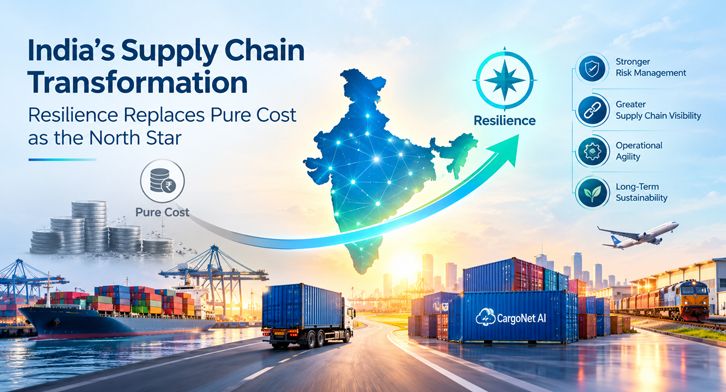
India’s supply chain community has reached a strategic inflection point. A comprehensive study by DP World — the “India Country Report 2026” — surveyed 451 senior logistics and supply chain decision-makers and found that supplier diversification has overtaken cost reduction as the dominant priority. That is not an incremental shift; it represents a wholesale rethink of what supply chain excellence actually means in a world where disruption is structural rather than exceptional.
Friend-shoring — routing supply chains through countries with aligned trade and political relationships — and strategic inventory positioning round out the top three priorities. Collectively, these three reflect a philosophy of managed redundancy: deliberately accepting additional cost and complexity in exchange for operational continuity when any single supply source fails.
The digitalization gap between India and the rest of the world is widening in India’s favour. More than half of surveyed Indian businesses have completed full digitalization of customer-facing services; globally, that milestone has been reached by fewer than four in ten. AI is delivering measurable results in three specific operational areas: route optimisation, documentation processing, and customs efficiency — the three highest-friction points in Indian cross-border freight.
India vs. Global — Strategic Priorities Comparison
Supply Chain Priorities — India versus Global Benchmark (DP World India Country Report 2026)
Priority / Metric
India
Global Benchmark
#1 Priority
Supplier diversification
Also high, lower urgency
#2 Priority
Strategic inventory positioning
Varies by sector
#3 Priority
Friend-shoring
Emerging globally
Customer-facing digitalization
>50% fully complete
<40% globally
Trade finance accessibility
57% report adequate
39% globally
AI adoption in logistics
Route, docs, customs
Patchy outside top players
Infrastructure priority
46% cite road networks
Varies by country
Top policy priority
FTAs (~50% of executives)
Lower ranked globally
The PLI (Production Linked Incentive) scheme is pulling manufacturing capacity back to Indian soil across 14 sectors. Meanwhile, eight trade agreements — with the UAE, Australia, UK, EFTA states, Oman, New Zealand, the EU, and most recently advances with the GCC and Israel — are opening new sourcing and distribution corridors. The DP World CEO for the Subcontinent region summarised the moment: diversified sourcing, strategic inventory, and access to new markets are no longer differentiators. They are prerequisites for competing in the decade ahead.
Frequently Asked Questions
What are the top supply chain priorities for Indian businesses in 2026?
According to the DP World India Country Report 2026, which surveyed 451 senior logistics executives, the top three priorities are:
- supplier diversification — overtaking cost reduction as
- strategic inventory positioning — building buffer stock closer to customers
- friend-shoring — routing supply chains through allied trade partners. More than 50% of Indian businesses have fully digitalized customer-facing services, vs. under 40% globally, and 57% report adequate trade finance access, vs. 39% globally
What is friend-shoring and why does it matter for Indian supply chains?
Friend-shoring means routing supply chains through countries with politically and commercially aligned relationships — preferring suppliers in allied nations over purely lowest-cost sources. For India, this means the UAE, Australia, UK, EFTA, Oman, and EU trade corridors are being prioritised not just for cost but for supply security. It directly influences which lanes, ports, and freight corridors see volume growth in FY27.