

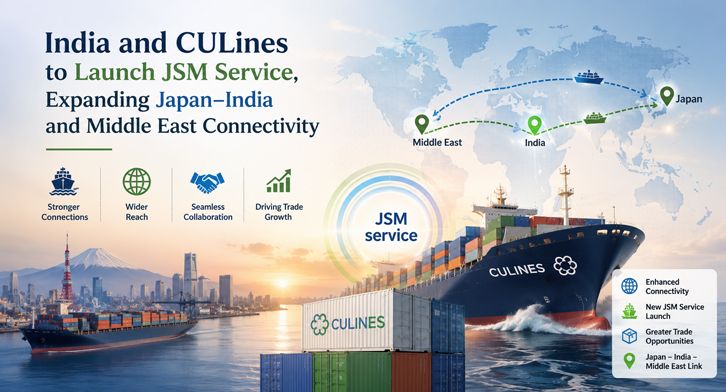
CULines will launch its new Japan–Straits–Malaysia (JSM) service on September 5, 2026, strengthening shipping connections between Japan, Southeast Asia and emerging markets across India, Pakistan, the Middle East and the Red Sea.
The weekly service will connect four major Japanese gateways—Tokyo, Yokohama, Nagoya and Kobe—with Keelung, Hong Kong, West Port Klang and Singapore.
CULines will operate the JSM service through a slot-exchange agreement with Ocean Network Express (ONE). The cooperation is expected to expand the carrier’s intra-Asia network while providing shippers with more flexible connections to South Asia and Middle Eastern markets.
JSM Service at a Glance
- Launch date: September 5, 2026
- Service name: Japan–Straits–Malaysia Service
- Service code: JSM
- Operator: CULines
- Cooperation partner: Ocean Network Express
- Japanese gateways: Tokyo, Yokohama, Nagoya and Kobe
- Asian hubs: Keelung, Hong Kong, West Port Klang and Singapore
- Onward markets: India, Pakistan, the Middle East and the Red Sea
- Connection type: Direct Asian port calls with onward transshipment options
JSM Port Rotation
Tokyo → Yokohama → Nagoya → Kobe → Keelung → Hong Kong → West Port Klang → Singapore → Tokyo
Rotation
Port
Market role
1
Tokyo
Major Japanese gateway
2
Yokohama
Key container port serving eastern Japan
3
Nagoya
Important industrial and manufacturing gateway
4
Kobe
Major western Japan shipping hub
5
Keelung
Taiwan gateway and regional connection point
6
Hong Kong
International transshipment and trading hub
7
West Port Klang
Connection point for South Asia, the Middle East and the Red Sea
8
Singapore
Major Southeast Asian transshipment hub
9
Tokyo
Beginning of the next service cycle
How Will the JSM Service Connect Japan with India?
India is not listed as a direct port call in the announced JSM rotation. Cargo moving between Japan and India can instead connect through West Port Klang, where shipments can be transferred to services operating toward Indian ports.
This transshipment structure can give exporters and importers access to additional routing options between Japan and India without adding Indian ports to the core JSM rotation.
Similar onward connections will be available for cargo moving to Pakistan, the Middle East and Red Sea markets.
Why the New Service Matters for Shippers
More access to Japanese gateways
The inclusion of Tokyo, Yokohama, Nagoya and Kobe gives shippers access to four important Japanese commercial and industrial regions through one service.
Improved connections through Port Klang
West Port Klang will serve as a central transshipment point for cargo moving between Japan and markets across South Asia, the Middle East and the Red Sea.
Greater routing flexibility
Connections through both Port Klang and Singapore may provide freight forwarders and cargo owners with additional options when planning regional and long-distance shipments.
Stronger intra-Asia connectivity
Calls at Keelung, Hong Kong, Port Klang and Singapore strengthen links between major manufacturing, trading and transshipment centres across Asia.
Direct Calls and Onward Markets
Direct JSM port calls
Markets reached through transshipment
Tokyo
India
Yokohama
Pakistan
Nagoya
Middle East
Kobe
Red Sea
Keelung
Other connected regional markets
Hong Kong
West Port Klang
Singapore
What Does the JSM Service Mean for Freight Forwarders?
Freight forwarders handling Japan–India and Japan–Middle East shipments may gain another routing option for:
- Comparing transit times and freight rates
- Planning cargo connections through Port Klang
- Consolidating shipments from several Japanese gateways
- Managing transshipment schedules
- Offering customers alternative sailing options
- Responding to capacity or schedule changes on existing services
Actual transit times, sailing frequency, capacity and destination connections should be confirmed through the carrier’s published schedule.
Frequently Asked Questions
When will CULines launch the JSM service?
CULines is scheduled to launch the JSM service on September 5, 2026.
What is the full form of the JSM service?
JSM stands for Japan–Straits–Malaysia.
Which ports are included in the JSM rotation?
The announced rotation is Tokyo, Yokohama, Nagoya, Kobe, Keelung, Hong Kong, West Port Klang, Singapore and back to Tokyo.
Does the JSM service call directly at Indian ports?
No Indian port appears in the announced rotation. India-bound cargo will be connected through transshipment, particularly via West Port Klang.
Who will operate the JSM service?
CULines will provide the service through a slot-exchange cooperation with Ocean Network Express.
Which markets will benefit from the service?
The service is designed to improve connections between Japan, Southeast Asia, India, Pakistan, the Middle East and Red Sea markets.