
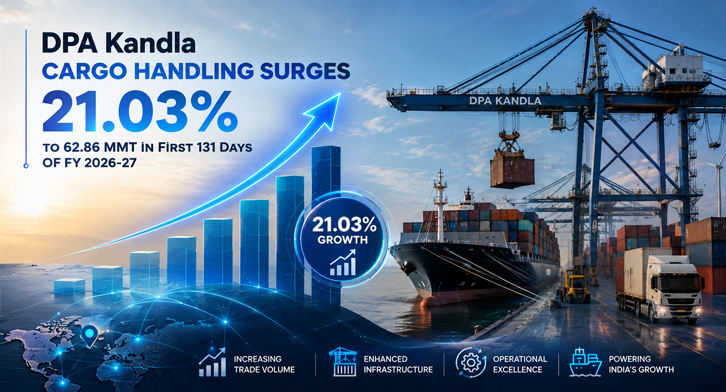
Deendayal Port Authority (DPA), Kandla, has started FY 2026-27 on a strong note, recording 21.03% year-on-year growth in cargo handling during the first 131 days of the financial year.
The port handled 62.86 million metric tonnes (MMT) of cargo between April 1 and August 9, 2026, compared with 51.94 MMT during the corresponding period of the previous year. The increase represents an additional 10.92 MMT of cargo, highlighting the continued strength of cargo movement through one of India’s major maritime gateways.
The latest performance comes after DPA Kandla handled a record 160.11 MMT in FY 2025-26, the highest cargo volume recorded in the history of India’s major ports, according to the port’s official release.
Key Highlights
- 62.86 MMT of cargo handled up to August 9, 2026
- 21.03% YoY growth compared with the same period last year
- 51.94 MMT handled during the corresponding period in 2025
- 10.92 MMT additional cargo handled year-on-year
- Cargo handled over the first 131 days of FY 2026-27
- DPA handled a record 160.11 MMT in FY 2025-26
DPA Kandla Cargo Growth at a Glance
Indicator
FY 2025-26 Comparable Period
FY 2026-27
Change
Cargo handled
51.94 MMT
62.86 MMT
+10.92 MMT
Year-on-year growth
—
21.03%
Strong increase
Period covered
April 1–August 9, 2025
April 1–August 9, 2026
131 days
Cargo Handling Growth
51.94 MMT → 62.86 MMT
+10.92 MMT | +21.03% YoY
The increase indicates that DPA Kandla is maintaining a strong cargo throughput trajectory early in the new financial year.
Why the Kandla Numbers Matter
DPA Kandla is strategically positioned on India’s western coast and serves cargo flows connected to important industrial, commercial and consumption centres across the hinterland.
For the logistics industry, higher cargo throughput can translate into increased activity across the wider supply chain, including road transportation, rail evacuation, warehousing, customs clearance, freight forwarding, cargo handling and distribution.
The port’s performance is particularly significant following its record FY 2025-26 result. DPA reported that cargo volumes reached 160.11 MMT, with growth across several important categories, including fertilisers, liquid cargo, containers, iron and steel and clay.
What Is Driving DPA Kandla's Growth?
The latest numbers point to several important factors supporting the port’s cargo momentum:
1. Strong Cargo Throughput
Handling nearly 63 MMT in the first 131 days demonstrates sustained cargo movement through the port and its associated logistics ecosystem.
2. Expanding Multimodal Connectivity
Efficient movement of cargo beyond the port gate is critical to maintaining throughput. Road and rail connectivity with the hinterland enables cargo to move between ports, industrial clusters, warehouses and consumption centres.
3. Growing Container and Other Cargo Segments
DPA’s FY 2025-26 performance showed particularly strong growth in container cargo, which increased by 54%, while fertiliser cargo grew by around 32% and liquid cargo by 23.4%.
4. Operational Efficiency
Higher cargo volumes require coordinated vessel operations, berth management, cargo handling, documentation, customs processes and evacuation. Continued operational efficiency therefore remains critical as throughput increases.
What This Means for the Logistics Industry
The growth at DPA Kandla has implications beyond the port itself.
For freight forwarders and logistics companies, higher cargo volumes can create additional demand for transportation planning, shipment coordination, documentation, customs clearance and cargo visibility.
For exporters and importers, sustained port throughput can support greater routing flexibility and strengthen the role of Kandla as a gateway for western and northern Indian trade.
For transporters and warehouse operators, higher cargo movement can generate additional requirements for first- and last-mile transportation, storage, cargo consolidation and distribution.
What This Means for India’s Logistics Sector
DPA Kandla’s latest performance reinforces a broader trend in India’s maritime sector: major ports are increasingly becoming critical engines of trade and logistics growth rather than simply cargo-handling points.
The port’s previous milestone of 160.11 MMT in FY 2025-26 and its latest 21.03% YoY growth suggest that cargo momentum remains strong.
As India’s EXIM volumes expand, the ability of ports to combine capacity, efficient cargo handling, digital processes and reliable hinterland connectivity will become increasingly important.
For freight forwarders, shipping lines, customs brokers and transport operators, the growth at Kandla represents an expanding logistics opportunity — particularly across western and northern India.
Kandla’s Cargo Growth Signals Stronger Momentum for India’s Logistics Sector
DPA Kandla’s 62.86 MMT cargo handling in the first 131 days of FY 2026-27, representing 21.03% YoY growth, signals strong momentum in India’s port-led logistics activity.
The additional 10.92 MMT handled compared with the previous year highlights rising cargo flows through the gateway. Combined with DPA’s record 160.11 MMT performance in FY 2025-26, the latest figures strengthen Kandla’s position as an important gateway for India’s maritime trade.
For the logistics sector, the growth could support opportunities across ,freight forwarding, transportation, warehousing, customs clearance, cargo handling and supply-chain management.
Frequently Asked Questions
What is the latest cargo volume handled by DPA Kandla?
DPA Kandla handled 62.86 million metric tonnes (MMT) of cargo between April 1 and August 9, 2026.
What is DPA Kandla's cargo growth rate in FY 2026-27?
The port recorded 21.03% year-on-year growth during the period.
How much additional cargo did DPA Kandla handle?
DPA handled 10.92 MMT more cargo than during the corresponding period of the previous year.
How much cargo did DPA Kandla handle in FY 2025-26?
DPA Kandla handled a record 160.11 MMT during FY 2025-26.
Why is DPA Kandla important for India's logistics sector?
Kandla is an important maritime gateway serving cargo movements connected with western and northern Indian markets. Its cargo growth can influence demand for transportation, warehousing, customs clearance, freight forwarding and other logistics services.