
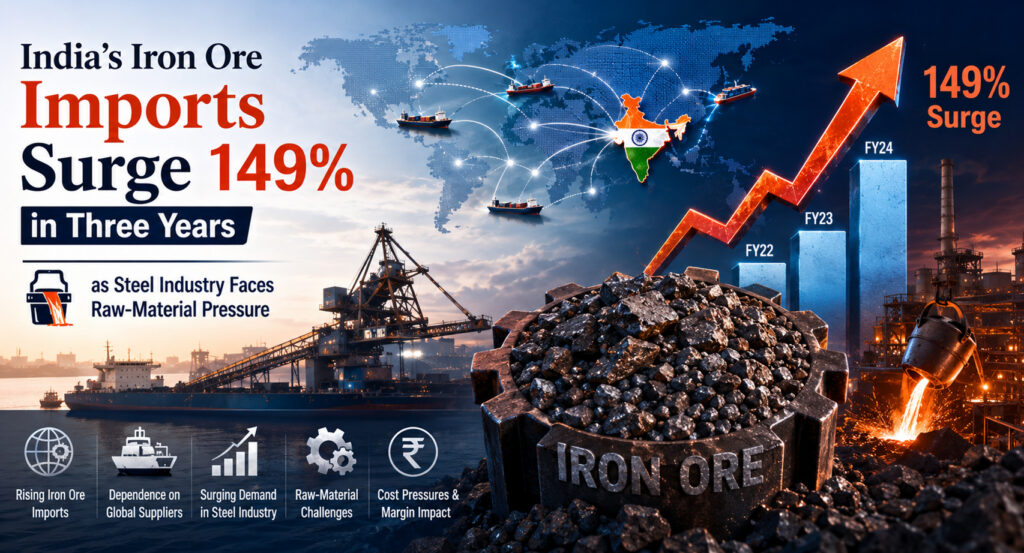
India’s iron ore and pellet imports have surged nearly 149% in three years, highlighting growing raw-material requirements as the country’s steel industry expands. Imports increased from 4.9 million tonnes to 12.2 million tonnes, according to data presented by the Ministry of Steel in the Lok Sabha.
The sharp rise points to a widening challenge for India’s steel supply chain: how to match rapidly growing steelmaking capacity and demand with reliable, cost-effective domestic supplies of key raw materials.
Higher input costs, logistics expenses, fuel shortages and constraints in raw-material availability are adding further pressure on steel manufacturers and the wider industrial logistics network.
Key Highlights
- Iron ore and pellet imports: Increased from 4.9 million tonnes to 12.2 million tonnes, up nearly 149%.
- Coking coal imports: Rose from 58 million tonnes to 66 million tonnes, an increase of about 13.8%.
- Ferrous scrap imports: Declined from 9.5 million tonnes to 7.7 million tonnes, a fall of nearly 19%.
- Iron ore and pellet imports: Reached a seven-year high in FY2025-26, according to industry data.
- Crude steel production: Increased 1.4% year-on-year in May 2026.
- Finished steel production: Rose 5.9% year-on-year in May 2026.
- Rising imports underline the importance of raw-material security, efficient freight movement and resilient supply chains for India’s steel sector.
India’s Iron Ore Import Growth at a Glance
Parameter
Earlier Level
Latest Level
Change
Iron ore & pellets
4.9 million tonnes
12.2 million tonnes
1.49
Coking coal
58 million tonnes
66 million tonnes
0.138
Ferrous scrap
9.5 million tonnes
7.7 million tonnes
-19%
Why Are India’s Iron Ore Imports Rising?
1. Expanding Steel Production
India’s steel industry continues to expand alongside infrastructure development, construction, manufacturing and other industrial activities.
The increase in finished steel production in May 2026 indicates continued strength in domestic steel output. As steelmakers expand production, their requirement for iron ore, pellets and other inputs also increases.
2. Availability of Specific Grades
Domestic iron ore production does not always provide the specific grades, qualities or characteristics required by individual steel plants.
Imports can therefore help steelmakers bridge supply gaps and maintain production when suitable domestic material is unavailable or commercially less attractive.
3. Rising Logistics and Input Costs
Steel manufacturers are also dealing with higher logistics and input costs. Transportation expenses are particularly important because iron ore, coal and other bulk materials require large-scale movement between mines, ports, processing facilities and steel plants.
Efficient rail, road and port connectivity can therefore play a critical role in controlling the delivered cost of raw materials.
4. Fuel and Supply-Chain Constraints
Fuel shortages and wider supply-chain disruptions have added pressure to the steel sector.
When domestic supply becomes constrained, imports can provide an alternative source of raw materials. However, greater import dependence also increases exposure to international commodity prices, ocean freight rates, port congestion and global supply disruptions.
Coking Coal Imports Also Increase
India’s dependence on imported raw materials is not limited to iron ore and pellets.
Coking coal imports increased from 58 million tonnes to 66 million tonnes, representing growth of approximately 13.8% over the period.
Coking coal is a critical input for conventional blast-furnace-based steelmaking, making its availability strategically important for India’s steel supply chain.
Ferrous Scrap Imports Move in the Opposite Direction
While iron ore and coking coal imports increased, ferrous scrap imports declined.
Imports fell from 9.5 million tonnes to 7.7 million tonnes, a reduction of nearly 19%.
This contrasting trend highlights how different steelmaking routes and raw-material requirements are evolving within India’s steel industry.
What Does the Rise in Iron Ore Imports Mean for Logistics?
The increase in imported iron ore and pellets has implications beyond the steel industry. It creates additional requirements across India’s maritime, port, rail, road and inland logistics networks.
A sustained increase in imports could therefore create additional demand for bulk cargo handling, port infrastructure, rail evacuation, warehousing and multimodal transportation capacity.
Steel Production Continues to Grow
Despite raw-material and supply-chain challenges, India’s steel production continued to increase.
Production Indicator
May 2026 Growth YoY
Crude steel production
0.014
Finished steel production
0.059
The stronger increase in finished steel production indicates continued activity across downstream steel markets, including construction, infrastructure, engineering and manufacturing.
The Bigger Supply-Chain Challenge
The latest import figures reveal a broader structural issue for India’s steel industry.
For steelmakers, securing raw materials is increasingly becoming a logistics and supply-chain management challenge, not simply a procurement issue.
Reliable port capacity, efficient cargo evacuation, predictable rail availability and optimized inland transportation can help reduce the landed cost of imported raw materials.
Government Measures to Support the Steel Sector
The government has been working to address challenges related to:
- Fuel availability
- Rising input costs
- Logistics expenses
- Raw-material availability
- Supply-chain constraints
- Overall competitiveness of the steel industry
Strengthening domestic raw-material availability while improving logistics infrastructure will remain important as India’s steelmaking capacity expands.
What Could Happen Next?
The trajectory of iron ore imports will depend on several factors, including:
- Growth in domestic steel demand
- Expansion of Indian steelmaking capacity
- Availability and quality of domestic iron ore
- Global iron ore and pellet prices
- Coking coal availability and prices
- Ocean freight rates
- Port handling capacity
- Rail and road evacuation infrastructure
- Government policies affecting mining, steel and trade
If domestic steel production continues to expand faster than the availability of suitable raw materials, imports could remain an important component of India’s steel supply chain.
Key Takeaway
India’s 149% increase in iron ore and pellet imports over three years is a significant signal for the country’s industrial and logistics sectors.
The rise reflects a combination of strong steel demand, expanding production capacity, raw-material availability challenges and the need for specific ore grades.
For India’s logistics ecosystem, the development reinforces the importance of efficient bulk cargo handling, port infrastructure, rail freight, road transportation and multimodal connectivity.
As India moves toward higher steel production, building a reliable and cost-efficient raw-material supply chain will be critical to maintaining the competitiveness of the country’s steel industry.
Frequently Asked Questions
Why have India’s iron ore imports increased?
India’s iron ore and pellet imports have increased due to rising steel production and demand, availability constraints for certain grades of domestic ore, and broader raw-material and supply-chain pressures.
By how much did India’s iron ore and pellet imports increase?
Imports increased from 4.9 million tonnes to 12.2 million tonnes, representing growth of nearly 149% over the three-year period.
What happened to India’s coking coal imports?
Coking coal imports increased from 58 million tonnes to 66 million tonnes, representing growth of approximately 13.8%.
Did ferrous scrap imports also increase?
No. Ferrous scrap imports declined from 9.5 million tonnes to 7.7 million tonnes, a decrease of nearly 19%.
Why are iron ore imports important for logistics?
Iron ore imports require extensive maritime and inland transportation involving bulk carriers, ports, cargo terminals, railways, roads, storage facilities and steel plants.
What was the growth in Indian steel production in May 2026?
Crude steel production increased 1.4% year-on-year, while finished steel production increased 5.9% in May 2026.