
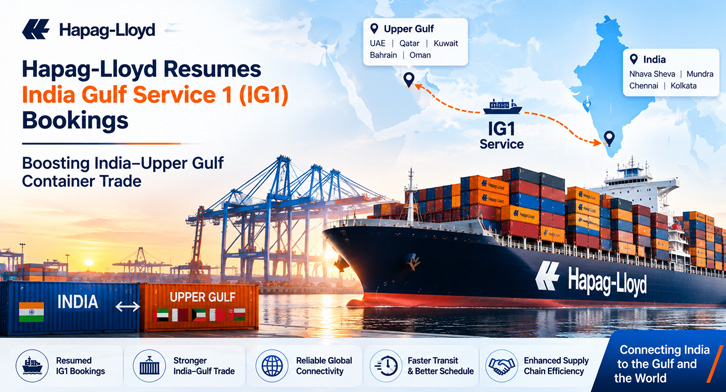
Hapag-Lloyd has officially resumed bookings for its India Gulf Service 1 (IG1), restoring an important shipping corridor between the Indian Subcontinent and the Upper Gulf. The revamped service strengthens regional supply chains by providing reliable container connectivity between India, Pakistan, the UAE, and Oman, while supporting uninterrupted cargo movement across one of the world’s busiest trade corridors.
The resumption comes as global shipping lines gradually normalize operations following recent geopolitical disruptions in the Gulf region. By restoring the IG1 service, Hapag-Lloyd aims to provide exporters, importers, freight forwarders, and logistics providers with greater schedule reliability and improved regional connectivity.
Key Highlights
- Hapag-Lloyd resumes bookings for the India Gulf Service 1 (IG1).
- Connects India, Pakistan, UAE, and Oman through a dedicated regional loop.
- Enhances container movement between South Asia and the Upper Gulf.
- Supports resilient supply chains following recent regional disruptions.
- Improves schedule reliability for exporters and importers.
- Strengthens Hapag-Lloyd's Middle East shipping network.
- Facilitates seamless movement of containerized cargo across major trade hubs.
What is Hapag-Lloyd's India Gulf Service 1 (IG1)?
The India Gulf Service 1 (IG1) is a regional container shipping service connecting major ports in India with Pakistan, the United Arab Emirates, and Oman. The service plays an important role in facilitating bilateral trade, industrial supply chains, and regional cargo distribution across the Middle East and South Asia.
The renewed service is expected to support industries including:
- Manufacturing
- Automotive
- Chemicals
- Consumer Goods
- Retail
- Engineering Products
- Food & Agriculture
- Project Cargo
Updated IG1 Port Rotation
Port
Country
Kandla
India
Nhava Sheva (JNPA)
India
Karachi
Pakistan
Khorfakkan
United Arab Emirates
Sohar
Oman
Return to Kandla
India
Why the Resumption Matters
The reopening of bookings represents more than the return of a shipping service—it signals increasing stability across regional maritime trade.
Benefits for Shippers
- Faster cargo movement between India and Gulf markets
- Reliable weekly connectivity
- Reduced shipment uncertainty
- Improved inventory planning
- Better access to Middle East markets
- Enhanced supply chain resilience
As Gulf economies continue investing in logistics infrastructure and manufacturing, dependable feeder and regional services like IG1 become increasingly important for maintaining trade efficiency.
Impact on India–Middle East Trade
The Middle East remains one of India’s largest trading partners for petroleum products, chemicals, food products, engineering goods, textiles, pharmaceuticals, and consumer products.
The resumed IG1 service will help
Stakeholder
Expected Benefit
Exporters
Improved shipping schedules
Importers
Reliable cargo availability
Freight Forwarders
Better routing options
Logistics Companies
Enhanced regional connectivity
Manufacturers
Stable supply chain planning
Retail Sector
Faster replenishment cycles
Regional Trade Outlook
Container trade between India and the Gulf Cooperation Council (GCC) countries continues to expand, driven by:
- Growing bilateral trade
- Manufacturing diversification
- E-commerce demand
- Infrastructure investments
- Regional distribution hubs
- Rising containerized cargo volumes
The restoration of IG1 aligns with these long-term trade trends and provides customers with additional service reliability across the Arabian Gulf.
FAQs
What is Hapag-Lloyd's India Gulf Service 1 (IG1)?
IG1 is a regional container shipping service connecting India with Pakistan, the UAE, and Oman to facilitate trade across South Asia and the Upper Gulf.
Which ports are included in the IG1 service?
The revised rotation includes Kandla, Nhava Sheva, Karachi, Khorfakkan, Sohar, and back to Kandla.
Why is the resumption of IG1 important?
It restores dependable shipping connectivity, improves supply chain resilience, and supports uninterrupted cargo movement between India and Gulf markets.
Who benefits from the resumed service?
Exporters, importers, freight forwarders, logistics companies, manufacturers, and regional distributors all benefit from improved connectivity and reliable schedules.
Which industries are expected to benefit the most?
Manufacturing, automotive, chemicals, pharmaceuticals, engineering goods, consumer products, food, and retail sectors are expected to gain from the enhanced regional shipping service.