
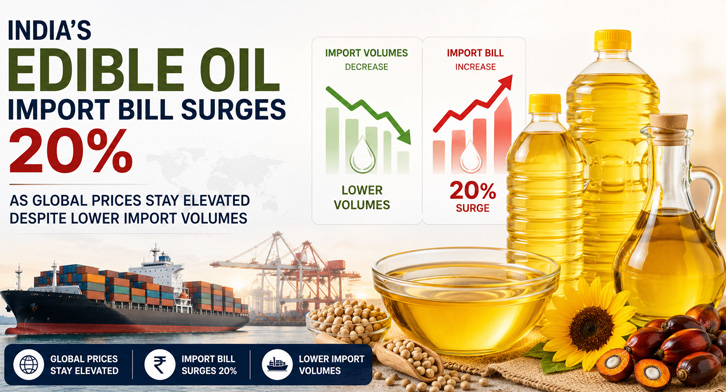
India’s edible oil import bill surged nearly 20% during the first eight months of the current oil marketing year, highlighting the country’s continued dependence on imported edible oils despite a decline in import volumes. Rising international prices, currency fluctuations, and higher freight costs significantly increased the overall value of imports.
Although import quantities moderated due to cautious buying and inventory management, elevated prices of palm oil, soybean oil, and sunflower oil pushed India’s import expenditure higher, adding pressure on the country’s trade balance.
The development reflects the vulnerability of India’s edible oil supply chain to global market disruptions, making international pricing, weather conditions, export policies, and shipping costs critical factors for domestic food inflation.
Key Highlights
- Edible oil import bill increased approximately 20%
- Import volumes declined, but higher global prices lifted total import value.
- Palm oil remains India's largest imported edible oil.
- Soybean and sunflower oil imports continue to support domestic demand.
- Higher freight charges and currency movements increased landed costs.
- Domestic consumption remains strong across households, hotels, restaurants, and food processors.
- Rising import costs could keep retail edible oil prices elevated.
- Global supply disruptions may further impact India's food inflation.
Why India's Import Bill Increased
Several factors contributed to the rise in import expenditure despite lower shipment volumes.
Factor
Impact on Imports
Higher international edible oil prices
Increased import value
Expensive ocean freight
Raised landed costs
Currency fluctuations
Higher import payments
Strong domestic consumption
Sustained import demand
Global supply uncertainty
Price volatility
India's Major Imported Edible Oils
Edible Oil
Share in Imports
Primary Use
Palm Oil
Highest
Cooking, processed foods
Soybean Oil
High
Household consumption
Sunflower Oil
Significant
Premium cooking oil
Major Supplier Countries
India sources edible oils from multiple producing nations.
Country
Major Export
Indonesia
Palm Oil
Malaysia
Palm Oil
Argentina
Soybean Oil
Brazil
Soybean Oil
Russia
Soybean Oil
Ukraine
Soybean Oil
Supply Chain & Logistics Impact
The increase in edible oil import expenditure has broader implications for India’s logistics and supply chain ecosystem.
Import Logistics
- Higher containerized and bulk cargo movement through major ports.
- Increased dependence on efficient maritime logistics.
- Rising freight rates affecting landed costs.
Port Operations
Major edible oil imports continue through ports including:
- Kandla
- Mundra
- Chennai
- Mumbai
- Visakhapatnam
Higher import values could increase storage demand at liquid cargo terminals and edible oil tank facilities.
Impact on the Indian Economy
The rising edible oil import bill could influence multiple economic indicators.
Sector
Expected Impact
Trade Deficit
Negative
Food Inflation
Upward Pressure
FMCG Industry
Higher input costs
Hospitality
Increased procurement costs
Food Processing
Margin pressure
Global Factors Driving Prices
International edible oil prices will largely depend on:
- Weather conditions in producing countries
- Palm oil production in Indonesia and Malaysia
- Soybean harvest in South America
- Sunflower oil exports from the Black Sea region
- Export restrictions by producing nations
- Crude oil prices affecting biofuel demand
- Ocean freight rates
- Exchange rate movements
Future of India's Edible Oil Imports
Industry analysts expect India’s edible oil imports to remain substantial due to limited domestic production. Unless global supplies improve significantly, elevated international prices may continue to increase import expenditure over the coming months.
Government policies aimed at improving domestic oilseed production under self-reliance initiatives could gradually reduce dependence on imports over the long term. However, in the near future, India will remain one of the world’s largest edible oil importers.
FAQs
Why did India's edible oil import bill increase despite lower imports?
Higher global prices, increased freight costs, and currency fluctuations raised the overall value of imports even though import volumes declined.
Which edible oil does India import the most?
Palm oil accounts for the largest share of India’s edible oil imports, followed by soybean oil and sunflower oil.
Which countries supply edible oils to India?
Indonesia, Malaysia, Argentina, Brazil, Russia, and Ukraine are among India’s largest edible oil suppliers.
How does the higher import bill affect consumers?
Higher import costs can increase domestic edible oil prices, leading to higher food inflation and increased costs for households and the food processing industry.
What factors will influence edible oil prices in the coming months?
Global production, weather conditions, export policies, freight costs, and currency movements will remain the key drivers of edible oil prices.