
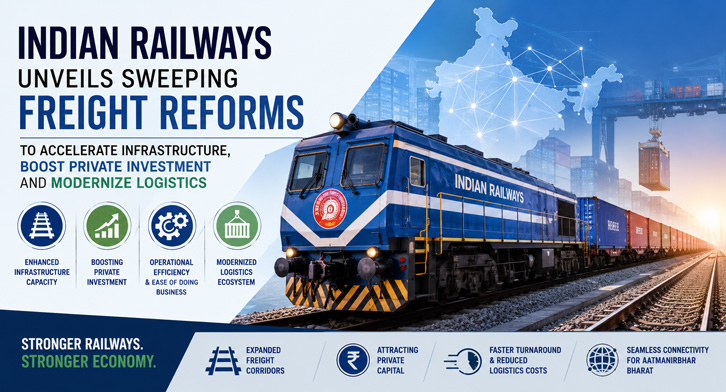
India’s logistics and freight transportation sector is set for a major transformation as Indian Railways has introduced a comprehensive series of reforms aimed at speeding up infrastructure projects, modernizing freight movement, and encouraging greater private sector participation. The measures form part of the Railways’ ambitious plan to implement 52 structural reforms during the current year.
Announcing the reforms, Railway Minister Ashwini Vaishnaw stated that the new initiatives are designed to improve project execution, strengthen accountability, promote innovation in freight operations, and make rail logistics more efficient for industries across the country.
Key Highlights
- 52 railway reforms planned for implementation in 2026.
- 10% upfront performance security mandatory for railway contractors.
- Contractors with excessive litigation barred from bidding.
- Private industries permitted to develop customized freight wagon designs.
- Containerized transportation introduced for fly ash.
- Expansion of containerized rail movement for petroleum, fertilizers, and agricultural commodities.
- Single nationwide licence introduced for container train operators.
- Licence renewal fees removed after 20 years of successful operations.
- Reforms expected to improve freight efficiency, reduce logistics costs, and attract private investment.
Indian Railways Tightens Contractor Eligibility
To improve the quality and timely completion of railway infrastructure projects, Indian Railways has introduced stricter eligibility norms for contractors.
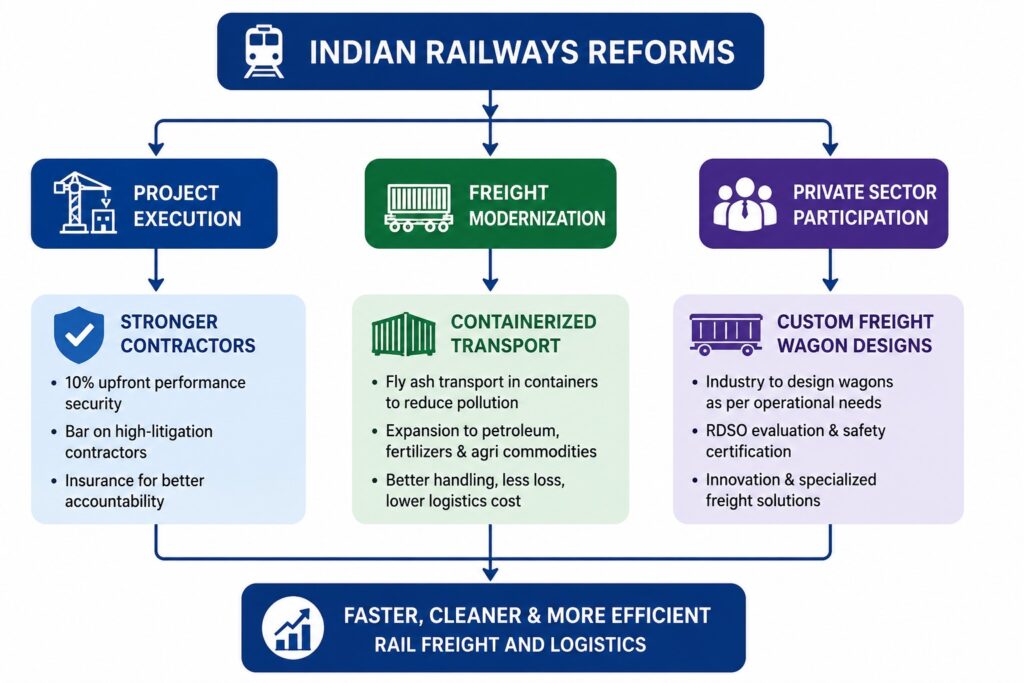
Under the revised framework, contractors must provide an upfront performance security equal to 10% of the contract value before project execution begins, replacing the previous system of deductions from running bills.
Additionally, companies whose pending litigation exceeds 50% of their net worth will no longer be eligible to participate in railway tenders.
To further strengthen accountability, the Railways has also made Professional Indemnity Insurance and Contractor All-Risk Insurance mandatory for eligible contractors.
According to the Railway Ministry, these measures are intended to encourage financially sound contractors while reducing project delays caused by contractual disputes.
Private Sector Invited to Design Freight Wagons
In a significant policy shift, Indian Railways will now allow industries and private manufacturers to design customized freight wagons tailored to their operational requirements.
The proposed wagon designs will undergo technical evaluation by the Research Designs and Standards Organization (RDSO), followed by prototype testing, safety certification, and regulatory approval before being deployed on the national railway network.
The initiative is expected to encourage innovation, improve cargo handling efficiency, and support specialized freight requirements across multiple industries.
Containerized Fly Ash Transportation to Reduce Pollution
Indian Railways has introduced container-based transportation of fly ash, replacing conventional open wagon movement.
Using enclosed containers is expected to significantly reduce dust emissions during loading, transportation, storage, and unloading while improving operational efficiency through mechanized handling equipment such as reach stackers.
Using enclosed containers is expected to significantly reduce dust emissions during loading, transportation, storage, and unloading while improving operational efficiency through mechanized handling equipment such as reach stackers.
With India producing approximately 340 million metric tonnes of fly ash annually, the reform could substantially improve the movement of industrial by-products and contribute to cleaner logistics operations.
Fly Ash Transport Statistics
Metric
Volume
Service Annual Fly Ash Production
340 Million MT
Cement Industry Consumption
96 Million MT
Current Rail Transportation
13 Million MT
Share Transported by Rail
Approximately 4%
Expanded Containerized Rail Cargo
The Railways is also expanding containerized freight transportation beyond fly ash.
The new policy includes commodities such as:
- Petroleum products
- Fertilizers
- Agricultural commodities
- Industrial bulk cargo
Containerized movement is expected to reduce cargo contamination, improve handling efficiency, minimize losses, and lower overall logistics costs for industries.
Simplified Rules for Container Train Operators
To encourage greater private participation in rail logistics, Indian Railways has simplified regulations governing container train operators.
Key Policy Changes
Reform
New Provision
Industry Benefit
Operating Licence
Single all-India licence
Simplifies nationwide operations
Registration Fee
Uniform ₹25 crore
Standardized entry framework
Licence Renewal
No renewal fee after 20 years
Reduces long-term operating costs
These reforms are expected to improve ease of doing business while increasing competition in India’s container rail transportation sector.
Industry Impact
The reforms are likely to deliver broad benefits across the logistics and supply chain ecosystem.
Logistics Companies
- Faster freight movement
- Improved cargo handling
- Reduced transportation costs
Infrastructure Developers
- Higher project accountability
- Better contractor quality
- Faster project completion
Manufacturers
- Customized freight solutions
- Improved rail connectivity
- Lower logistics expenses
Container Operators
- Simplified licensing process
- Easier nationwide expansion
- Greater investment opportunities
Transforming India's Rail Freight Ecosystem
FAQs
What are the key reforms announced by Indian Railways in 2026?
Indian Railways has introduced major reforms to strengthen project execution, modernize freight transportation, simplify container train operations, expand containerized cargo movement, and encourage greater private sector participation in rail logistics.
How will the new reforms improve rail freight and logistics?
The reforms are expected to improve cargo handling, reduce logistics costs, speed up freight movement, increase operational efficiency, promote innovation in freight wagons, and enhance the overall reliability of India’s rail logistics network.
Can private companies now design freight wagons?
Yes. Indian Railways now allows private industries to develop customized freight wagon designs based on their operational needs. These designs will be evaluated, tested, and approved by the Research Designs and Standards Organization (RDSO) before deployment.
What changes have been made for container train operators?
The new policy introduces a single all-India operating licence, a uniform ₹25 crore registration fee, and eliminates licence renewal fees after 20 years, making it easier for private operators to expand rail freight services across India.
Why is Indian Railways introducing containerized transportation for fly ash?
Containerized transportation helps reduce dust pollution, minimizes cargo loss, improves handling efficiency through mechanized equipment, and supports cleaner, more sustainable freight operations.
Why are these railway reforms important for India's logistics sector?
The reforms are designed to accelerate infrastructure development, attract private investment, improve supply chain efficiency, lower transportation costs, and strengthen India’s position as a global logistics and manufacturing hub.