
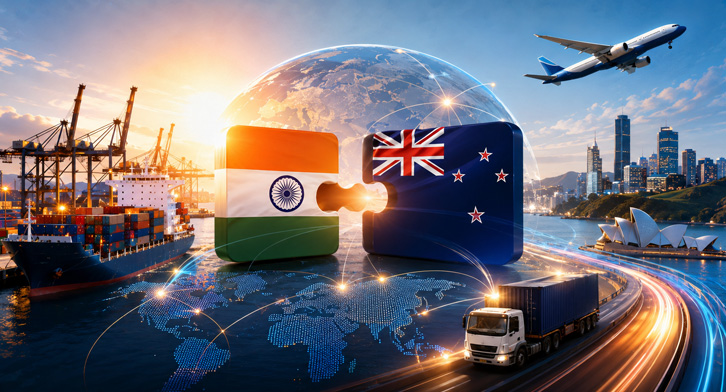
The upcoming India–New Zealand Free Trade Agreement (FTA) is expected to become operational by the end of 2026, opening a new chapter in bilateral trade, investment and supply chain collaboration. The agreement is set to improve market access, reduce trade barriers and create fresh opportunities for exporters, manufacturers, logistics providers and investors in both countries.
According to New Zealand’s Minister for Trade and Investment, Todd McClay, the agreement has successfully completed its first reading in the New Zealand Parliament, with both governments working towards its early implementation
Once the FTA comes into force, Indian businesses are expected to gain immediate duty-free access across a wide range of products and services in New Zealand, while New Zealand exporters will gradually receive tariff reductions on nearly 95% of exports to India over the next seven to eight years.
The agreement is expected to strengthen regional supply chains, improve trade efficiency and reduce logistics costs, making bilateral commerce more competitive.
Key Highlights
- Immediate zero-tariff market access for Indian exports to New Zealand
- Up to 95% of New Zealand exports to India to become duty-free over 7–8 years
- Significant boost expected in bilateral trade and investments
- Enhanced opportunities for exporters, manufacturers and logistics companies
- Investment Facilitation Desk to support New Zealand investments in India
- Direct Air India–Air New Zealand flights under discussion
- Collaboration expands to defence, security, climate, space technology and critical minerals
- Improved supply chain resilience and reduced logistics costs
India-New Zealand FTA at a Glance
Particular
Details
Agreement
India–New Zealand Free Trade Agreement (FTA)
Expected Implementation
End of 2026
Indian Export Benefit
Immediate Zero Tariff Access
New Zealand Export Benefit
95% Duty-Free Access over 7–8 Years
Major Beneficiaries
Exporters, Importers, Logistics Companies, Manufacturers
New Investment Initiative
Investment Facilitation Desk
Aviation
Direct Air India–Air New Zealand flights under discussion
Strategic Focus Areas
Critical Minerals, Defence, Space Technology, Advanced Manufacturing, Climate Cooperation
Major Sectors Expected to Benefit
The FTA is expected to accelerate growth across multiple industries, including:
- Automobile Components
- Chemicals
- Agricultural Machinery
- Food Processing
- Professional Services
- Manufacturing
- Logistics & Supply Chain
- Aviation
- Technology
- Renewable Energy
Lower tariffs and improved market access are expected to increase export competitiveness while encouraging long-term business partnerships.
Logistics Industry Set to Gain
For the logistics sector, the agreement is expected to create several operational advantages:
- Higher bilateral cargo volumes
- Increased container movement
- Growth in air freight demand
- Expansion of ocean freight services
- Faster customs clearance through stronger trade cooperation
- Better multimodal connectivity
- Lower end-to-end supply chain costs
- Increased demand for freight forwarding and warehousing
Freight forwarders, customs brokers, shipping companies and third-party logistics providers (3PLs) are expected to benefit from growing cross-border trade flows.
Strategic Partnership Expands Beyond Trade
The FTA complements the recently upgraded India–New Zealand Strategic Partnership, under which both nations signed 16 cooperation declarations covering:
- Trade
- Investment
- Defence
- Security
- Science & Technology
- Climate Change
- Education
- People-to-People Connectivity
The partnership reflects a broader commitment to strengthening economic and strategic cooperation across the Indo-Pacific region.
Investment and Connectivity to Improve
To facilitate greater business collaboration, both countries will establish a dedicated Investment Facilitation Desk aimed at supporting New Zealand companies investing in India.
Additionally, Air India and Air New Zealand are exploring the launch of direct flights within the next one to two years, a move expected to:
- Improve business travel
- Increase tourism
- Strengthen diaspora connections
- Reduce travel time
- Enhance high-value cargo movement
Why This FTA Matters
The India–New Zealand FTA arrives at a time when global businesses are seeking diversified supply chains and resilient trade networks.
By lowering tariffs, simplifying market access and strengthening strategic cooperation, the agreement is expected to:
- Improve export competitiveness
- Reduce trade costs
- Encourage foreign investment
- Strengthen supply chain resilience
- Support long-term economic integration
- Expand opportunities for MSMEs and exporters
The agreement is also expected to position both countries as stronger trading partners in the Indo-Pacific region.
FAQs
When will the India–New Zealand FTA come into effect?
The agreement is expected to be implemented by the end of 2026, subject to completion of legislative and procedural approvals.
What benefits will Indian exporters receive?
Indian exporters are expected to receive immediate zero-tariff access to the New Zealand market across a broad range of goods and services.
How will the FTA benefit logistics companies?
The agreement is expected to increase cargo volumes, improve supply chain efficiency, reduce logistics costs and create new opportunities for freight forwarding, shipping, warehousing and customs services.
Which industries will benefit the most?
Automobiles, chemicals, agricultural machinery, manufacturing, professional services, logistics, aviation, technology and food processing are among the sectors expected to benefit significantly.