

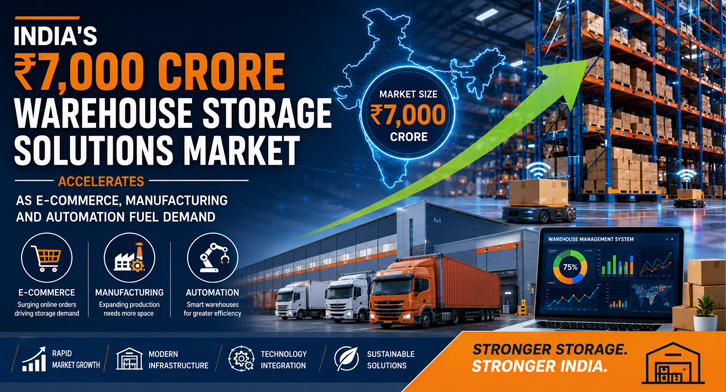
India’s warehousing revolution is creating significant opportunities for the country’s storage solutions industry, which is now valued at approximately ₹7,000 crore (Rs.70 billion). Driven by rapid growth in e-commerce, quick commerce, manufacturing, organized retail, and third-party logistics (3PL), businesses are investing heavily in advanced warehouse infrastructure to improve efficiency, optimize storage capacity, and support faster deliveries.
As India’s supply chains become increasingly sophisticated, warehouse operators are shifting away from traditional storage methods toward high-density, technology-driven facilities that maximize vertical space while reducing operational costs.
Key Highlights
- India's storage solutions industry is valued at around ₹7,000 crore (Rs.70 billion).
- Demand is being driven by e-commerce, quick commerce, manufacturing, retail, and 3PL logistics.
- Warehouses are increasingly adopting high-rise pallet racking, Automated Storage and Retrieval Systems (ASRS), mezzanine floors, robotics, conveyors, and Warehouse Management Systems (WMS).
- Current capacity stands at 1.6 million TEUs annually
- Companies are investing in high-density vertical warehouses to maximize storage without expanding floor space.
- Godrej Enterprises Group plans to expand its storage solutions manufacturing capacity near Chennai after completing 25 years at its Ambattur facility.
- Major industry players including Nilkamal and Spanco Storage Systems are benefiting from rising warehouse infrastructure investments.
- Grade A warehousing and warehouse automation continue to attract strong investments across India.
Warehouse Automation Becomes the New Growth Engine
India’s logistics sector is undergoing a major transformation as companies seek faster, smarter, and more cost-effective warehouse operations.
Instead of constructing larger warehouses, developers are increasingly building taller, high-density storage facilities equipped with automated systems that significantly improve inventory management and warehouse productivity.
Modern warehouses now feature:
- High-rise pallet racking
- Automated Storage and Retrieval Systems (ASRS)
- Mezzanine flooring
- Conveyor systems
- Robotics and automated material handling
- AI-enabled Warehouse Management Systems (WMS)
These technologies enable businesses to:
- Increase storage capacity
- Improve inventory accuracy
- Reduce manual handling
- Lower operating costs
- Speed up order fulfillment
The trend is particularly important as same-day and next-day deliveries become the industry standard.
Godrej Enterprises Expands Manufacturing Capacity
Among the biggest beneficiaries of India’s warehouse expansion is Godrej Enterprises Group’s Storage Solutions business.
The company operates one of Asia’s largest and most advanced storage systems manufacturing facilities at Ambattur, Chennai, spread across 26 acres.
The plant manufactures industrial storage solutions for:
- Warehouses
- Manufacturing plants
- Distribution centres
- Industrial facilities
As the Ambattur facility completes 25 years of operations, Godrej is planning its next phase of expansion around Chennai to meet growing domestic demand from logistics, manufacturing, and industrial customers.
E-commerce and Manufacturing Drive Warehouse Investments
Industry experts say warehouse infrastructure spending is accelerating due to sustained growth in:
- E-commerce
- Quick commerce
- Organized retail
- Third-party logistics (3PL)
- FMCG
- Automotive
- Pharmaceuticals
- Engineering
- Domestic manufacturing
Businesses are increasingly investing in automation to improve supply chain resilience while reducing inventory costs and improving customer service levels.
Storage Equipment Manufacturers See Strong Demand
Apart from Godrej Enterprises Group, several leading manufacturers are witnessing increased demand for industrial storage solutions.
Key companies benefiting from the trend include:
- Nilkamal
- Spanco Storage Systems
These firms supply warehouse infrastructure and storage equipment across multiple sectors including manufacturing, retail, pharmaceuticals, automotive, engineering, and consumer goods.
India's Grade A Warehousing Market Continues to Expand
India’s logistics modernization is encouraging significant investments in Grade A warehouses, where advanced storage technologies are becoming standard infrastructure rather than optional upgrades.
As inventory volumes continue to grow and delivery timelines become shorter, warehouse operators are expected to increase investments in:
- Automation
- Smart storage systems
- Smart storage systems
- Digital inventory management
- Warehouse analytics
- AI-powered warehouse operations
Industry analysts believe these investments will play a crucial role in improving productivity, maximizing warehouse space utilization, and supporting India’s rapidly expanding manufacturing and distribution ecosystem.
Why This Matters
The growth of India’s storage solutions industry reflects the broader modernization of the country’s logistics sector. Efficient warehouses have become critical for maintaining competitive supply chains, enabling businesses to reduce costs, improve inventory visibility, and meet rising consumer expectations for faster deliveries.
With government support for manufacturing, expanding industrial corridors, and sustained growth in e-commerce, demand for intelligent warehouse infrastructure is expected to remain strong over the coming years.
FAQs
What is the size of India's storage solutions industry?
India’s storage solutions industry is currently valued at approximately ₹7,000 crore (Rs.70 billion) and continues to grow alongside the country’s expanding warehousing sector.
What is driving demand for warehouse storage solutions in India?
Growth is primarily driven by e-commerce, quick commerce, manufacturing, organized retail, third-party logistics (3PL), and increasing investments in Grade A warehouses.
What technologies are modern warehouses adopting?
Modern warehouses are deploying Automated Storage and Retrieval Systems (ASRS), high-rise pallet racking, Warehouse Management Systems (WMS), robotics, conveyors, mezzanine flooring, and AI-enabled automation to improve operational efficiency.
Which companies are leading India's storage solutions market?
Major players include Godrej Enterprises Group, Nilkamal, and Spanco Storage Systems, supplying industrial storage infrastructure across multiple sectors.
Why are warehouses being built vertically?
Vertical warehouses maximize storage capacity without increasing land requirements, helping businesses reduce costs while improving inventory management and operational efficiency.