

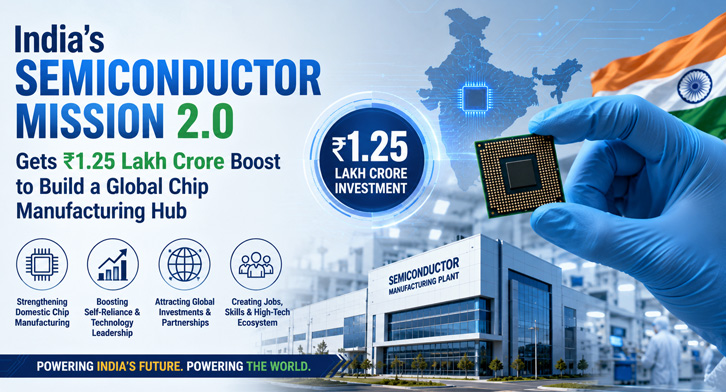
India has taken a major step toward becoming a global electronics powerhouse. The Expenditure Finance Committee (EFC) has officially approved the proposal for the India Semiconductor Mission (ISM) 2.0, earmarking an allocation of ₹1.25 lakh crore (US$13.21 billion). The proposal now awaits final approval from the Union Cabinet.
This new phase represents a massive expansion in domestic high-tech manufacturing, aiming to secure global technology supply chains and transition India from a chip consumer to a primary global chip manufacturer.
ISM 1.0 vs. ISM 2.0: The Strategic Expansion
To understand the scale of India’s semiconductor ambitions, the table below breaks down the growth and shift in strategy from the initial phase to the newly proposed mission:
Metric / Focus Area
ISM 1.0 (First Phase)
ISM 2.0 (Proposed Phase)
Budget Allocation
₹76,000 crore (US$8.03 billion)
₹1.25 lakh crore (US$13.21 billion) (~64% Increase)
Core Ecosystem Goal
Attracting basic fabrication (Fab) facilities
Strengthening the entire value chain (Raw materials, Equipment, IP)
Approved Projects
12 Manufacturing Projects
Focus on scaling commercial production & market integration
Total Investment Pipeline
-
₹1.64 lakh crore (US$17.33 billion)
Design Support
24 DLI projects backed
Scaling advanced tool access for 105+ companies
What is India Semiconductor Mission 2.0?
India Semiconductor Mission (ISM) 2.0 is the government’s next phase of investment aimed at creating a complete semiconductor ecosystem within the country.
Unlike the first phase, which primarily focused on attracting fabrication facilities, ISM 2.0 aims to strengthen the entire semiconductor value chain by supporting:
- Semiconductor fabrication (Fab)
- Compound semiconductor manufacturing
- Chip packaging and testing
- Semiconductor equipment manufacturing
- Raw materials ecosystem
- Indigenous semiconductor intellectual property (IP)
- Chip design and product development
- Skilled workforce and talent development
- Supply chain resilience
The initiative was announced as part of the Union Budget 2026–27 and aligns with India’s broader vision of becoming a global electronics manufacturing hub.
Government Focus: From Chip Design to Global Manufacturing
Union Minister for Electronics and Information Technology Ashwini Vaishnaw stated that ISM 2.0 will prioritize:
- Indigenous semiconductor innovation
- Commercial chip product development
- Talent and skill development
- Attracting global semiconductor ecosystem partners
- Building resilient domestic supply chains
- Strengthening India's position in the global semiconductor industry
The government’s strategy is designed not only to manufacture chips but also to establish India as a center for semiconductor research, design, and innovation.
Progress Under India Semiconductor Mission 1.0
India has already made notable progress under the first phase of the Semiconductor Mission.
Manufacturing Projects Approved
The government has approved 12 semiconductor manufacturing projects, including:
- 1 Semiconductor Fabrication Plant (Fab)
- 2 Compound Semiconductor Fabrication Units
- 9 Semiconductor Packaging and Assembly Units
Together, these projects represent an investment pipeline worth approximately ₹1.64 lakh crore (US$17.33 billion).
Growth in India's Chip Design Ecosystem
India is also strengthening its semiconductor design capabilities.
Achievements include:
- Government backs 24 chip design projects through the Design Linked Incentive (DLI) Scheme
- 105 companies receiving access to advanced Electronic Design Automation (EDA) tools
- 23 successful semiconductor tape-outs completed
These achievements are strengthening India’s semiconductor innovation ecosystem by enabling startups and technology firms to develop homegrown chip technologies.
Commercial Production Begins
India’s semiconductor manufacturing journey is entering the commercial production stage.
Two semiconductor facilities have already been inaugurated, while CG Semi is expected to commence commercial operations on July 4, 2026. Several additional semiconductor projects are expected to become operational later this year.
The transition from project approvals to commercial manufacturing represents a major milestone in India’s ambition to become a trusted semiconductor manufacturing destination.
Why This Matters for Logistics and Supply Chains
The semiconductor industry is one of the world’s most strategically important sectors. A stronger domestic semiconductor ecosystem can significantly improve supply chain resilience and reduce dependence on overseas suppliers.
For the logistics sector, this could lead to:
- Increased movement of high-value semiconductor equipment
- Growth in specialized warehousing and cold-chain infrastructure
- Higher demand for secure air cargo and multimodal transportation
- Higher demand for secure air cargo and multimodal transportation
- Development of semiconductor logistics clusters across India
As semiconductor production scales, logistics providers will play a critical role in handling sensitive components, supporting just-in-time manufacturing, and enabling global distribution.
FAQs
What is India Semiconductor Mission 2.0?
India Semiconductor Mission 2.0 is the government’s next-phase initiative to build a complete semiconductor ecosystem through investments in chip manufacturing, design, equipment, materials, and supply chains.
How much funding has been allocated?
The government has proposed ₹1.25 lakh crore (US$13.21 billion) for ISM 2.0, subject to Cabinet approval.
How many semiconductor projects have been approved?
The government has approved 12 semiconductor manufacturing projects with a combined investment pipeline of around ₹1.64 lakh crore (US$17.33 billion).
Why is ISM 2.0 important?
The mission aims to reduce India’s dependence on imported semiconductors, strengthen supply chains, attract global investment, generate skilled jobs, and position India as a major semiconductor manufacturing hub.