

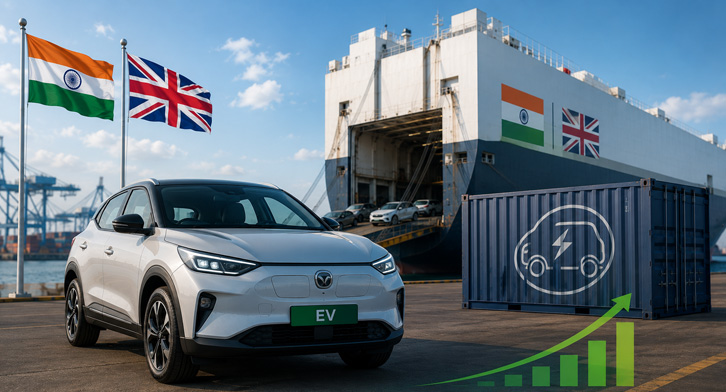
The India-UK Comprehensive Economic and Trade Agreement (CETA) is set to create significant export opportunities for Indian passenger vehicle manufacturers, including Maruti Suzuki, Mahindra & Mahindra, and Tata Motors Passenger Vehicles. Scheduled to come into effect on July 15, the agreement provides a phased roadmap for duty-free exports of electric, hybrid, and hydrogen-powered passenger vehicles to the United Kingdom.
The trade pact is expected to strengthen India’s position as a global manufacturing hub for clean mobility while improving the international competitiveness of Indian-made electric vehicles.
Duty-Free EV Exports to Expand Through Quota System
Under the agreement, tariff concessions for eligible clean mobility vehicles will begin from the sixth year through a quota-based mechanism. The benefits apply to vehicles priced below GBP 80,000 across three price categories.
The annual export quota will start at 17,600 vehicles in the sixth year and gradually increase to 88,000 vehicles by the fifteenth year, providing Indian automakers with greater market access and long-term export growth.
Indian Automakers Eye UK EV Market
Indian manufacturers are expected to leverage the agreement to expand their presence in the UK’s rapidly growing electric vehicle market.
Maruti Suzuki is well positioned after successfully exporting its eVITARA to Europe, including the UK. Meanwhile, Mahindra & Mahindra and Tata Motors Passenger Vehicles are also evaluating opportunities to increase exports of affordable right-hand-drive electric vehicles.
The phased implementation gives manufacturers sufficient time to scale production, strengthen supply chains, and expand dealership and distribution networks in the UK.
Trade Pact Supports India's EV Manufacturing Ambitions
The United Kingdom remains one of Europe’s largest right-hand-drive automobile markets, making it an ideal export destination for Indian-made vehicles. The agreement is expected to boost India’s ambitions of becoming a global hub for electric vehicle manufacturing and exports.
In addition to the automotive sector, the India-UK trade pact aims to deepen bilateral economic cooperation, with both countries targeting US$100 billion in bilateral trade by 2030. Clean mobility, advanced manufacturing, and technology are expected to be major drivers of this growth.
Key Highlights:
- India-UK Comprehensive Economic and Trade Agreement (CETA) comes into effect on July 15.
- Indian EV makers gain phased duty-free access to the UK market.
- Export benefits cover electric, hybrid, and hydrogen-powered passenger vehicles.
- Duty concessions apply to vehicles priced below GBP 80,000.
- Annual export quota starts at 17,600 vehicles in Year 6.
- Export quota increases to 88,000 vehicles by Year 15.
- Maruti Suzuki, Mahindra & Mahindra, and Tata Motors Passenger Vehicles are expected to benefit.
- Maruti Suzuki's eVITARA is already being exported to European markets.
- The agreement strengthens India's position as a global EV manufacturing and export hub.
- India and the UK aim to achieve US$100 billion in bilateral trade by 2030.