
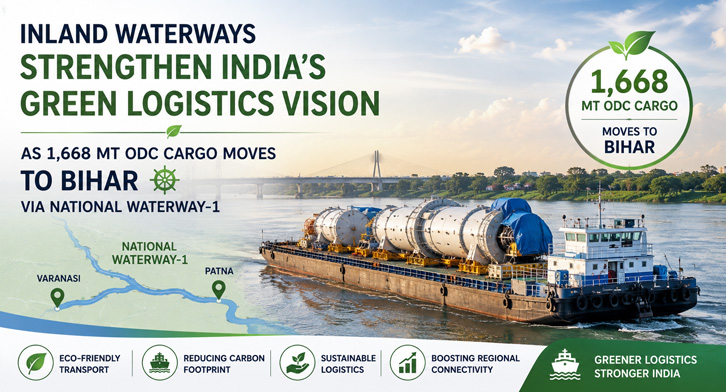
India’s inland waterways sector has achieved another significant milestone with the successful transportation of a 1,668 metric tonne (MT) Over Dimensional Cargo (ODC) to Bihar through National Waterway-1 (NW-1) on the Ganga River.
The achievement reinforces the growing role of Inland Water Transport (IWT) as a reliable, cost-efficient, and environmentally sustainable alternative for transporting oversized industrial equipment. It also highlights India’s continued investment in multimodal logistics infrastructure aimed at reducing logistics costs while improving supply chain efficiency.
The successful movement demonstrates the increasing operational capability of National Waterway-1, one of India’s most important inland shipping corridors connecting northern and eastern India.
Key Highlights
- 1,668 MT Over Dimensional Cargo (ODC) transported successfully.
- Cargo moved via National Waterway-1 (River Ganga).
- Destination: Bihar.
- Demonstrates readiness for heavy industrial cargo movement.
- Reduces dependence on road transportation.
- Supports multimodal logistics under PM Gati Shakti.
- Lower transportation costs and reduced carbon emissions.
- Strengthens India's green logistics ecosystem.
Why This Milestone Matters
Transporting heavy engineering cargo through inland waterways offers several strategic advantages over conventional road transport.
Lower Logistics Cost
Water transport enables movement of extremely heavy cargo in a single shipment, reducing handling costs, fuel consumption, and road permits.
Greener Transportation
Compared to road transport, inland waterways consume significantly less fuel per tonne-kilometre, helping industries lower their carbon footprint.
Better Supply Chain Efficiency
National Waterway-1 provides dependable connectivity for power plants, manufacturing projects, heavy engineering, steel, cement, and infrastructure sectors.
Reduced Highway Congestion
Moving oversized cargo through waterways minimizes pressure on highways while improving road safety.
National Waterway-1: India's Flagship Inland Water Corridor
National Waterway-1 stretches along the River Ganga and serves as one of India’s most strategically important inland freight corridors.
It is rapidly emerging as a preferred logistics route for:
Cargo Type
Major Industries
Over Dimensional Cargo (ODC)
Power, Engineering, Infrastructure
Steel Products
Manufacturing
Cement
Construction
Fertilizers
Agriculture
Food Grains
FMCG & Public Distribution
Coal
Power Generation
Containers
Domestic Trade
Project Cargo
Heavy Industries
Benefits of Inland Water Transport
Parameter
Inland Waterways
Road Transport
Logistics Cost
Low
High
Carbon Emissions
Very Low
High
Fuel Efficiency
Excellent
Moderate
Heavy Cargo Handling
Excellent
Limited
Road Congestion
None
High
Sustainability
High
Moderate
Impact on India's Logistics Sector
The successful transportation highlights India’s growing emphasis on multimodal logistics integration.
With investments in:
- Inland Water Transport (IWT)
- Dedicated Freight Corridors
- Multimodal Logistics Parks
- River Ports
- Cargo Terminals
- Digital Freight Infrastructure
India is steadily moving toward a more resilient and efficient freight transportation network.
The expansion of National Waterway-1 is expected to:
- Improve hinterland connectivity
- Reduce end-to-end logistics costs
- Enhance industrial competitiveness
- Support export-oriented manufacturing
- Accelerate regional economic development
Environmental Benefits
Using waterways instead of roads contributes to:
- Lower greenhouse gas emissions
- Reduced diesel consumption
- Lower road infrastructure wear and tear
- Reduced traffic congestion
- Cleaner freight transportation
The milestone aligns with India’s commitment toward sustainable logistics and greener supply chains.
Industry Outlook
As industrial cargo movement on the Ganga continues to increase, National Waterway-1 is expected to become a major logistics backbone for eastern and northern India.
The successful movement of the 1,668 MT ODC cargo serves as another strong indicator that inland waterways are transitioning from an alternative transport option to a mainstream logistics solution for heavy industrial cargo.
Improved river terminals, modern barges, digital cargo tracking, and enhanced multimodal connectivity are expected to further strengthen the competitiveness of inland waterways over traditional transport modes.
Quick Facts
Particular
Details
Cargo Type
Over Dimensional Cargo (ODC)
Cargo Weight
1,668 MT
Route
National Waterway-1 (River Ganga)
Destination
Bihar
Mode
Inland Water Transport
Key Benefit
Lower logistics cost & emissions
Government Focus
Multimodal Logistics & Green Transport
FAQs
What is National Waterway-1 (NW-1)?
National Waterway-1 (NW-1) is India’s longest inland waterway, stretching approximately 1,390 km from Prayagraj to Haldia along the Ganga-Bhagirathi-Hooghly river system. It serves as a major corridor for transporting bulk cargo, containers, and oversized industrial equipment, supporting India’s multimodal logistics network.
Why is the 1,668 MT ODC cargo movement to Bihar important?
The successful transportation of 1,668 MT Over Dimensional Cargo (ODC) via National Waterway-1 demonstrates the capability of India’s inland waterways to handle heavy industrial shipments efficiently. It reduces logistics costs, lowers carbon emissions, and strengthens multimodal connectivity for infrastructure and manufacturing projects.
What are the benefits of transporting cargo through inland waterways?
Inland Water Transport (IWT) offers several advantages, including:
- Lower transportation and fuel costs
- Reduced carbon emissions
- Higher cargo carrying capacity
- Less highway congestion
- Safer movement of oversized cargo
- Improved supply chain efficiency
Which industries benefit the most from National Waterway-1?
National Waterway-1 supports industries that require the movement of heavy and bulk cargo, including power, steel, cement, infrastructure, engineering, manufacturing, mining, fertilizers, and project logistics. It provides a reliable and cost-effective transportation option for large-scale industrial projects.
How does National Waterway-1 support India's Green Logistics and PM Gati Shakti initiatives?
National Waterway-1 promotes sustainable freight transportation by shifting cargo from roads to waterways, reducing fuel consumption and greenhouse gas emissions. It aligns with the PM Gati Shakti National Master Plan by improving multimodal connectivity, lowering logistics costs, enhancing supply chain efficiency, and boosting economic growth through integrated transport infrastructure.