
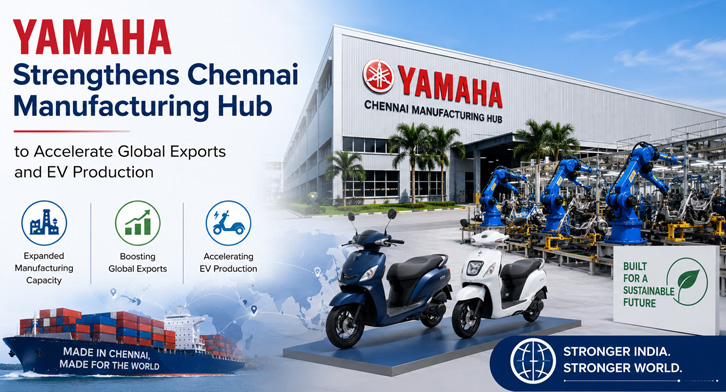
Japanese two-wheeler manufacturer Yamaha Motor India is strengthening its manufacturing footprint in India with a fresh ₹58 crore investment in its Chennai facility, reinforcing the plant’s role as a strategic global export hub while preparing for the next phase of electric vehicle (EV) production.
The investment follows the company’s ₹180 crore expansion announced last year, highlighting Yamaha’s long-term confidence in India as both a manufacturing and export destination.
Located at Vallam Vadagal near Chennai, the plant has become Yamaha’s largest production facility in India and plays a critical role in supplying motorcycles to domestic and international markets.
Key Highlights
- ₹58 crore fresh investment announced for Chennai facility.
- Builds upon the earlier ₹180 crore expansion.
- Chennai accounts for nearly 60% of Yamaha India's production capacity.
- Annual manufacturing capacity stands at 900,000 motorcycles.
- Over 250,000 motorcycles exported annually.
- More than 350,000 units supplied to the Indian market every year.
- Facility crossed the milestone of 5 million vehicles produced.
- Yamaha targeting 1.1 million total production in 2026.
- Chennai facility expected to become a key manufacturing base for future electric vehicles (EVs).
- Higher component localization planned to improve global competitiveness.
Yamaha Chennai Manufacturing
Parameter
Details
Manufacturing Plant
Vallam Vadagal, Chennai
Operational Since
2015
Latest Investment
₹58 Crore
Previous Expansion
₹180 Crore
Annual Capacity
900,000 Units
Share of Yamaha India's Capacity
60%
Total India Capacity
1.5 Million Units
Domestic Production
350,000+ Units
Annual Exports
250,000+ Units
Employees
Around 7,000
Production Milestone
5 Million Vehicles
2026 Target
1.1 Million Units
Chennai Emerging as Yamaha's Global Export Engine
Yamaha is increasingly positioning Chennai as one of its most important international manufacturing centers.
The city’s excellent access to major seaports, global shipping routes, and export infrastructure provides significant logistical advantages, enabling faster deliveries to overseas markets.
According to Yamaha leadership, exports have always been central to the Chennai plant’s operations, but their strategic importance will continue to grow as international demand expands.
This approach aligns with India’s ambition to become a preferred global manufacturing destination under the “Make in India” initiative.
EV Manufacturing to Shape Yamaha's Next Growth Phase
As the global automotive industry rapidly transitions toward electric mobility, Yamaha is preparing the Chennai facility to support future electric vehicle production alongside its existing internal combustion engine (ICE) motorcycles.
The company believes India will play a significant role in its future EV manufacturing strategy by combining:
- Advanced manufacturing capabilities
- Skilled workforce
- Competitive production costs
- Strong supplier ecosystem
- Growing domestic EV demand
The move positions Yamaha to remain competitive in both conventional and electric mobility markets.
Higher Localization to Improve Global Competitiveness
Besides expanding production, Yamaha plans to increase localization of components manufactured in India.
Higher domestic sourcing will help the company:
- Reduce manufacturing costs
- Minimize supply chain risks
- Improve export competitiveness
- Strengthen local supplier networks
- Support India's manufacturing ecosystem
Localization also reduces dependency on imported components, making production more resilient against global supply chain disruptions.
Strategic Importance for India's Logistics Sector
Yamaha’s investment is expected to generate positive momentum across India’s logistics and export ecosystem.
Logistics Impact
Area
Expected Benefit
Container Exports
Higher two-wheeler shipments
Chennai Port
Increased export volumes
Automotive Logistics
Greater demand for specialized transportation
Warehousing
Expansion of finished vehicle storage
Component Suppliers
Increased manufacturing activity
Shipping Lines
More export bookings
Supply Chain
Improved localization and resilience
Why This Matters
The latest investment demonstrates Yamaha’s long-term commitment to India as a global manufacturing base rather than only a domestic sales market.
For India’s logistics industry, the expansion signals:
- Higher export cargo volumes
- Stronger automotive supply chains
- Increased demand for multimodal logistics
- More opportunities for freight forwarders
- Greater utilization of Chennai Port infrastructure
- Growth in automotive component exports
As India strengthens its position in global manufacturing, investments like Yamaha’s will continue to drive export-led industrial growth and create new opportunities across shipping, logistics, warehousing, and international trade.
FAQs
Why is Yamaha investing in its Chennai plant?
Yamaha is investing ₹58 crore to expand manufacturing capacity, strengthen exports, prepare for electric vehicle production, and improve localization.
What is the production capacity of Yamaha's Chennai facility?
The Chennai plant has an annual production capacity of 900,000 motorcycles, making it Yamaha’s largest manufacturing facility in India.
How many motorcycles does Yamaha export from Chennai?
The facility exports over 250,000 motorcycles annually to international markets.
Why is Chennai important for Yamaha's export strategy?
Chennai offers excellent port connectivity, strong logistics infrastructure, and efficient access to global shipping routes, making it an ideal export hub.
Is Yamaha planning electric vehicle production in India?
Yes. Yamaha is preparing its Chennai facility to support future electric vehicle manufacturing alongside traditional motorcycles.