
The United Kingdom has announced more than US$1.32 billion (approximately ₹12,500 crore) in new commercial deals with India, strengthening bilateral business ties following the implementation of the India–UK Comprehensive Economic and Trade Agreement (CETA) on July 15, 2026.
The announcement followed the 16th meeting of the India–UK Joint Economic and Trade Committee (JETCO), held in New Delhi on October 12. Union Commerce and Industry Minister Piyush Goyal and UK Business and Trade Secretary Jonathan Reynolds co-chaired the meeting, which focused on expanding trade, improving market access and turning the agreement into commercial opportunities for businesses in both countries.
A UK trade delegation representing more than 100 businesses and regional government representatives also visited India to explore investment and commercial partnerships. The announced deals span aviation services, artificial intelligence (AI), healthcare, advanced communications, engineering and technology.
Key Highlights
- US$1.32 billion in commercial deals: The UK announced new business agreements worth more than ₹12,500 crore with India.
- India–UK CETA in effect: The trade agreement entered into force on July 15, 2026.
- More than 100 businesses involved: A UK trade delegation visited India to explore contracts, investment and regional partnerships.
- Priority sectors: Aviation, AI, healthcare, advanced communications, engineering and technology.
- Annual trade data exchange: Both governments agreed to monitor businesses’ use of preferential tariffs and gather feedback on the agreement’s implementation.
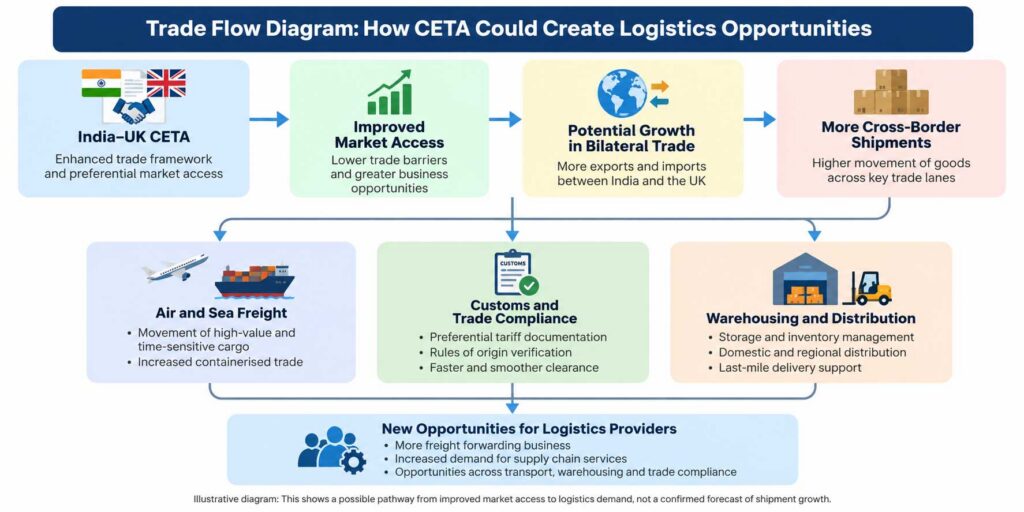
- Potential logistics impact: Stronger trade links could create additional demand for international freight, customs clearance, warehousing and cross-border supply chain services if commercial activity translates into higher shipment volumes.
India–UK Trade Agreement: What the Latest Announcement Means
The new commercial deals signal an effort by both countries to move beyond trade negotiations and expand practical business cooperation. The JETCO meeting focused on helping companies understand and use CETA, strengthening business-to-business relationships and addressing implementation challenges.
The governments also agreed to exchange information annually on how companies use the agreement, including claims for preferential tariff treatment and feedback on difficulties encountered during implementation. This process is intended to help identify where businesses need further support.
The two countries will also deepen cooperation in services, innovation, science and technology, government procurement and regional business partnerships. The next JETCO meeting is scheduled to take place in the UK in 2027.
How Could the India–UK Trade Expansion Affect Logistics?
For freight forwarders, exporters, importers and logistics service providers, the commercial expansion creates potential opportunities across several parts of the supply chain. However, the actual impact will depend on the volume and type of goods traded, the sectors involved and how quickly the announced agreements translate into shipments.
Logistics segment
Potential opportunity
What businesses should monitor
Air freight
Movement of high-value electronics, engineering components and time-sensitive cargo
Export orders, shipment frequency and capacity requirements
Sea freight
Growth in containerised trade involving manufactured goods, textiles and other eligible products
Cargo volumes, container demand and shipping schedules
Customs clearance
Greater need for accurate tariff classification and preferential duty documentation
Product-specific rules of origin and CETA eligibility
Warehousing and distribution
Potential demand for storage, inventory management and distribution services
Import volumes, delivery locations and stockholding requirements
Freight forwarding
More cross-border shipments and opportunities to coordinate multimodal transport
New customer contracts, trade lanes and service requirements
Trade compliance
Increased importance of verifying origin documents and tariff claims
Certificates of origin, customs declarations and supporting records
These are potential business implications rather than confirmed increases in freight demand. The announcement does not establish how much additional cargo will move between India and the UK.
What Exporters and Importers Need to Know
Businesses planning to trade between India and the UK should assess how CETA applies to their products and supply chains.
- Check preferential tariffs: Confirm whether the relevant product qualifies for reduced or zero customs duties under the agreement.
- Verify rules of origin: Goods must satisfy the applicable origin requirements to qualify for preferential treatment.
- Prepare accurate documentation: Ensure commercial invoices, shipping documents, origin declarations and customs entries are consistent with the applicable requirements.
- Review freight costs: Compare air and sea freight options, transit times, handling charges and customs-related costs.
- Coordinate with logistics partners: Work with freight forwarders and customs brokers to identify documentation requirements before dispatch.
- Track implementation updates: Monitor official guidance and changes that could affect product eligibility or customs procedures.
Preferential tariff treatment is not automatic for every shipment. Eligibility depends on the relevant product rules and compliance with the agreement’s requirements.
Frequently Asked Questions
What is the value of the new UK–India commercial deals?
The United Kingdom announced more than US$1.32 billion (approximately ₹12,500 crore) in new commercial deals with India on October 12–13, 2026.
When did the India–UK CETA come into force?
The India–UK Comprehensive Economic and Trade Agreement entered into force on July 15, 2026.
Which industries are covered by the new commercial deals?
The announcement covers aviation services, artificial intelligence, healthcare, advanced communications, engineering and technology.
How could the trade agreement benefit freight forwarders?
If the agreement leads to higher trade volumes, freight forwarders could benefit from demand for international transportation, customs clearance, shipment documentation, warehousing and distribution. The scale of any increase remains uncertain.
How can exporters benefit from CETA?
Eligible exporters may be able to claim preferential tariffs, subject to the product-specific rules of origin and other applicable requirements. Businesses should verify eligibility before claiming benefits.