

India’s expanding economy and the implementation of the India-European Free Trade Association (EFTA) Trade and Economic Partnership Agreement (TEPA) are creating significant opportunities for Norwegian companies across manufacturing, renewable energy, infrastructure, maritime services and financial technology.
The agreement is expected to strengthen India-Norway economic relations, encourage foreign investment and support cooperation in sustainable technologies, advanced manufacturing and digital innovation.
According to an EY India report, India’s GDP growth is projected to average approximately 6.5% through 2030. The country is also expected to become the world’s third-largest economy by the end of the decade. Growing domestic consumption, infrastructure investment, industrial expansion and business-friendly reforms are contributing to India’s economic momentum.
For Norwegian businesses, India’s growing market presents opportunities to expand operations, establish strategic partnerships and participate in emerging industrial and infrastructure projects.
India-EFTA Trade Agreement: $100 Billion Investment Commitment
A major feature of the India-EFTA Trade and Economic Partnership Agreement is the commitment to facilitate US$100 billion (approximately Rs. 9.51 lakh crore) in investments over 15 years, with the potential to generate one million direct jobs in India.
The agreement aims to strengthen economic ties between India and the four EFTA member countries: Norway, Switzerland, Iceland and Liechtenstein.
By reducing trade barriers, facilitating investment and improving market access, TEPA is expected to support stronger commercial relationships between Indian and European businesses.
The agreement also provides a framework for cooperation in innovation, sustainability, advanced technologies and industrial development.
Key Sectors Offering Opportunities for Norwegian Companies
Norway has considerable expertise in maritime industries, renewable energy, advanced manufacturing and sustainable industrial technologies. These capabilities complement India’s growing infrastructure requirements and industrial development ambitions.
The following sectors present promising opportunities for bilateral cooperation.
Sector
Potential opportunities
Renewable Energy
Solar, wind energy, green hydrogen and clean energy technologies
Manufacturing
Advanced manufacturing, industrial equipment and technology transfer
Oil and Gas
Offshore engineering, energy infrastructure and technical services
Maritime and Shipping
Shipbuilding, port development, maritime technology and logistics
Seafood Processing
Seafood exports, processing technology and cold-chain infrastructure
ICT and Digital Economy
Digital transformation, enterprise technology and software solutions
Fintech and Financial Services
Digital payments, financial technology and investment services
1. Renewable Energy and Green Technology
Renewable energy is expected to become an important area of India-Norway cooperation. India’s ambitions to expand clean energy capacity and reduce carbon emissions create opportunities for Norwegian companies specialising in offshore wind, green hydrogen, energy storage and sustainable infrastructure.
Norwegian expertise in clean energy technologies could support India’s transition towards a more sustainable energy ecosystem.
2. Manufacturing and Industrial Development
India’s expanding manufacturing ecosystem offers opportunities for Norwegian companies involved in industrial automation, engineering, machinery and advanced production technologies.
The partnership could encourage technology transfer, joint ventures and investment in industrial facilities, strengthening India’s manufacturing capabilities and integration into global supply chains.
3. Maritime, Shipping and Logistics
Maritime cooperation is another important area of potential growth.
Norway’s established maritime industry and expertise in sustainable shipping, offshore engineering, vessel technology and maritime services could complement India’s investments in ports, shipping infrastructure and logistics modernisation.
Potential areas of collaboration include:
- Sustainable shipping and maritime technologies.
- Port infrastructure and modernisation.
- Shipbuilding and vessel engineering.
- Digital solutions for maritime operations.
- Offshore logistics and marine services.
- Supply chain efficiency and cargo management.
These developments could create new opportunities for companies operating across India’s shipping, freight forwarding and maritime logistics sectors.
4. Digital Economy, ICT and Financial Services
India’s expanding digital economy, technology ecosystem and digital payment infrastructure offer opportunities for Norwegian companies seeking access to a large and rapidly growing consumer and business market.
Potential collaboration areas include financial technology, enterprise software, digital infrastructure, cybersecurity and technology-driven business services.
India-EFTA Agreement: Important Facts at a Glance
Parameter
Details
Agreement
India-EFTA Trade and Economic Partnership Agreement (TEPA)
EFTA members
Norway, Switzerland, Iceland and Liechtenstein
Investment commitment
US$100 billion over 15 years
Employment potential
One million direct jobs
Investment focus
Manufacturing, infrastructure, energy and technology
Norwegian opportunities
Green energy, maritime, manufacturing and digital services
India’s projected GDP growth
Approximately 6.5% through 2030, according to the cited EY report
How the India-EFTA Agreement Could Strengthen Trade and Investment
India-EFTA Economic Cooperation Framework
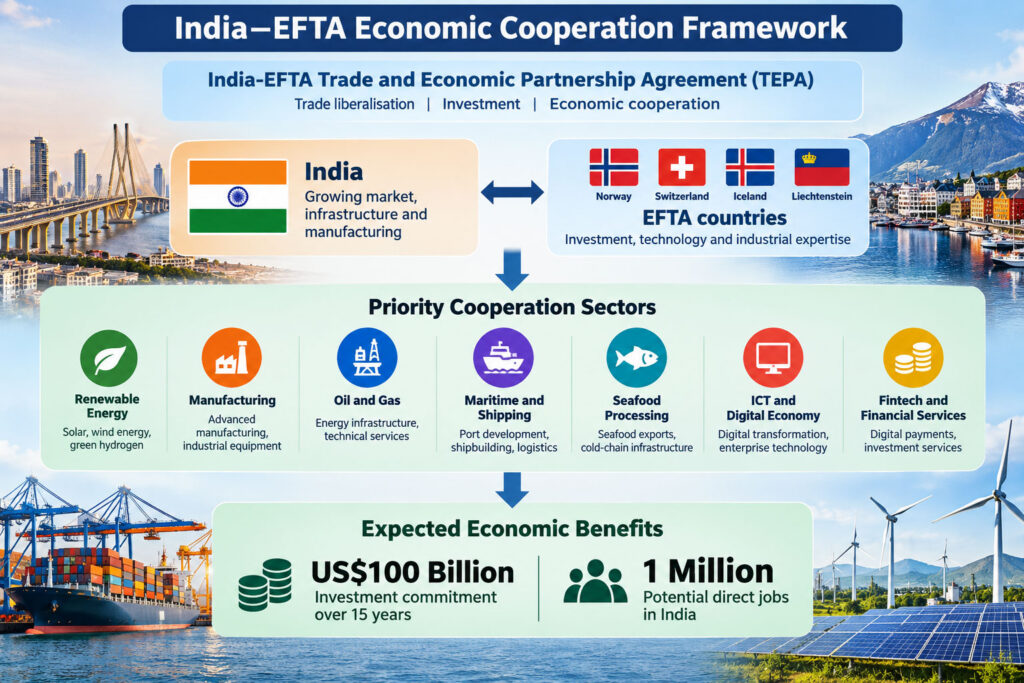
Illustrative representation of the agreement’s investment and cooperation framework. Investment and employment figures represent the collective EFTA commitment.
Conclusion
The India-EFTA Trade and Economic Partnership Agreement represents an important step towards strengthening India’s economic relationship with European markets. For Norway, India’s expanding manufacturing base, infrastructure development and renewable energy ambitions offer opportunities for long-term commercial partnerships.
Cooperation in maritime services, green energy, industrial technology and digital innovation could further strengthen bilateral economic relations while supporting India’s position in global trade and supply chains.
Frequently Asked Questions
What is the India-EFTA Trade and Economic Partnership Agreement?
The India-EFTA Trade and Economic Partnership Agreement (TEPA) is a trade agreement between India and the four EFTA countries: Norway, Switzerland, Iceland and Liechtenstein. It aims to improve market access, encourage investments and strengthen economic cooperation.
How much investment is expected under the India-EFTA agreement?
The agreement includes an EFTA investment commitment of US$100 billion over 15 years, with the potential to generate one million direct jobs in India.
Which Norwegian industries could benefit from the India-EFTA agreement?
Norwegian companies operating in renewable energy, manufacturing, maritime services, oil and gas, seafood processing, ICT and financial services could find new business and investment opportunities in India.
How will the agreement benefit India’s manufacturing sector?
The agreement could encourage foreign investment, technology transfers, industrial partnerships and access to advanced manufacturing capabilities, supporting India’s industrial development.
What opportunities does the agreement create for India’s logistics and shipping industry?
The agreement could encourage cooperation in maritime technology, sustainable shipping, port infrastructure, shipbuilding and offshore logistics, potentially supporting India’s wider supply chain development.
Which countries are members of EFTA?
The European Free Trade Association comprises Norway, Switzerland, Iceland and Liechtenstein.