
India’s core infrastructure sector recorded its strongest growth in the revised index series in September 2026, expanding by 7.9% year-on-year (YoY), compared with 5.9% in August and 3.1% in September 2025. Strong production across coal, refinery products, electricity and iron ore contributed to the growth, supported by increased infrastructure spending and a favourable base effect.
The expansion signals continued momentum in India’s infrastructure and industrial activities, with potential implications for freight transportation, bulk cargo movement, port operations and supply chain demand.
Key Developments in India’s Core Sector Growth
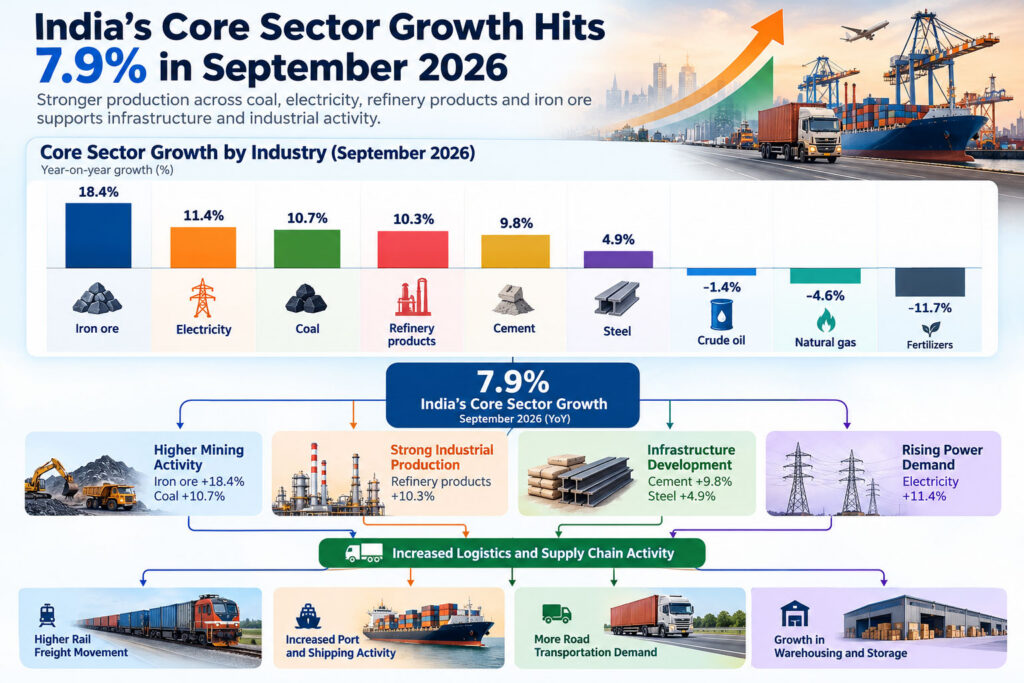
- Core sector growth: Reached 7.9% in September, compared with 5.9% in August.
- Iron ore production: Increased 18.4% year-on-year.
- Coal production: Recovered to 10.7% growth after contracting 3.8% in August.
- Refinery products: Registered 10.3% growth, the strongest performance in the revised series.
- Electricity generation: Expanded 11.4%, moderating from 13.1% in August.
- Cement production: Increased 9.8%, reflecting continued infrastructure activity.
- Steel production: Grew 4.9% compared with 3.5% in August.
Performance of India’s Core Industries
The September data indicates broad-based improvement across several infrastructure-related industries, although fertilizer, natural gas and crude oil production continued to experience contractions.
Core industry
September 2026 growth
Coal
10.70%
Crude oil
-1.40%
Natural gas
-4.60%
Refinery products
10.30%
Fertilizers
-11.70%
Steel
4.90%
Cement
9.80%
Electricity
11.40%
Iron ore
18.40%
Growth rates are year-on-year.
Infrastructure Spending Supports Industrial Expansion
Government investment in infrastructure continued to support industrial production during September.
According to Bank of Baroda Chief Economist Madan Sabnavis, expenditure on roads supported cement demand, while railway infrastructure spending contributed to higher iron and steel production.
The revised Index of Industrial Production (IIP) series uses 2022–23 as its base year, replacing the earlier 2011–12 base year. Iron ore has also been incorporated into the revised core sector index, expanding its coverage to nine industries.
The eight traditional core industries previously accounted for 40.27% of the IIP. The revised index coverage and weighting should be considered when comparing historical data.
Impact on India’s Logistics and Freight Industry
The increase in core sector production could create additional opportunities across India’s logistics and transportation ecosystem.
1. Higher demand for bulk cargo transportation
Growth in coal and iron ore production could support demand for rail-based and road-based bulk cargo transportation, particularly across mining and industrial corridors.
2. Increased demand for port and shipping services
Higher iron ore and refinery product output could influence cargo availability, coastal transportation and port-handling requirements, depending on domestic consumption and export demand.
3. Infrastructure development supports construction logistics
Growth in cement and steel production reflects continued infrastructure activity. This can support demand for construction material transportation, warehousing and project logistics.
4. Greater importance of supply chain coordination
As industrial production expands, manufacturers and logistics providers may need to coordinate inventory, transportation capacity, shipment documentation and delivery schedules more efficiently.
Industrial Production Outlook
Bank of Baroda projected September IIP growth in the range of 7.5–8.5%, while ICRA estimated growth at 6–7%, compared with 8% in August.
The actual industrial production figures will provide a clearer indication of whether the improvement in core sector activity is translating into broader industrial growth.
Frequently Asked Questions
What was India’s core sector growth in September 2026?
India’s core sector output grew by 7.9% year-on-year in September 2026, compared with 5.9% in August 2026.
Which industries contributed most to India’s core sector growth?
Iron ore, coal, refinery products and electricity were among the major contributors. Iron ore production grew 18.4%, coal 10.7%, refinery products 10.3% and electricity generation 11.4%.
How does core sector growth affect India’s logistics industry?
Higher industrial production can increase demand for bulk cargo transportation, rail freight, road logistics, port handling, warehousing and industrial supply chain services.
What is the weight of core industries in India’s Index of Industrial Production?
The eight traditional core industries accounted for 40.27% of the Index of Industrial Production (IIP). The revised series also incorporates iron ore as the ninth industry.
Why is iron ore production important for India’s freight and shipping industry?
Iron ore is a major bulk commodity transported through railways, roads and ports. Changes in production can influence cargo availability, transportation demand and port-handling activity.
What is India’s industrial production growth forecast for September 2026?
Bank of Baroda projected IIP growth of 7.5–8.5%, while ICRA estimated growth at 6–7%.